Aluminum Billet: The Strategic Raw Material Transforming Global Manufacturing — From Metal Ingots to the Future of Industry | ARTICLE by SO OK TRADING 8 August 2026
Aluminum Billet: The Strategic Raw Material Transforming Global Industry
SO OK TRADING | 8 August 2026
Aluminum Billet: The Beating Heart of Global Industry
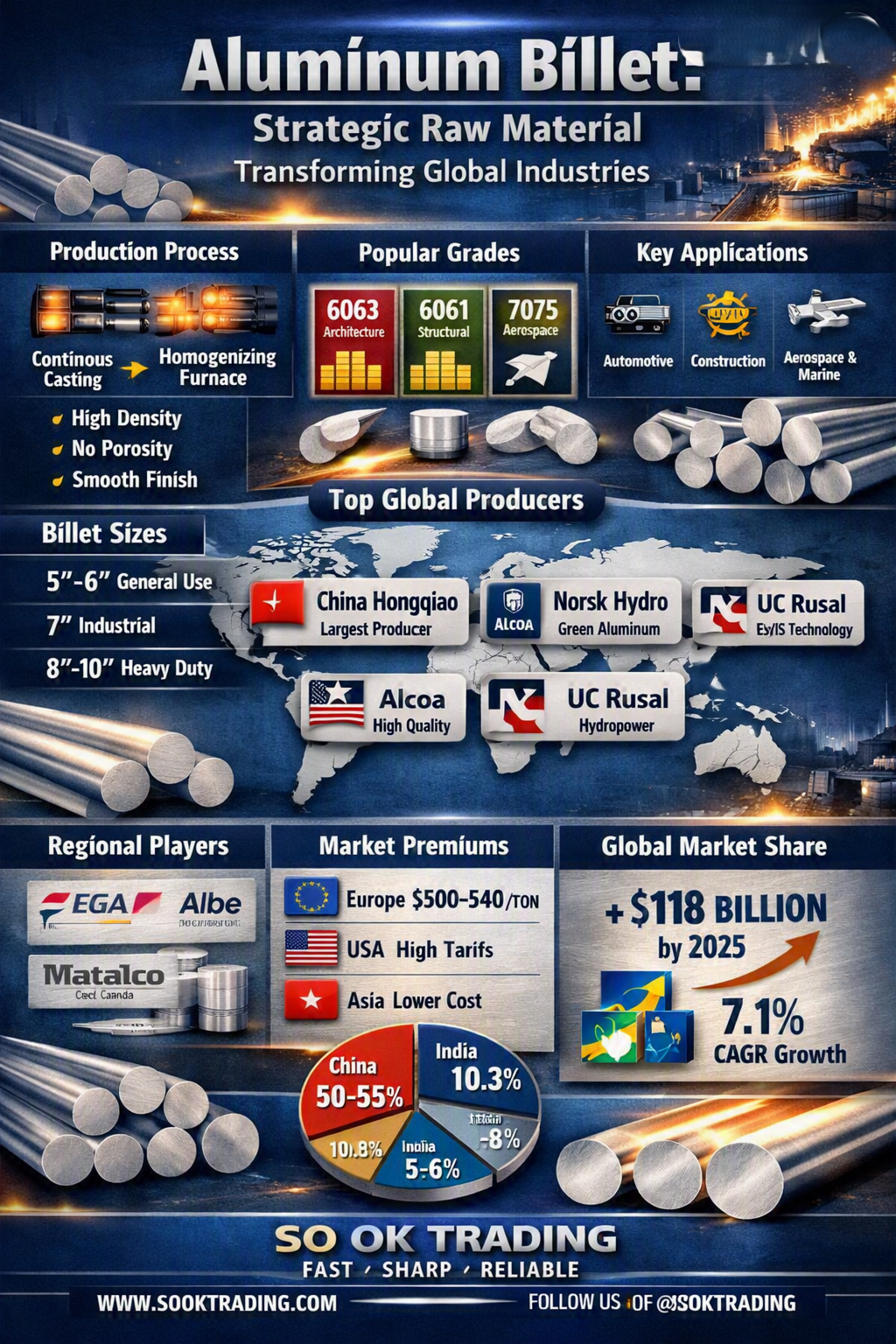
Definition & Production Process Aluminum Billet is a semi-finished cylindrical aluminum product. It is produced by pouring molten aluminum through Continuous Casting or Direct Chill (DC) Casting, then treated in a Homogenizing Furnace to refine internal structure, enhance strength, and prepare for extrusion or CNC machining.
Its key advantages are high density, no internal porosity, superior strength compared to conventional casting, and a smooth surface finish — ideal for painting or anodizing.
Popular Grades
6063 (Architecture) – Easy extrusion, smooth finish, widely used for window frames and curtain walls.
6061 (Structural) – High strength, applied in automotive, machinery, and shipbuilding.
7075 (Aerospace) – Maximum strength with zinc alloying, used in aircraft, defense, and racing cars.
Advantages vs. Conventional Casting
Dense structure, free of voids
Superior tensile and torsional strength
Smooth finish, perfect for coating and anodizing
Industrial Applications
Automotive & Transport: 6061 for wheels and truck chassis; 6063 for interior trim.
Construction & Architecture: 6061 for bridges; 6063 for curtain walls and window frames.
Electronics & Energy: 6061 for robotics structures; 6063 for heat sinks and solar frames.
Aerospace & Marine: 6061 for aircraft and ship structures; 6063 for piping and decorative fittings.
Popular Diameters
5″ (~127 mm): Most common for frames and general profiles
6″ (~152 mm): Automotive parts and heat sinks
7″ (~178 mm): Industrial structures
8–10″ (~203–254 mm): Heavy-duty use such as railways and building walls
Standard billet log length: 5.8–6 m for efficient transport.
Major Global Producers
China Hongqiao Group (China): Largest producer worldwide
Norsk Hydro (Norway): Leader in Green Aluminum
Alcoa (USA): Premium high-quality producer
UC RUSAL (Russia): Hydropower advantage
Rio Tinto (UK/Australia): ELYSIS technology for reduced emissions
Regional Players:
EGA (UAE) & Alba (Bahrain): Natural gas-based production
Matalco (Canada/USA): Leading recycled billet producer
Market Overview & Premiums
Europe: Premium ~USD 500–540/ton (down from peak of 600)
USA: Premium remains high due to Section 232 tariffs
Asia: Lower premiums thanks to strong production in China and Indonesia
Global Market Share
China (Chinalco/Hongqiao): ~50–55%
Hindalco (India): ~10.3%
Norsk Hydro: 5–7%
Alcoa: 5–6%
EGA & RUSAL: 8–11%
Market Outlook
Market value expected to rise from USD 111 billion (2025) to USD 118 billion
Average growth rate (CAGR): 7.1%
Short- to mid-term supply surplus anticipated
✅ Conclusion
Aluminum Billet is the strategic raw material linking industries from automotive and construction to electronics, aerospace, and marine. Its strength, density, and smooth finish make it indispensable, while global producers compete on both quality and sustainability. China dominates market share, while Europe and the US focus on premium and eco-friendly production.
✅ SO OK TRADING — Your trusted partner in the non‑ferrous metals industry FAST • SHARP • RELIABLE www.sooktrading.com Facebook: SO OK TRADING