Copper Cathode: The Lifeblood of the Global Economy The Heart of the Energy Transition The Strategic Metal the World Demands Insights by SO OK TRADING
Copper Cathode: The Strategic Metal of the Future : SO OK TRADING : 10 MAY 2026
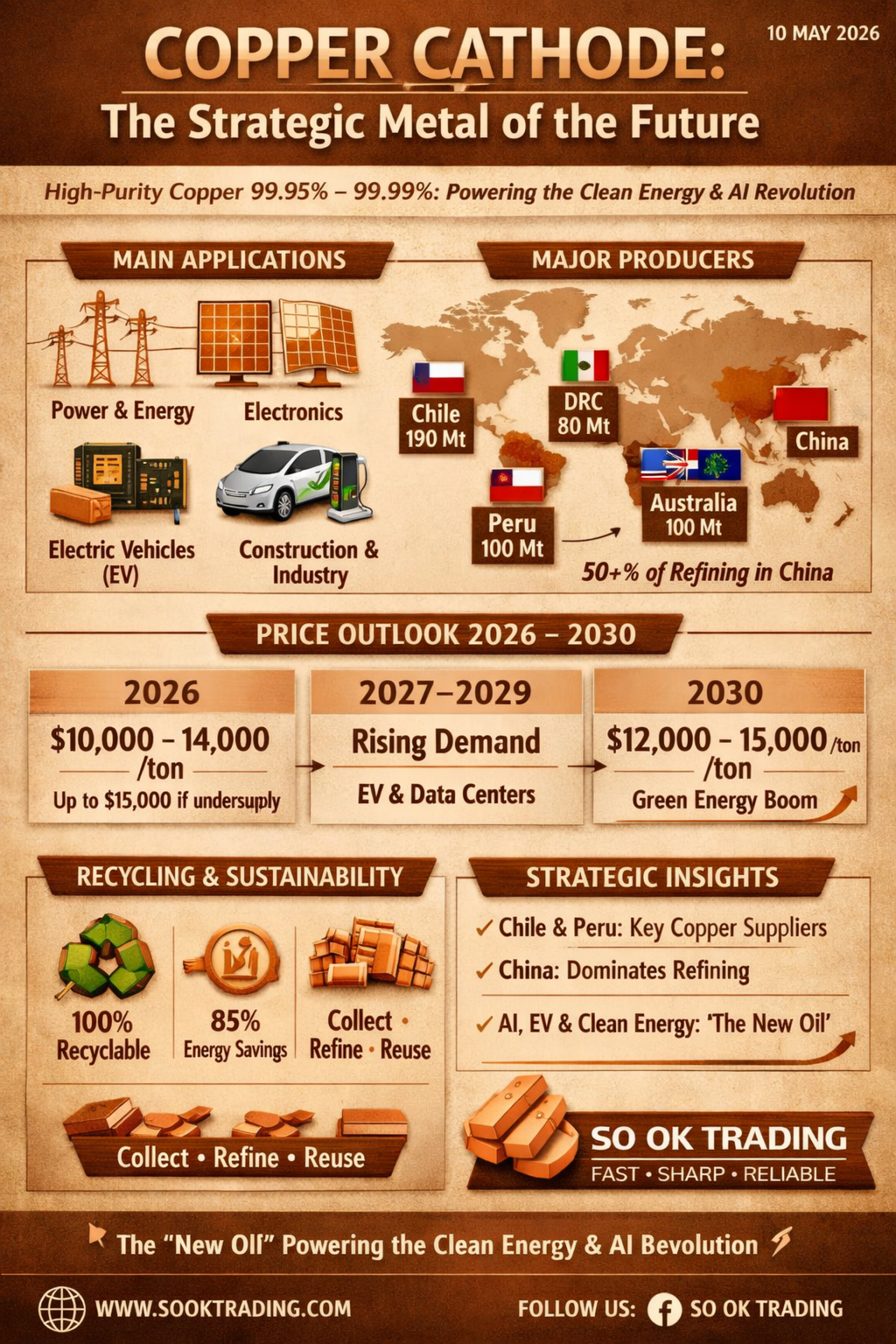
Copper Cathode is high-purity copper (99.95%–99.99%) produced through electrolytic refining. It is the backbone of the global metals industry, valued for its conductivity and durability, and recognized as the “strategic metal” of the clean energy and AI era.
⚡ Key Applications – Copper Cathode
Power & Energy: wires, transformers, motors, solar cells, wind turbines
Electronics: PCB boards, signal connectors
Electric Vehicles (EVs): battery systems, motors, internal wiring
Construction & Heating Systems: copper pipes in air conditioning, plumbing systems
Alloys & Machinery: brass, bronze, heavy industrial components
Quality Standards
LME Grade A: purity ≥ 99.99%
Impurity control: sulfur ≤ 15 ppm, iron ≤ 10 ppm
Must be flat sheets, free of rust or oil stains
Major Producing Countries
Chile: World’s No.1, reserves of 190 million tons, home to Escondida – the largest copper mine globally
Australia: ~100 million tons, key production hub in the Southern Hemisphere
Peru: another copper powerhouse in the Andes, ~100 million tons
DRC: 80 million tons, heavily invested in by China
Russia: 80 million tons, influential in Eurasian markets
Mexico, USA, China, Poland, Indonesia together account for over 20% of global reserves
The top five countries alone control more than half of the world’s copper resources.
Strategic Relationships
China: Though only 8th in reserves, it is the “smelter of the world”, holding nearly 60% of global cathode production capacity, importing massive volumes from Chile and Peru.
Chile & Peru: Strategic hubs with high-grade, low-cost ores and Pacific ports for efficient exports.
US & Europe: Increasing investments in African copper mines to reduce reliance on China.
Copper Price Outlook (2026–2030)
2026: Expected range $10,000–14,000/ton, potentially hitting $15,000/ton if shortages occur
2027–2029: Prices remain high, driven by EV and data center demand
2030: Forecast $12,000–15,000/ton, supported by new mining costs and clean energy demand
Key Drivers
AI & Data Centers: additional copper demand of ~1 million tons by 2030
Energy Transition & Supply Risks
EVs and global power grids: clean energy demand projected to reach 20% of total by 2035
Supply risks: South American politics, geopolitical tensions, and aluminum substitution trials
♻️ Copper Recycling
100% recyclable without loss of properties
Saves up to 85% energy compared to new production
Process: sorting → shredding → smelting & electrolytic refining → casting & fabrication
⚡ Copper is increasingly recognized as the “strategic mineral of modern industry” in the 21st century:
The heart of the clean energy transition
A core material for AI and the digital economy
A strategic resource linking producers (Chile/Peru) and consumers (China)
Copper Cathode is not just a metal — it is the lifeblood of the global economy’s future ⚡
SO OK TRADING : Your Trusted Business Partner SO OK TRADING : FAST SHARP RELIABLE VISIT US AT : WWW.SOOKTRADING.COM FACEBOOK : SO OK TRADING