Share

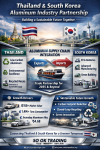
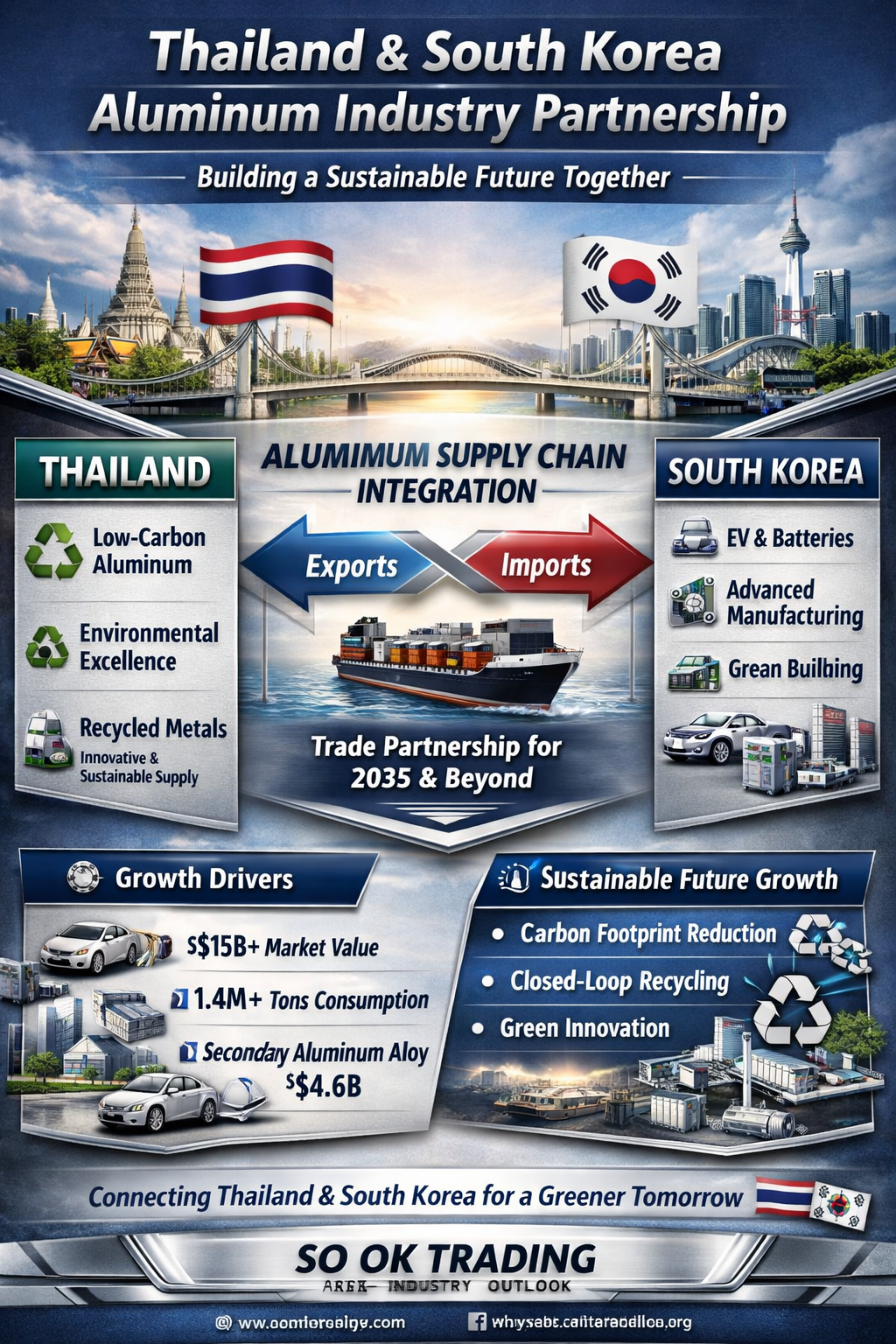
“South Korea Aluminum Power – Bridging Thailand & Korea’s Future Economy with Low‑Carbon Strategic Metal Transforming the World”
Last updated: 13 Jul 2026
1776 Views

“South Korea Aluminum Industry – Driving Future Economic Power and Opportunities for Thailand” An in‑depth article by SO OK TRADING : July 13, 2026

 
South Korea: The World’s Highest Per‑Capita Aluminum Consumer South Korea consumes an average of 42.76 kg of aluminum per person per year, the highest in the world. Aluminum is a strategic metal underpinning electric vehicles (EVs), lithium‑ion batteries, semiconductors, and clean energy — the core pillars of the modern economy.

 
Supply Chain Structure & Imports

Annual imports exceed USD 10 billion
Import ratio: 55% primary ingot and 45% mid‑stream & downstream products (rolled sheets, alloys)
Key players: Novelis Korea (rolling & recycling), Sam‑A Aluminium (battery foil), Sambo Industrial (alloys)
 
⚙️ Downstream Industries – Demand Accelerators

EV & Battery: aluminum in EV structures and battery foil
Electronics & Semiconductors: heat sinks, high‑purity aluminum powder for chip production
Construction: green buildings and 100% recyclable extrusion structures
Packaging: beverage cans and circular packaging with closed‑loop recycling
 
The “Green Aluminum” Trend

Government promotes low‑carbon aluminum and scrap recycling to align with EU CBAM measures
Secondary aluminum alloy market projected to reach USD 4.6 billion by 2035 (CAGR 5.2%)
Gwangyang Port has become the LME aluminum storage hub
 
Industry Outlook to 2035

Market value: USD 8.79 billion (2024) → USD 15.32 billion (2035)
Average CAGR: 5.18–5.77%
Consumption volume: 850,000 tons → 1.44 million tons (2035)
Volume CAGR: 4.67%
Specialty Segments:

Superhard aluminum plate → USD 1.1 billion (CAGR 6.2%)
Al‑RE alloy (rare‑earth mixed) → USD 2.8 billion (CAGR 6.2%)
EV battery enclosures → USD 3.5 billion (CAGR 12.5%)
 
Key Growth Drivers

Automotive electrification: Hyundai & Kia shifting platforms to aluminum structures
Infrastructure modernization: green buildings and high‑speed rail systems
Advanced recycling hubs: large‑scale domestic recycling plant investments
 
Opportunities for Thailand South Korea’s demand for low‑carbon and recycled aluminum is a golden opportunity for Thai producers. By upgrading production standards and achieving Carbon Footprint certification (e.g., TGO), Thai companies can immediately integrate into South Korea’s new supply chain.

 
About SO OK TRADING SO OK TRADING is Thailand’s leading trader and supplier of industrial raw materials, specializing in non‑ferrous metals such as aluminum, copper, zinc, and high‑quality recycled metals.

Strengths: High quality, on‑time delivery, flexible volumes Vision: To become a global partner in strategic metals markets Opportunity: Ready to meet South Korea’s and the world’s demand for low‑carbon aluminum

 
✨ SO OK TRADING — FAST • SHARP • RELIABLE When you think ALUMINUM, think of us

www.sooktrading.com Facebook: SO OK TRADING


Related Content
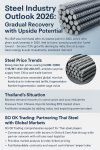
Steel Industry Outlook 2026: Gradual Recovery with Rising Price Potential BY SOOK TRADING
Steel Industry Outlook 2026: Gradual Recovery with Rising Price Potential The year 2026 marks a turning point for the global steel industry. After hitting its lowest point in 2025, the market is entering a “new equilibrium,” with demand gradually recovering and prices showing signs of stable upward movement. Global steel demand is forecast to grow 1.3%, reaching 1,773 million tons. India will be the main driver, with growth of 9% fueled by infrastructure investments in roads, railways, and energy. The United States and Europe are also expected to recover steadily, supported by interest rate cuts, clean energy projects, and the automotive sector—1.8% growth in the US and 3.2% in the EU. China, while still facing a slowdown in real estate, will see demand decline ease to -1%, supported by infrastructure projects and steel exports. Meanwhile, Southeast Asia and the Middle East are expected to contribute to diversified demand growth through infrastructure and energy investments. On the pricing side, steel bars (Rebar) are expected to average 16,000–17,000 THB/ton (450–530 USD/MT). Iron ore costs are projected at 83–95 USD/ton, with new supply from Guinea and Australia helping to stabilize input costs. Although trade barriers in the US and EU may keep domestic prices above global levels, the market is moving toward a more stable balance. In Thailand, steel demand is expected to grow modestly, driven by construction and automotive industries, with a base of 16.2 million tons in 2025. However, cheap Chinese steel could account for up to 50% of the market, putting pressure on local producers. Thai businesses must adapt by developing value-added specialty products, enhancing quality standards, and targeting premium and niche export markets such as ASEAN, the Middle East, and Africa. SO OK Trading: Partnering Thai Steel with Global Markets SO OK Trading supports Thai steel producers with comprehensive solutions: - Market Connectivity: Linking Thai producers with buyers in China and East Asia through an extensive partner network and integrated rail–sea–road logistics. - Market Analysis & Pricing Strategy: Providing insights into steel and iron ore price trends, with index-linked pricing recommendations to reduce volatility. - Stable Contracts & Compliance: Assisting in contract structuring, export documentation, standards, and certifications to ensure reliable trade. - Customer Development: Delivering tailored technical and commercial proposals to meet the needs of Chinese buyers seeking specialty steel. SO OK Trading is more than an exporter—it is a trusted business partner, helping Thai steel enterprises compete with stability and sustainability in the global steel market.
15 Jan 2026
This website uses cookies for best user experience, to find out more you can go to our Privacy Policy and Cookies Policy
Powered By MakeWebEasy Logo MakeWebEasy