Share

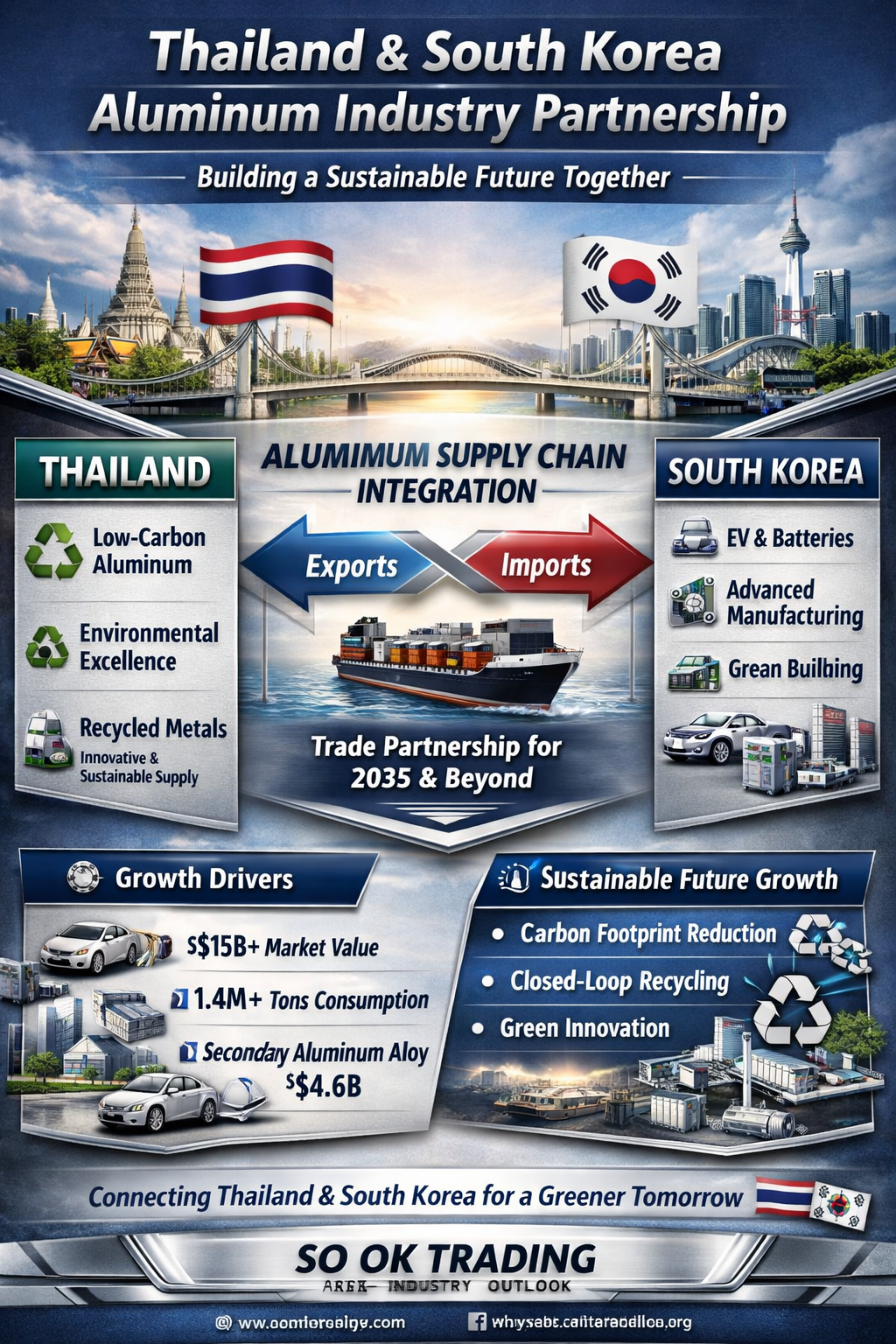
“South Korea Aluminum Power – Bridging Thailand & Korea’s Future Economy with Low‑Carbon Strategic Metal Transforming the World”
Last updated: 13 Jul 2026
120 Views

“South Korea Aluminum Industry – Driving Future Economic Power and Opportunities for Thailand” An in‑depth article by SO OK TRADING : July 13, 2026

 
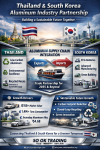
South Korea: The World’s Highest Per‑Capita Aluminum Consumer South Korea consumes an average of 42.76 kg of aluminum per person per year, the highest in the world. Aluminum is a strategic metal underpinning electric vehicles (EVs), lithium‑ion batteries, semiconductors, and clean energy — the core pillars of the modern economy.

 
Supply Chain Structure & Imports

Annual imports exceed USD 10 billion
Import ratio: 55% primary ingot and 45% mid‑stream & downstream products (rolled sheets, alloys)
Key players: Novelis Korea (rolling & recycling), Sam‑A Aluminium (battery foil), Sambo Industrial (alloys)
 
⚙️ Downstream Industries – Demand Accelerators

EV & Battery: aluminum in EV structures and battery foil
Electronics & Semiconductors: heat sinks, high‑purity aluminum powder for chip production
Construction: green buildings and 100% recyclable extrusion structures
Packaging: beverage cans and circular packaging with closed‑loop recycling
 
The “Green Aluminum” Trend

Government promotes low‑carbon aluminum and scrap recycling to align with EU CBAM measures
Secondary aluminum alloy market projected to reach USD 4.6 billion by 2035 (CAGR 5.2%)
Gwangyang Port has become the LME aluminum storage hub
 
Industry Outlook to 2035

Market value: USD 8.79 billion (2024) → USD 15.32 billion (2035)
Average CAGR: 5.18–5.77%
Consumption volume: 850,000 tons → 1.44 million tons (2035)
Volume CAGR: 4.67%
Specialty Segments:

Superhard aluminum plate → USD 1.1 billion (CAGR 6.2%)
Al‑RE alloy (rare‑earth mixed) → USD 2.8 billion (CAGR 6.2%)
EV battery enclosures → USD 3.5 billion (CAGR 12.5%)
 
Key Growth Drivers

Automotive electrification: Hyundai & Kia shifting platforms to aluminum structures
Infrastructure modernization: green buildings and high‑speed rail systems
Advanced recycling hubs: large‑scale domestic recycling plant investments
 
Opportunities for Thailand South Korea’s demand for low‑carbon and recycled aluminum is a golden opportunity for Thai producers. By upgrading production standards and achieving Carbon Footprint certification (e.g., TGO), Thai companies can immediately integrate into South Korea’s new supply chain.

 
About SO OK TRADING SO OK TRADING is Thailand’s leading trader and supplier of industrial raw materials, specializing in non‑ferrous metals such as aluminum, copper, zinc, and high‑quality recycled metals.

Strengths: High quality, on‑time delivery, flexible volumes Vision: To become a global partner in strategic metals markets Opportunity: Ready to meet South Korea’s and the world’s demand for low‑carbon aluminum

 
✨ SO OK TRADING — FAST • SHARP • RELIABLE When you think ALUMINUM, think of us

www.sooktrading.com Facebook: SO OK TRADING


Related Content
“Recycling 5.0: The New Business Game — How AI and the Circular Economy Transform Waste into the Strategic Capital of the Future” SO OK TRADING|May 16, 2026
Recycling – From “Waste” to “Strategic Capital” In an era where the world is accelerating toward Net Zero and the Circular Economy, recycling is no longer just about “being eco-friendly.” It has become a new global business rule that every industry must adapt to. Discarded materials are now being redefined as strategic resources driving clean energy, electric vehicles (EVs), and AI data centers. Today, “waste” is not something to be disposed of — it is a resource to be seized. Recycling is the capital of the future, shaping the trajectory of the global economy in the decade ahead
16 May 2026
“The Year of Challenges: Global Economy 2026 – Crises Creating New Opportunities. As the world changes, energy prices soar, inflation spikes, yet AI continues to drive the business game forward.”   SO OK TRADING: June 13, 2026
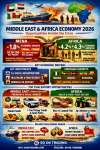
Global Economy 2026 – When the World Shakes, New Opportunities Arise Article by SO OK TRADING | June 13, 2026 The year 2026 has become a major test for the global economy — growth is slowing, inflation is resurging, and geopolitical tensions remain unresolved. Yet within every crisis lies a “new opportunity” for those who can see it first. From downgraded GDP forecasts worldwide to mounting pressures from soaring energy prices, trade wars, and persistently high interest rates, the global economy is under strain. SO OK TRADING takes you deep into the 2026 economic outlook, uncovering emerging market trends — from AI and advanced technologies, to affordable essential goods, and even gold and bonds that have become safe havens for investors.
13 Jun 2026
Aluminum Recycling the Circle and How it work
Aluminium is the most abundant metal in the earth’s crust. Approximately 75% of aluminium ever produced is still in use today as it can be recycled endlessly without compromising any of its unique properties or quality. Aluminium’s lifecycle provides significant benefits through recycling, saving 95% of the energy it would take to make new aluminium metal. More information on recycling may be found here. Recycling aluminium has five steps: Step 1: Collecting Scrap There are two categories of aluminium scrap: New Scrap New Scrap is surplus material that arises during the manufacture and fabrication of aluminium products, up to the point where they are sold to the final consumer. For example, off cuts of aluminium sheet or extrusions are considered new scrap. Sometimes, this new scrap can be safely recycled by aluminium smelters as its composition is known. Old Scrap Old Scrap is material that has been used by the consumer and subsequently discarded. For example, used beverage cans, window frames, electrical cabling and car cylinder heads are all considered old scrap. Aluminium smelters are unable to safely accept this old scrap as its composition is usually unknown and it can be contaminated. Scrap aluminium is also collected from the community – from households, scrap merchants, local and regional authorities, etc. Step 2: Sorting Scrap The scrap is then sorted – grouping all coated (painted or lacquered) aluminium together, and grouping all uncoated aluminium together. Paper, plastic and other non-aluminium recycling needs to be removed. Step 3: Crushing The sorted aluminium is then crushed into bales – by compacting the aluminium scrap, it reduces freight, storage and handling costs Step 4: Remelting Uncoated scrap is loaded directly into a large furnace called a remelter, where it is heated at high temperatures and turned into molten form. If the scrap aluminium is coated, it is processed through a gas fired rotary furnace to remove any coating and then transferred to the remelter. Step 5: Casting The molten aluminium is cast at a temperature of just over 700°C to form ingots
13 Nov 2025
This website uses cookies for best user experience, to find out more you can go to our Privacy Policy and Cookies Policy
Powered By MakeWebEasy Logo MakeWebEasy