Share

Cassava chips and pellets from Thailand are reaching far and wide — from China and the Middle East to global markets. Strong demand in animal feed, bioenergy, and industrial applications continues to position Thailand as a world leader in cassava exports.
Last updated: 24 Jan 2026
1174 Views

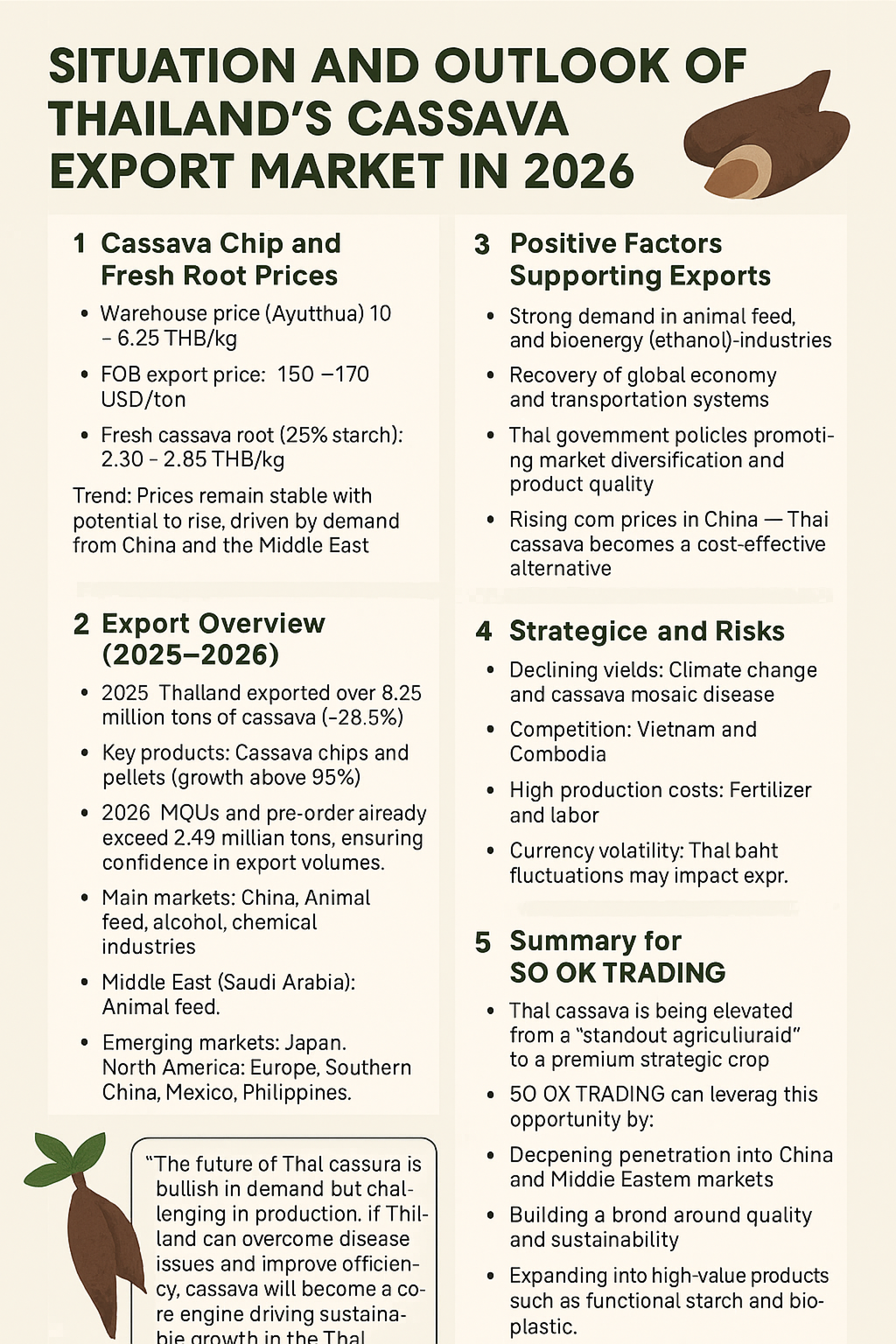
Situation and Outlook of Thailand’s Cassava Export Market in 2026

1. Cassava Chip and Fresh Root Prices

Warehouse price (Ayutthaya): 6.10 – 6.25 THB/kg
FOB export price: 160 – 170 USD/ton
Fresh cassava root (25% starch): 2.30 – 2.85 THB/kg
Trend: Prices remain stable with potential to rise, driven by demand from China and the Middle East
 

2. Export Overview (2025–2026)

2025: Thailand exported over 8.25 million tons of cassava (+26.53%)
Key products: Cassava chips and pellets (growth above 95%)
2026: MOUs and pre-orders already exceed 2.46 million tons, ensuring confidence in export volumes
Main markets:
China: Animal feed, alcohol, chemical industries
Middle East (Saudi Arabia): Animal feed
Emerging markets: Japan, North America, Europe, Southern China, Mexico, Philippines
 

3. Positive Factors Supporting Exports

Strong demand in animal feed and bioenergy (ethanol) industries
Recovery of global economy and transportation systems
Thai government policies promoting market diversification and product quality
Rising corn prices in China → Thai cassava becomes a cost-effective alternative
 

4. Challenges and Risks

Declining yields: Climate change and cassava mosaic disease
Competition: Vietnam and Cambodia
High production costs: Fertilizer and labor
Currency volatility: Thai baht fluctuations may impact exporters’ income
 

5. Strategic Outlook (2026–2027)

Market diversification: Reduce reliance on China (80–90%) by expanding into Saudi Arabia, Japan, and the EU
Product upgrading:
Functional starch for pharmaceuticals, cosmetics, and health foods
Bioplastic as eco-friendly plastic
Technology-driven production: Precision agriculture and disease-resistant varieties to boost yields
Continued investment: Ethanol, animal feed, chemicals, adhesives, paper
 

6. Summary by SO OK TRADING

Thai cassava is being elevated from a “standout agricultural product” to a “premium strategic crop.”
SO OK TRADING can leverage this opportunity by:

Deepening penetration into China and Middle Eastern markets
Building a brand around quality and sustainability
Expanding into high-value products such as functional starch and bioplastic
Positioning strategically: from “cassava exporter” to “global value creator in industry”
 

✨ Key Message

“The future of Thai cassava is bullish in demand but challenging in production. If Thailand can overcome disease issues and improve efficiency, cassava will become a core engine driving sustainable growth in the Thai agricultural economy.”


Related Content
Steel Industry Outlook 2026: Gradual Recovery with Rising Price Potential BY SOOK TRADING
Steel Industry Outlook 2026: Gradual Recovery with Rising Price Potential The year 2026 marks a turning point for the global steel industry. After hitting its lowest point in 2025, the market is entering a “new equilibrium,” with demand gradually recovering and prices showing signs of stable upward movement. Global steel demand is forecast to grow 1.3%, reaching 1,773 million tons. India will be the main driver, with growth of 9% fueled by infrastructure investments in roads, railways, and energy. The United States and Europe are also expected to recover steadily, supported by interest rate cuts, clean energy projects, and the automotive sector—1.8% growth in the US and 3.2% in the EU. China, while still facing a slowdown in real estate, will see demand decline ease to -1%, supported by infrastructure projects and steel exports. Meanwhile, Southeast Asia and the Middle East are expected to contribute to diversified demand growth through infrastructure and energy investments. On the pricing side, steel bars (Rebar) are expected to average 16,000–17,000 THB/ton (450–530 USD/MT). Iron ore costs are projected at 83–95 USD/ton, with new supply from Guinea and Australia helping to stabilize input costs. Although trade barriers in the US and EU may keep domestic prices above global levels, the market is moving toward a more stable balance. In Thailand, steel demand is expected to grow modestly, driven by construction and automotive industries, with a base of 16.2 million tons in 2025. However, cheap Chinese steel could account for up to 50% of the market, putting pressure on local producers. Thai businesses must adapt by developing value-added specialty products, enhancing quality standards, and targeting premium and niche export markets such as ASEAN, the Middle East, and Africa. SO OK Trading: Partnering Thai Steel with Global Markets SO OK Trading supports Thai steel producers with comprehensive solutions: - Market Connectivity: Linking Thai producers with buyers in China and East Asia through an extensive partner network and integrated rail–sea–road logistics. - Market Analysis & Pricing Strategy: Providing insights into steel and iron ore price trends, with index-linked pricing recommendations to reduce volatility. - Stable Contracts & Compliance: Assisting in contract structuring, export documentation, standards, and certifications to ensure reliable trade. - Customer Development: Delivering tailored technical and commercial proposals to meet the needs of Chinese buyers seeking specialty steel. SO OK Trading is more than an exporter—it is a trusted business partner, helping Thai steel enterprises compete with stability and sustainability in the global steel market.
15 Jan 2026
“Thai Natural Rubber: The Soft Power Driving the World – A Strategic Commodity of the New Century in the EV and BCG Era. Thai Rubber: The Essential Resource Demanded by Global Industries” Article by SO OK TRADING | March 26, 2026
“Thai Natural Rubber: From Plantations to Global Strategic Commodity” Published: March 28, 2026 Thailand is not just a rubber producer—it is the world’s leading exporter, holding over 30% of global natural rubber exports. Thai rubber has become the backbone of industries worldwide, from automotive and medical to construction. This article explores Thailand’s strengths and the future direction of the rubber industry in the EV era and the Bio-Circular-Green (BCG) economy.
28 Mar 2026
“Post-Ceasefire World 2026: Gold Surges, Oil Plunges, Stocks Rally — 48 Hours That Shake Global Markets” — Article by SO OK TRADING, April 8, 2026
Post-Ceasefire World: A Turning Point for the Global Economy Following the announcement of a two-week temporary ceasefire between the United States and Iran, the world now stands at a critical crossroads. The upcoming peace talks in Pakistan may mark the first step toward lasting peace and the easing of sanctions that have long shaken the global economy. Oil prices have plunged more than 15%, gold has surged above $4,800 per ounce, the U.S. dollar has weakened, and global stock markets have entered Risk-on mode, with investor confidence returning. SO OK TRADING provides a comprehensive overview of the impacts on gold, stocks, currencies, and oil, along with insights into the opportunities and risks the world must watch closely over the next 48 hours. FAST • SHARP • RELIABLE Your trusted business partner — SO OK TRADING
8 Apr 2026
This website uses cookies for best user experience, to find out more you can go to our Privacy Policy and Cookies Policy
Powered By MakeWebEasy Logo MakeWebEasy