Base Metals Market February 2026: When Volatility Turns into Opportunity - From Volatility to Opportunity: SO OK TRADING ’s In-Depth Analysis of the Base Metals Market: Aluminum, Copper, Zinc, Tin, Lead — The Latest Trends Investors Must Watch
Base Metals Market – February 2026: Opportunities and Risks Investors Must Watch
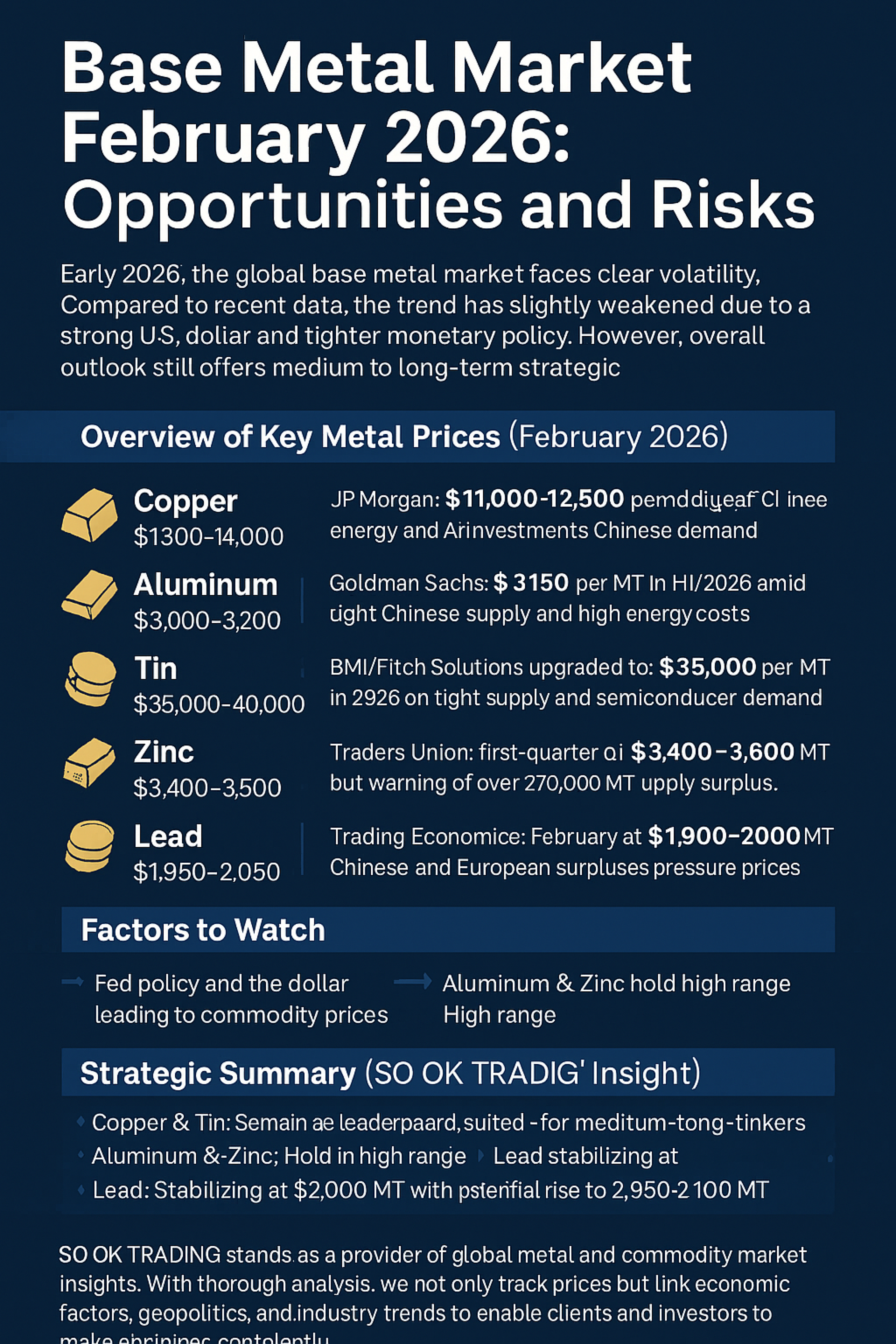
At the start of 2026, the global base metals market is facing clear volatility. Comparing past data with current prices (February 2–3, 2026), the overall trend has softened slightly, pressured by a stronger U.S. dollar and tighter monetary policy. Yet the broader picture still reflects strategic opportunities for medium- to long-term investors.
Key Metal Price Overview (February 2026)
Copper
Trading in the range of USD 13,000–14,000/MT.
JP Morgan forecasts an annual average of USD 11,000–12,500/MT, supported by clean energy and AI infrastructure investment, though Chinese demand remains a concern.
Aluminum
Trading in the range of USD 3,000–3,200/MT.
Goldman Sachs projects USD 3,150/MT for H1 2026, driven by tight Chinese supply and high energy costs.
Tin
Trading in the range of USD 36,000–40,000/MT.
BMI/Fitch Solutions upgraded its 2026 forecast to USD 35,000/MT, citing supply constraints and strong semiconductor demand.
Zinc
Trading around USD 3,400–3,500/MT.
Traders Union expects Q1 averages of USD 3,400–3,600/MT, but warns of a surplus exceeding 270,000 MT.
Lead
Trading in the range of USD 1,950–2,050/MT.
Trading Economics forecasts February averages of USD 1,900–2,000/MT, with oversupply from China and Europe exerting pressure.
Factors to Watch
Federal Reserve policy and U.S. dollar strength → Direct impact on commodity prices
EV and clean energy demand → Supporting copper and aluminum
Asian mine supply → Tin and zinc highly sensitive to production news
Geopolitical tensions → Driving risk-hedging purchases
Strategic Summary (SO OK TRADING Insight)
Copper & Tin: Continue to lead the market. Prices are unlikely to collapse—holding steady with potential upward moves.
Aluminum & Zinc: Holding firm in high ranges, better suited for hedging than speculation.
Lead: Stable around USD 2,000/MT, with potential to rise toward USD 2,050–2,100/MT.
About SO OK TRADING
SO OK TRADING stands as a trusted provider of global insights into metals and commodities. Our analysis goes beyond price tracking—we connect economic factors, geopolitics, and industry trends to empower clients and investors with confidence in their decisions.
“In a volatile world, base metals are the lifeblood of the global economy — and SO OK TRADING is the partner that helps you spot opportunities before anyone else.”