Share

“Middle East War: Energy Flashpoint Shaking Global Markets — 50/50 Between Peace or Escalation” — SO OK TRADING: May 24, 2026
Last updated: 24 May 2026
2612 Views

“Middle East War – Energy Flashpoint Shaking Global Markets” UPDATED Situation: May 24, 2026 BY SO OK TRADING

The unrest in the Middle East remains a wildfire with no sign of extinguishing. The conflict between the United States and Iran has escalated into direct military confrontation at the strategic Strait of Hormuz, the vital artery of global energy that carries more than 20% of the world’s oil supply. If blocked, the world would face an immediate historic supply shock.

 
Why the War Persists
Nuclear Deadlock: The U.S. demands Iran hand over highly enriched uranium, but Iran insists on its right to peaceful nuclear energy.
Sanctions & Frozen Assets: Iran calls for the release of frozen assets, while the U.S. maintains a hardline stance.
Strait of Hormuz Tensions: Attacks on cargo ships and warships have turned the world’s oil lifeline into a battlefield.
 
Peace Talks Without Resolution
Despite mediation efforts by Pakistan and Qatar, the gap between both sides remains too wide. The U.S. has signaled readiness to launch new military operations if negotiations collapse.

 
Global Economic Impacts
Oil & Gold Prices: Extreme volatility driven by clashes and rumors.
Air Travel & Shipping: Airlines reroute flights to avoid conflict zones.
Supply Chains: Freight rates and insurance premiums surge.
 
Three Scenarios to Watch
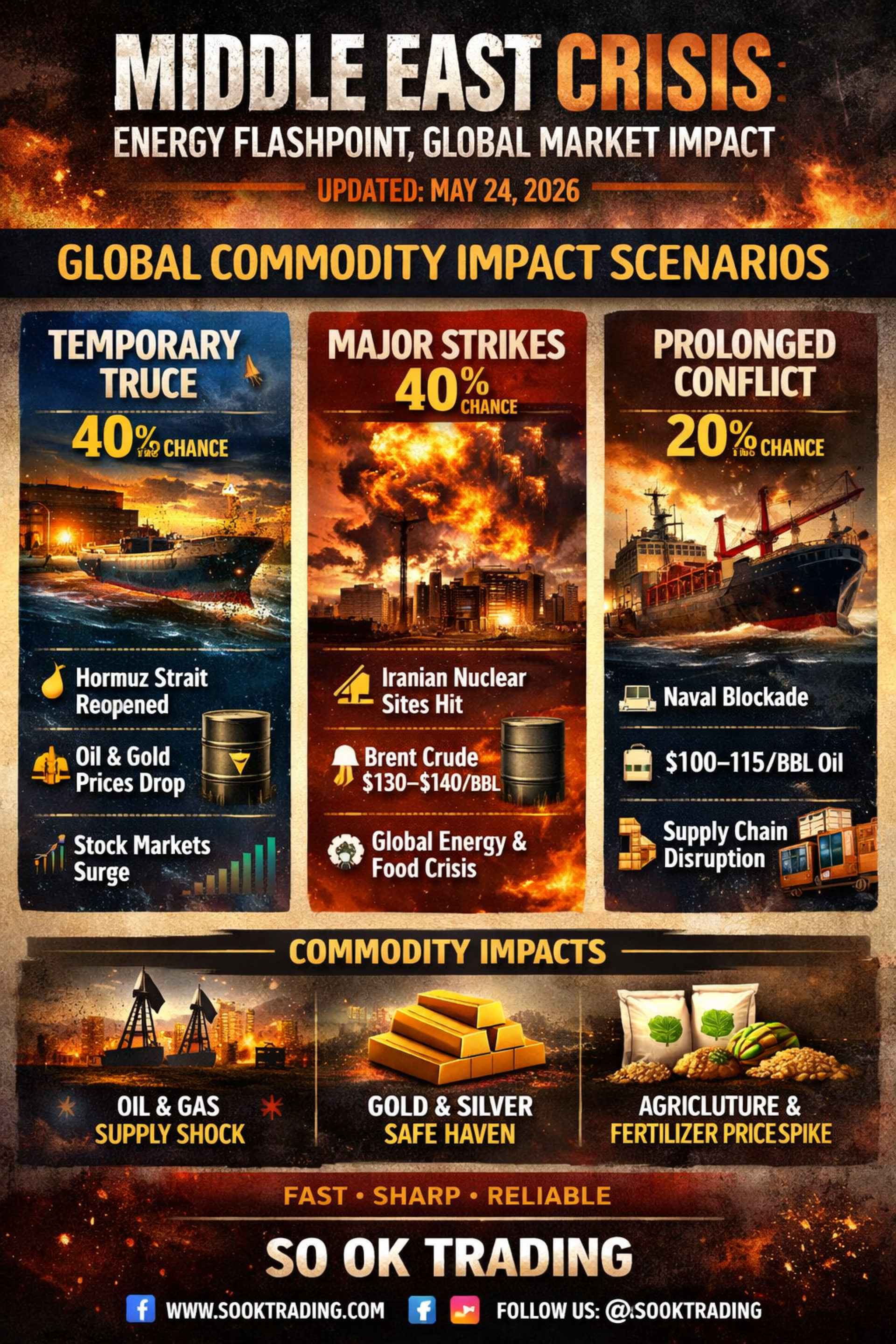
1️⃣ Temporary Truce (40%) Iran eases the Strait of Hormuz blockade → Oil and gold prices drop, stock markets rebound.

2️⃣ Negotiations Collapse – Major Strikes (40%) U.S. and Israel strike Iran’s nuclear facilities → Brent crude surges to $130–140/barrel, triggering a global energy crisis and food inflation.

3️⃣ Prolonged Limited Conflict (20%) U.S. enforces naval blockade and maximum sanctions → Oil stabilizes at $100–115/barrel, global supply chains remain strained.

 
Commodity Impacts
Energy: Severe supply shock if Hormuz is closed, oil and gas prices spike.
Precious Metals: Gold becomes the “final safe haven,” attracting global investors.
Agriculture: Fertilizer and food prices rise sharply due to higher production and shipping costs.
 
✨ Middle East Situation Summary
The world now stands at a crossroads — either a historic peace deal or a new energy war. The outcome of today’s emergency meeting between the U.S. and its allies will immediately determine the direction of global markets. Investors and businesses must stay vigilant, as every move in the Middle East will send instant and powerful shockwaves across the commodity market. The next round of talks is scheduled for May 24–25, 2026.

 
SO OK TRADING FAST • SHARP • RELIABLE WWW.SOOKTRADING.COM FACEBOOK: SO OK TRADING

Related Content
Global Rice Market on Fire! Thailand Must Rethink the Price War – Cultivating with Heart, Selling with Value, Rising as a World-Class Premium Brand: SO OK TRADING: May 13, 2026
Thai Rice 2026 – The Price War and the Path to Premium Markets The year 2026 marks a major challenge for “Thai Rice” on the global stage. World rice production has surged to a historic high of 541–556 million tons. India’s aggressive stock clearance at rock-bottom prices has ignited a price war that shakes the global market. Thailand, in response, has had to revise its export target down to 7.0 million tons from the original 7.9 million tons. Yet within this crisis lies hidden “opportunity.” Thai Jasmine rice and health-focused rice remain star products in global demand. If Thailand plays the right game — shifting from “selling volume” to “selling value” — premium rice, low-carbon rice, and government-to-government (G2G) trade with China will be the keys. SO OK TRADING is committed to driving Thai rice beyond the price war and into the global premium market, guided by the philosophy: FAST • SHARP • RELIABLE. Because we believe: “Thai rice is not just a product, but a story of quality and national pride.”
13 May 2026
Coffee Knowledge, Useful of Coffee, History of Coffee
Coffee knowledge covers its origins (coffee cherries), types (Arabica, Robusta), processing (washed, natural), flavor profiles influenced by terroir (origin, soil, altitude) and roast (light, medium, dark), brewing methods, and cultural aspects, revealing how these factors create the complex tastes and aromas we enjoy, from fruity & floral to nutty & chocolatey. Key Aspects of Coffee Knowledge Coffee Origins & Plant: Beans come from seeds inside coffee cherries on the Coffea plant, grown in the "bean belt" between the tropics. Key species are Arabica (sweeter, popular) and Robusta (stronger, higher caffeine). Terroir & Processing: Flavor is shaped by region (e.g., Ethiopian fruitiness vs. Brazilian nuttiness), altitude, soil, and processing (drying beans inside the cherry vs. washing them). Roasting: Lighter roasts are brighter/acidic, medium roasts are balanced, and darker roasts are bolder/bitter; roasting develops deep brown colors and complex flavors. Tasting & Flavor: Coffee has sweet, sour, bitter, salty, and aromatic (floral, fruity, spicy, nutty, etc.) components, with sweetness often indicating careful processing. Brewing: Techniques like espresso, drip, or cold brew extract - Coffee is a beverage made from roasted, ground seeds of coffee cherries. Finland consumes the most coffee per capita. Brazil grows the most coffee in the world. -----
22 Dec 2025
This website uses cookies for best user experience, to find out more you can go to our Privacy Policy and Cookies Policy
Powered By MakeWebEasy Logo MakeWebEasy