Share

Global Rice Market on Fire! Thailand Must Rethink the Price War – Cultivating with Heart, Selling with Value, Rising as a World-Class Premium Brand: SO OK TRADING: May 13, 2026

Last updated: 13 May 2026
3800 Views

Thai Rice 2026 – The Price War and the Path to Premium Markets

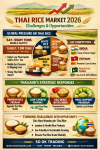
Global Market Situation (2026) Thai rice is facing significant pressure. World rice production has surged to a historic high of 541–556 million tons. India’s massive stock clearance at ultra-low prices (USD 350–370/ton) has triggered a price war, forcing Thailand and Vietnam to cut prices as well. Although global consumption demand is rising, international trade has slowed, leading Thailand to revise its export target down to 7.0 million tons from 7.9 million tons last year.

 
Overview of Thai Rice Exports
White rice (45.8%) – Largest volume but heavily pressured by Vietnam and India
Jasmine rice (22.2%) – Premium markets remain strong in the US, Hong Kong, and China, but a strong baht makes competition harder
Parboiled rice (19.1%) – Growing well in Africa, especially South Africa
Brown rice – Rising star, exports up over 200% thanks to health trends
 
⚠️ Risk Factors Pressuring Thai Rice
India’s massive stock release driving global prices down
Strong baht making Thai rice more expensive abroad
Low yield per rai and high costs, disadvantaging Thailand in the low-carbon rice market
Middle East conflict disrupting transport and raising fertilizer costs
 
Key Reasons for Falling Global Rice Prices
Global Glut – India’s release of 20–30 million tons of stock pushed white rice prices down to around USD 350/ton, forcing competitors to follow
Middle East War – Disruptions in the Strait of Hormuz, container shortages, and soaring freight rates slowed imports, leaving premium rice unsold
High Fertilizer Costs Not Yet Reflected – Current global supply is from older harvests produced under previous cost structures, so prices don’t yet reflect true costs
Strong Baht – For Thailand, the problem is doubled, as the strong currency makes rice more expensive internationally, forcing exporters to lower purchase prices from farmers
 
Thailand’s Adaptation Strategies
Refined Rice Project 2026 – Elevating Thai rice into premium products
Low-Carbon Rice – Driving the “70:30 fertilizer” strategy, targeting 1 million rai of cultivation
G2G Market with China – Accelerating government-to-government contracts to support exports
Domestic Price Stabilization – Government allocating over 60 billion baht to delay paddy sales and stabilize prices
 
Competitors’ Strategic Positioning
India – Massive volume + lowest price
Vietnam – Lower volume but higher value, focusing on premium and low-carbon rice
Thailand – Escaping the price war by targeting premium markets and eco-friendly rice
Pakistan/China – Staying in the low-price segment and relying on self-sufficiency
 
Conclusion: New Opportunities for Thai Rice
Despite global pressures, Thai Jasmine rice and health-focused rice remain strong differentiators. By accelerating brand and quality development, and highlighting taste, environmental sustainability, and health benefits, Thailand can turn the “price war” crisis into an opportunity to rise into premium markets.

 
SO OK TRADING : Your Business Partner SO OK TRADING : FAST • SHARP • RELIABLE

✨ VISIT US AT : WWW.SOOKTRADING.COM FACEBOOK : SO OK TRADING


Related Content
Global Aluminium Market Q4/2026: Japan Premium (MJP) Under Supply Pressure SO OK TRADING | 6 OCT 2026
Global Aluminium Market Q4/2026 — Japan Premium (MJP) Under Supply Pressure SO OK TRADING | 6 OCT 2026 As the fourth quarter of 2026 begins, the global aluminium market is entering a decisive turning point. The Japan Premium (Main Japan Premium – MJP) for Q4 has yet to reach a final settlement, reflecting cautious negotiations between buyers and sellers. Although structural demand from electric vehicles (EVs) and clean energy remains strong, the market is under pressure from tight supply in the Middle East and sluggish demand across Asia. As a result, the Japan Premium is expected to settle below $280 per ton, following Rio Tinto’s latest offer cut from $310 to $280 per ton (CIF Japan). Meanwhile, China has accelerated production and boosted exports by more than 17% year-on-year to offset supply gaps caused by Middle Eastern disruptions. This has created a fragile balance in the global market — prices remain elevated compared to 2025, but buyers are increasingly cautious. This analysis from SO OK TRADING explores every dimension of the aluminium market in Q4/2026: the state of MJP negotiations, the Middle East supply crisis, China’s counterbalance, LME price trends, and the industrial impact across Asia. ✨ FAST. SHARP. RELIABLE. SO OK TRADING — Your Trusted Partner in Non-Ferrous & Aluminium Business from Thailand
6 Oct 2026
Thai Refined Rice: Premium Quality Delivering a Unique Experience
Thai Refined Rice: Premium Quality for Global Markets Thai rice is globally recognized for its consistent quality and distinctive flavor. It is not only a staple food but also a premium product that appeals to high-end markets. “Refined Rice” emphasizes excellence in variety, cultivation, milling, sorting, and storytelling—making it more than just food, but a cultural experience. Major Types of Thai Refined Rice - Thai Hom Mali Rice (Jasmine Rice) - Long-grain, soft texture, naturally fragrant - World-renowned reputation - Main production area: Northeastern Thailand (Thung Kula Ronghai) - White Rice - Affordable, widely consumed - Exported in large volumes - Parboiled Rice - Firm grains, resistant to breakage - Popular in Africa and the Middle East - Brown Rice / Riceberry - Health-focused varieties - Targeted at premium and health-conscious markets - Glutinous Rice (Sticky Rice) - Staple food in Northeastern and Northern Thailand - Used in desserts and traditional dishes Strengths of Thai Rice - Consistent quality and taste - Strong global image and reputation - GI (Geographical Indication) certification, e.g., Jasmine Rice from Thung Kula Ronghai - Suitable for premium and health-oriented markets Key Export Markets - China - United States - Africa (South Africa, Benin, Nigeria) - Middle East - ASEAN
5 Jan 2026
THAI DURIAN (KING OF FRUIT)
Thai durian is one of the country’s most iconic fruits, earning the title "King of Fruits” thanks to the rich, distinctive flavour that sets it apart from other varieties. If you're looking to try durian at its best, it's a seasonal fruit available about six months a year, typically from April to September. 1.April to June - Eastern Thailand produces most of the country's durian, with May being the peak month. 2.July to September - Southern Thailand takes over as the primary durian producing region. There are five main Thai durian varieties that are especially popular: 1.Monthong (Golden Pillow): Pale yellow flesh, smooth and dry texture, thick meat with small seeds. Very sweet with a mild aroma. 2.Chanee: Deep yellow flesh with a rich, creamy texture. Medium fibre content. When fully ripe, the flesh becomes soft and bold in both sweetness and smell. 3.Kanyao: Golden yellow flesh, soft and fine texture with a balanced sweet, creamy taste. Medium fibre, pleasantly aromatic. 4.Puangmanee: Deep yellow, sticky flesh with a thin layer of fruit. Intensely sweet with a fragrant aroma. 5.Gradoom: Bright yellow, soft textured flesh with a thinner layer of fruit and larger seeds. Mildly sweet, less creamy and tends to become mushy when overripe.
28 Dec 2025
This website uses cookies for best user experience, to find out more you can go to our Privacy Policy and Cookies Policy
Powered By MakeWebEasy Logo MakeWebEasy