“Aluminum Sow vs. Remelt Block: A New Strategy in Recycled Aluminum Transforming Global Industry Toward Circular Economy and a Net Zero Future” SO OK TRADING – 18 May 2026
Aluminum Sow vs. Remelt Block: Recycling Giants Transforming Global Industry Toward the Net Zero Era SO OK TRADING – 18 May 2026
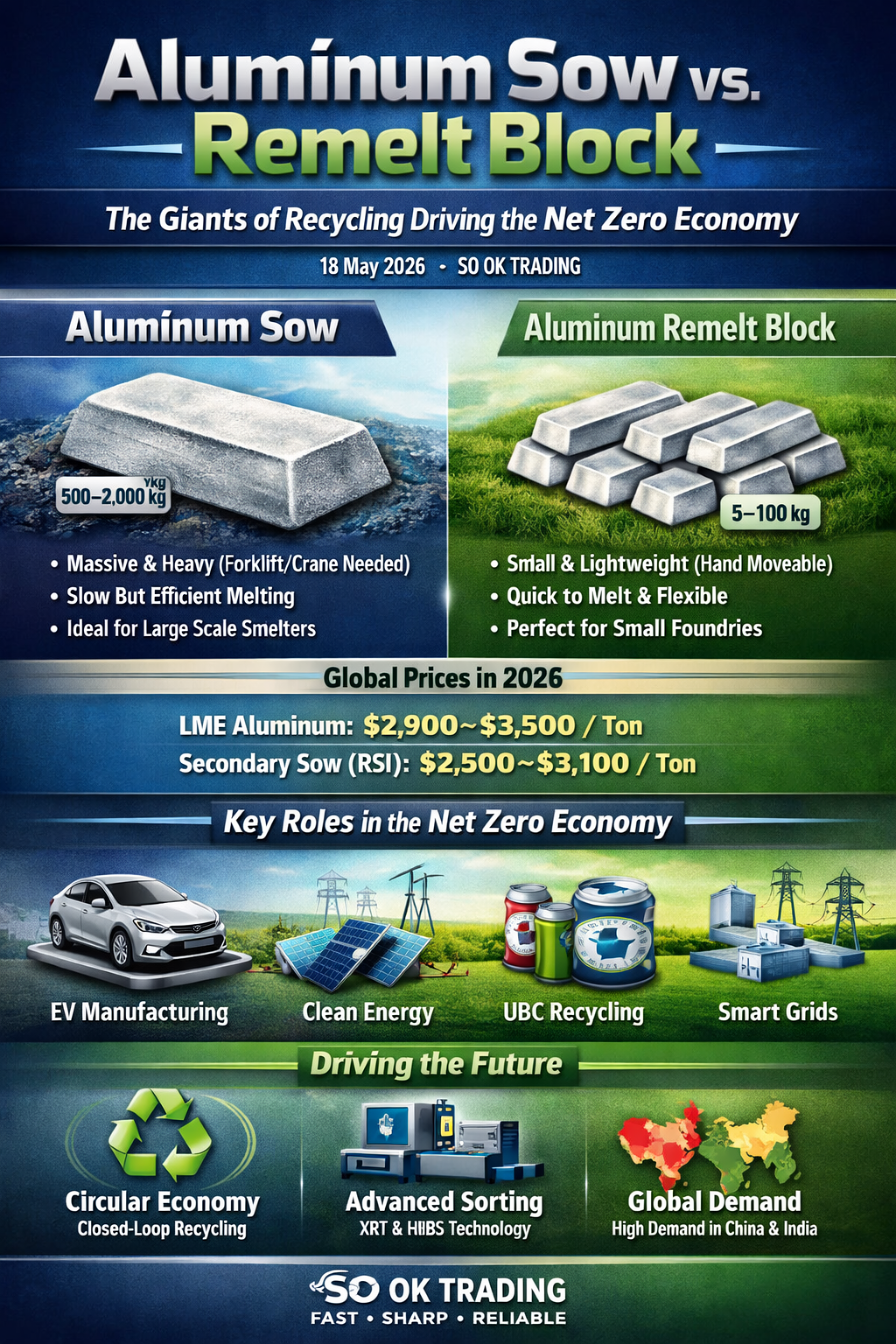
✨ What is Aluminum Sow? Aluminum Sow, or Sow Ingot, is a massive aluminum block weighing between 500–2,000 kilograms. It is produced as a fundamental raw material for industries worldwide, used in electric vehicle components, clean energy cables, and recycled packaging. Its key features are its large size, squat shape, and the ability to be manufactured from both primary aluminum (from ore) and secondary aluminum (from scrap).
⚖️ Aluminum Sow vs. Aluminum Remelt Block
Although both are made for “remelting,” their differences lie in size, shape, and usage.
Aluminum Sow: A giant ingot weighing hundreds to thousands of kilograms, requiring heavy machinery such as forklifts or cranes for movement. It is suited for large industrial furnaces (Reverb Furnaces). Melting takes longer and requires strict moisture control to prevent steam explosions. Its strength lies in low unit cost and suitability for bulk transport.
Aluminum Remelt Block/Ingot: Smaller in size, weighing 5–100 kilograms. Easily moved by workers or conveyors, quick to melt due to larger surface area, and highly flexible. Ideal for small to medium foundries, allowing batch feeding into furnaces for precise temperature and alloy adjustments.
In short: Sow is the “giant” for large-scale industries, while Remelt Block is the “compact partner” for general foundries needing flexibility.
Global Market Prices (2026)
LME Aluminum: 2,900–3,500 USD/ton
Secondary Sow (RSI): 2,500–3,100 USD/ton Recycled Sow is usually 10–20% cheaper than primary aluminum, but with high-quality scrap, its price can approach LME levels.
Role in the Circular Economy Aluminum Sow is becoming a cornerstone of the Circular Economy, reducing energy use by up to 95% compared to primary production, while also helping industries avoid Europe’s carbon border tax (CBAM). Key applications include:
Electric Vehicles (EVs): Casting vehicle structures and battery housings
Clean Energy: Manufacturing cables for smart grids and solar farms
Packaging: Recycling UBC cans into foil and new cans
Thailand’s Position Although Thailand does not produce primary aluminum, it is the hub of recycling and mid-to-downstream processing in ASEAN. Domestic secondary smelters purchase scrap aluminum such as UBC cans and old auto parts, remelting them into Sow or Remelt Blocks for export to China, Japan, and India. The EEC (Chonburi–Rayong) region, in particular, is seeing soaring demand for Sow driven by the EV and clean energy boom.
Future Outlook
Closed-loop Recycling: Advancing Circular Economy / Green Environment
Advanced Sorting Technologies (XRT, LIBS): Enhancing purity levels
Global Competition: Especially China and India, with massive demand for recycled Sow
✨ Conclusion Aluminum Sow is not just a giant ingot — it is a bridge to a green future through the Circular Economy. Remelt Block, as its flexible partner, supports general foundries. Together, they are vital gears driving the world toward a stable Net Zero future.
SO OK TRADING: Your trusted business partner FAST • SHARP • RELIABLE Visit us: www.sooktrading.com Contact: sooktrading@outlook.com Facebook: SO OK TRADING