Share

“Aluminum Sow vs. Remelt Block: A New Strategy in Recycled Aluminum Transforming Global Industry Toward Circular Economy and a Net Zero Future” SO OK TRADING – 18 May 2026
Last updated: 18 May 2026
85 Views

 Aluminum Sow vs. Remelt Block: Recycling Giants Transforming Global Industry Toward the Net Zero Era SO OK TRADING – 18 May 2026

 
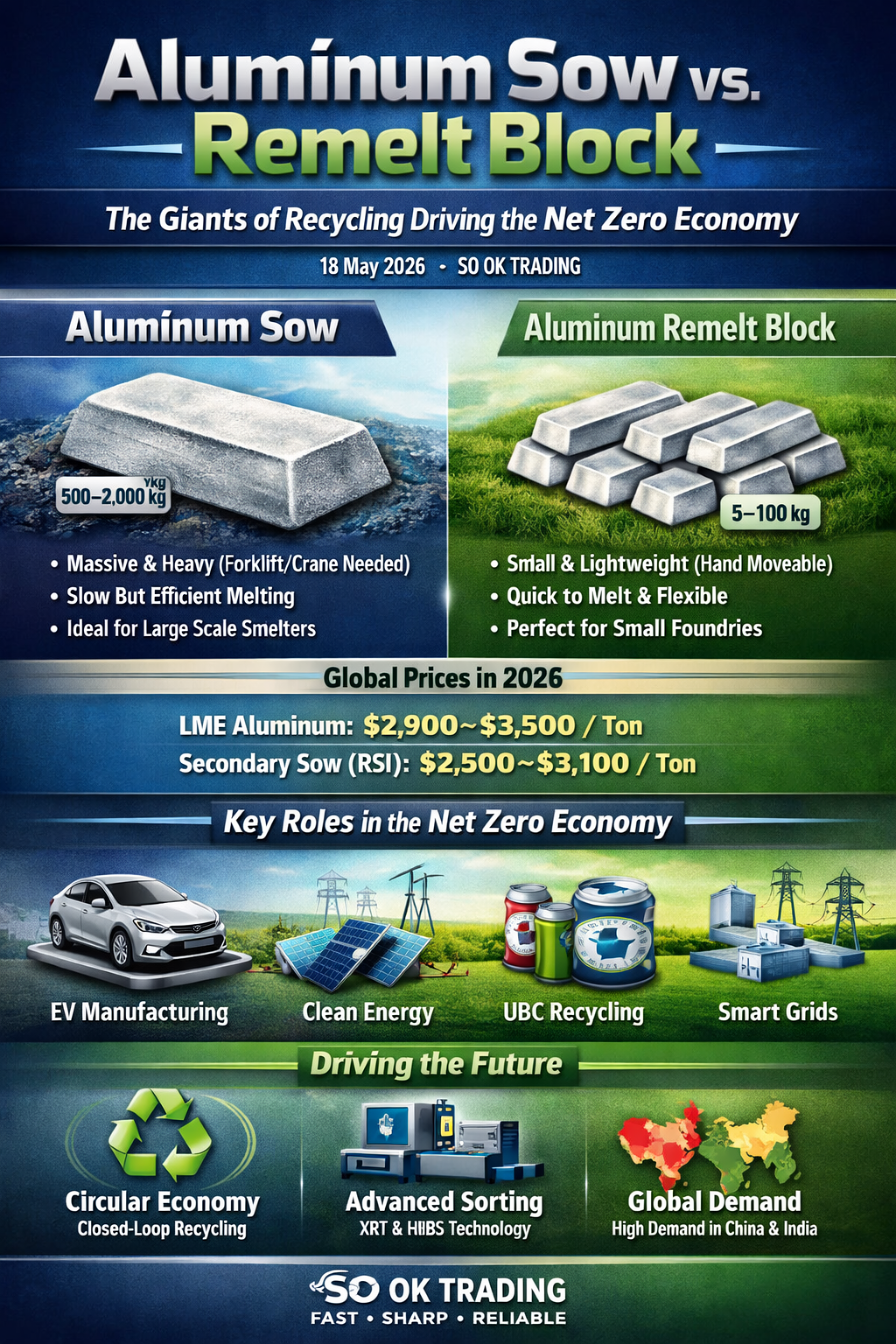
✨ What is Aluminum Sow? Aluminum Sow, or Sow Ingot, is a massive aluminum block weighing between 500–2,000 kilograms. It is produced as a fundamental raw material for industries worldwide, used in electric vehicle components, clean energy cables, and recycled packaging. Its key features are its large size, squat shape, and the ability to be manufactured from both primary aluminum (from ore) and secondary aluminum (from scrap).

 
⚖️ Aluminum Sow vs. Aluminum Remelt Block

Although both are made for “remelting,” their differences lie in size, shape, and usage.

Aluminum Sow: A giant ingot weighing hundreds to thousands of kilograms, requiring heavy machinery such as forklifts or cranes for movement. It is suited for large industrial furnaces (Reverb Furnaces). Melting takes longer and requires strict moisture control to prevent steam explosions. Its strength lies in low unit cost and suitability for bulk transport.
Aluminum Remelt Block/Ingot: Smaller in size, weighing 5–100 kilograms. Easily moved by workers or conveyors, quick to melt due to larger surface area, and highly flexible. Ideal for small to medium foundries, allowing batch feeding into furnaces for precise temperature and alloy adjustments.
In short: Sow is the “giant” for large-scale industries, while Remelt Block is the “compact partner” for general foundries needing flexibility.

 
Global Market Prices (2026)

LME Aluminum: 2,900–3,500 USD/ton
Secondary Sow (RSI): 2,500–3,100 USD/ton Recycled Sow is usually 10–20% cheaper than primary aluminum, but with high-quality scrap, its price can approach LME levels.
 
Role in the Circular Economy Aluminum Sow is becoming a cornerstone of the Circular Economy, reducing energy use by up to 95% compared to primary production, while also helping industries avoid Europe’s carbon border tax (CBAM). Key applications include:

Electric Vehicles (EVs): Casting vehicle structures and battery housings
Clean Energy: Manufacturing cables for smart grids and solar farms
Packaging: Recycling UBC cans into foil and new cans
 
Thailand’s Position Although Thailand does not produce primary aluminum, it is the hub of recycling and mid-to-downstream processing in ASEAN. Domestic secondary smelters purchase scrap aluminum such as UBC cans and old auto parts, remelting them into Sow or Remelt Blocks for export to China, Japan, and India. The EEC (Chonburi–Rayong) region, in particular, is seeing soaring demand for Sow driven by the EV and clean energy boom.

 
Future Outlook

Closed-loop Recycling: Advancing Circular Economy / Green Environment
Advanced Sorting Technologies (XRT, LIBS): Enhancing purity levels
Global Competition: Especially China and India, with massive demand for recycled Sow
 
✨ Conclusion Aluminum Sow is not just a giant ingot — it is a bridge to a green future through the Circular Economy. Remelt Block, as its flexible partner, supports general foundries. Together, they are vital gears driving the world toward a stable Net Zero future.

 
SO OK TRADING: Your trusted business partner FAST • SHARP • RELIABLE Visit us: www.sooktrading.com Contact: sooktrading@outlook.com Facebook: SO OK TRADING

Related Content
“Gold Consolidation, Power Unstoppable – The Golden Path Toward New Highs”   : Article by SO OK TRADING : April 4, 2026
“Gold Consolidation – The Opportunity to Accumulate Before the Next Big Wave!” As of April 2026, the global gold market is in a phase of “high-level consolidation” after reaching a record high of $5,594 per ounce earlier this year. Currently, gold spot prices are moving within the range of $4,522 – $4,702 per ounce (around 72,200 THB per baht gold bar in Thailand). Although prices have corrected from the peak, the overall trend remains a Structural Bull Market, underscoring gold’s strength as a safe-haven asset. Strong buying from central banks worldwide, especially China and emerging markets, continues to provide solid support. Meanwhile, geopolitical risks and expectations of a Fed rate cut in the second half of the year remain positive drivers for gold’s long-term outlook. For short-term investors, this is a “wait-and-see” moment. But for long-term investors, April represents a golden opportunity to gradually accumulate, preparing for the next major wave ahead. SO OK TRADING Your Trusted Business Partner FAST • SHARP • RELIABLE
4 Apr 2026
ALUMINUM PRICE TREND 2026
An analysis of the aluminum market in 2026 indicates a likely continued market deficit and upward price pressure, driven by constrained supply and resilient demand from green energy sectors. However, significant volatility is expected due to policy uncertainties and the potential for new Indonesian supply to eventually balance the market. Key Drivers and Projections for 2026 Supply Side Analysis Capacity Constraints: China's primary aluminum output is approaching its self-imposed 45 million-tonne capacity cap, limiting global supply growth. Power Challenges: Smelters outside of China face intense competition for power from energy-intensive sectors like AI data centers, which are willing to pay higher prices for long-term contracts. This has kept significant capacity offline in Europe and the US. Production Disruptions: Outages and potential shutdowns at existing smelters in Iceland and Mozambique further tighten the market. Scrap Supply Pressure: The EU's planned implementation of the Carbon Border Adjustment Mechanism (CBAM) and potential scrap export tariffs in spring 2026 are expected to impact global scrap flows, creating regional shortages and price volatility. New Capacity: Indonesia is a key source of new supply, with several projects in the pipeline. However, analysts suggest the pace of the ramp-up may be slower than expected due to infrastructure and policy challenges, meaning it is unlikely to fully offset near-term tightness. Demand Side Analysis Green Transition Demand: Demand from "green" sectors such as solar panels, new energy vehicles, and energy transition infrastructure remains strong, providing fundamental support for the market. Substitution Effect: Aluminum's wide price discount relative to copper has encouraged substitution in electrical applications, acting as a tailwind for demand and prices. Construction and Automotive: The construction and automotive industries continue to be major consumers, with growing demand for lightweight, low-carbon aluminum products. Price Forecasts and Volatility The market is expected to remain in a deficit in 2026, with estimates ranging from 200,000 to 600,000 tonnes. This structural tightness is leading most analysts to forecast sustained or rising prices. Bullish Views: Analysts at Bank of America project prices of $3,000/tonne as early as 2026. J.P. Morgan also expects prices to approach $3,000/tonne in Q1 2026. ING forecasts an average price of $2,900/tonne for the year. Bearish/Conservative Views: Goldman Sachs is an outlier, forecasting prices to decline to $2,350/tonne by Q4 2026, anticipating a market surplus later in the year. SMM forecasts a "high first, then lower" pattern, with prices finding equilibrium in the $2,700–$2,800/tonne range by year-end. Premiums: Regional premiums, particularly the US Midwest premium, are expected to remain high and volatile due to tariffs and regional supply dynamics, creating a disconnect from the LME benchmark price. In essence, 2026 is projected to be a year of high volatility where participants need to focus on scenario readiness rather than relying on a single price forecast, as geopolitical and energy policies significantly influence regional supply and costs
31 Dec 2025
Copper Cathode: The Lifeblood of the Global Economy The Heart of the Energy Transition The Strategic Metal the World Demands Insights by SO OK TRADING
Copper Cathode: The Strategic Metal of the Future With a purity of 99.95–99.99%, copper cathode is hailed as the “lifeblood of the global economy” — the core material powering clean energy, AI, EVs, and Data Centers.
10 May 2026
This website uses cookies for best user experience, to find out more you can go to our Privacy Policy and Cookies Policy
Powered By MakeWebEasy Logo MakeWebEasy