Share

“Clean Energy Revolution: Transforming the Global Economy — From Solar to Hydrogen, the Future’s Turning Point” SO OK TRADING : May 3, 2026
Last updated: 3 May 2026
163 Views

⚡ Alternative Energy: The Turning Point to the Clean Power Era

The world is moving decisively into the “Clean Power Era.” Alternative energy is no longer just a supplementary option — it is becoming the core driver of the new global economy, forcing nations to accelerate adaptation.

 
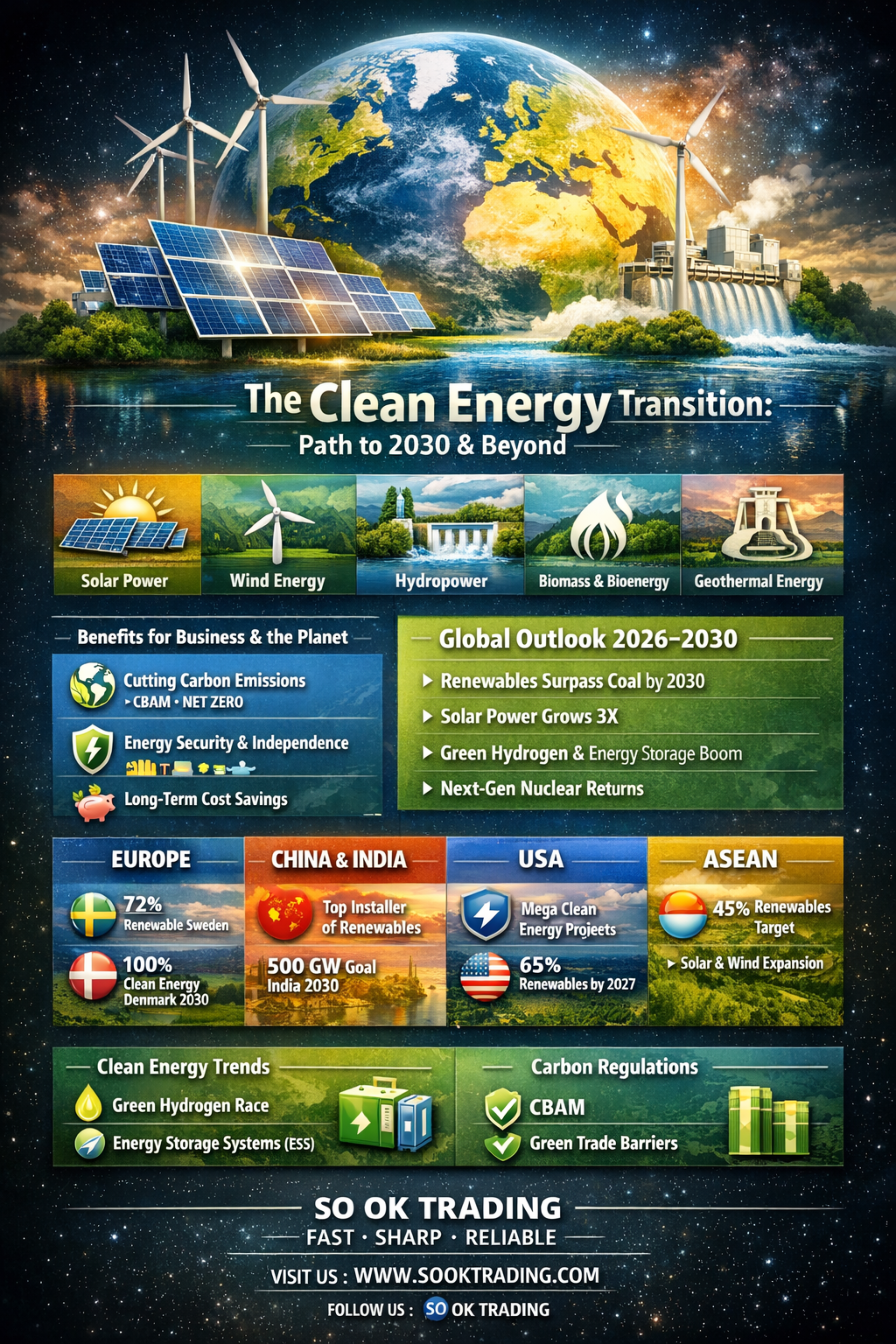
Key Types of Alternative Energy
Solar PV – The star of growth, lower costs, rapid installation
Wind – Expanding massively both onshore and offshore
Hydropower – Dams and rivers remain vital energy bases in many countries
Biomass & Bioenergy – Converting agricultural waste and biofuels into energy
Geothermal – Stable energy, available year-round
Nuclear – Returning as a stabilizing energy source in many nations
 
Benefits for Business & the Planet
Reduce greenhouse gas emissions, protect the environment — CBAM • NET ZERO • GREEN ENVIRONMENT
Strengthen energy security, reduce reliance on imports
One-time investment, long-term low costs (sunlight and wind are free resources)
 
Global Outlook 2026–2030
Renewables surpass coal by 2030
Solar power grows 3X by 2030
Energy storage batteries and green hydrogen become “game changers”
Next-generation nuclear returns to reinforce stability
 
Regional Trends
Northern Europe – Leaders in renewable efficiency

Sweden: 72% renewable electricity
Denmark: Targeting 100% clean energy by 2030
Iceland: 100% geothermal heating for households
China – The global market driver

Largest installer of new renewables (half of global additions in 2026)
Dominates offshore wind and pumped-storage hydropower
India – Fastest-growing market

Targeting 500 GW non-fossil energy by 2030
Record investment of over $101 billion in 2026
United States – Clean energy megaprojects

Large-scale solar projects meeting 65% demand growth by 2027
Massive investment in utility-scale energy storage
Latin America – Hydropower and biomass

Brazil: 93.6% renewable electricity
Chile: Emerging as a major exporter of green hydrogen
Southern Europe – Steady clean energy growth

Spain: Nearly 57% clean electricity
Portugal: 71% renewable share
ASEAN – A new energy hub

Target: 45% renewables by 2030
Thailand & Vietnam: Expanding solar farms and rooftop PV
Indonesia & Philippines: Developing large-scale wind farms
Laos: Exporting hydropower to Singapore via ASEAN Power Grid
Japan – GX 2040 Vision

Target: 40–50% renewables by 2040
Nuclear revival (20–22%)
Heavy investment in offshore wind and co-firing (ammonia + hydrogen)
 
Global Trends
Green Hydrogen Race – Competing to decarbonize heavy industry
Energy Storage Systems (ESS) – Solving intermittency challenges
Green Trade Barriers (CBAM) – EU carbon tariffs forcing global factories to adopt clean energy
 
✨ Conclusion The world is truly entering the “Clean Power Era.” By 2030, renewables will dominate global electricity generation, shaping the future of economies and trade. Those who adapt quickly will be the winners in the new energy game.

 
SO OK TRADING: Your Business Partner FAST • SHARP • RELIABLE VISIT US AT: WWW.SOOKTRADING.COM FACEBOOK: SO OK TRADING

Related Content
Carbon Credit คืออะไร ใช้งานอย่างไร และ ส่งผลต่อภาพธุรกิจอย่างไร ?
คาร์บอนเครดิตคือ สิทธิที่เกิดจากการลดปริมาณก๊าซเรือนกระจก หรือจากการกักเก็บก๊าซเรือนกระจก ซึ่งสามารถวัดปริมาณได้ในหน่วยตันคาร์บอนไดออกไซด์เทียบเท่า (\(tCO_{2}e\)) สิทธินี้สามารถซื้อขายได้ในตลาดคาร์บอนเพื่อใช้ชดเชยการปล่อยก๊าซเรือนกระจก การเกิดคาร์บอนเครดิต เกิดขึ้นจากโครงการที่ช่วยลดหรือกักเก็บก๊าซเรือนกระจก เช่น: โครงการพลังงานสะอาด: การเปลี่ยนมาใช้พลังงานหมุนเวียน เช่น พลังงานแสงอาทิตย์หรือพลังงานลมโครงการปลูกป่า: การเพิ่มพื้นที่ป่าเพื่อดูดซับคาร์บอนไดออกไซด์โครงการจัดการของเสีย: การนำขยะมาผลิตเป็นพลังงานการผลิตแบบ Low-Carbon: การปรับปรุงกระบวนการผลิตในภาคอุตสาหกรรมให้มีประสิทธิภาพมากขึ้น การซื้อขายคาร์บอนเครดิต การซื้อ: องค์กรที่ปล่อยก๊าซเรือนกระจกเกินกว่าที่กำหนดจะซื้อคาร์บอนเครดิตเพื่อชดเชยส่วนที่เกินการขาย: องค์กรที่ดำเนินโครงการแล้วสามารถลดหรือกักเก็บก๊าซเรือนกระจกได้ จะได้คาร์บอนเครดิตไปขายตลาดคาร์บอน: มี 2 ประเภทหลัก ได้แก่ตลาดภาคบังคับ (Mandatory Carbon Market): ดำเนินการตามกฎหมาย เช่น โดยรัฐบาลหรือสหประชาชาติตลาดภาคสมัครใจ (Voluntary Carbon Market): ดำเนินการโดยองค์กรเอกชน เช่น องค์การบริหารก๊าซเรือนกระจก (อบก.) ที่ดูแลโครงการ T-VER ในประเทศไทย
30 Nov 2025
“2026 Global & Thai Economy Outlook: AI, Clean Energy, and the Rise of Strategic Commodities” Article by SO OK TRADING
2026 is shaping up to be a pivotal year for both the global and Thai economies. The world is being driven by Artificial Intelligence (AI) and Clean Energy, alongside the rise of strategic commodities such as gold, silver, copper, and aluminum. While global growth continues, risks from trade wars and geopolitical tensions remain strong headwinds. Thailand, meanwhile, is still in a transition phase, where attracting more Foreign Direct Investment (FDI) and boosting Research & Development (R&D) are critical to avoid falling behind. In this article, SO OK TRADING explores the 2026 outlook for the global and Thai economies, highlighting new opportunities across rising industries — from digital technology and integrated healthcare to clean energy and niche lifestyle markets that are expanding rapidly. 2026 marks a pivotal transition for the global and Thai economies. Driven by Artificial Intelligence (AI) and Clean Energy, the world is witnessing the rise of strategic commodities — gold, silver, copper, and aluminum. While global growth continues, Thailand remains in transition, seeking FDI and stronger R&D to capture opportunities in medical hub, green manufacturing, and lifestyle markets.
17 Feb 2026
“CBAM & Carbon Credit: Transforming Global Trade — From Cost to Opportunity, Adapting Early with Carbon Footprint as the Survival Blueprint for Thai Businesses in the Green Era”
CBAM & Carbon Credit: A Guide for Thai Businesses to the New Global Trade Alongside “Carbon Footprint: The Blueprint for Future Business” The EU’s CBAM regulation is reshaping global trade entirely! Thai businesses—especially exporters and SMEs—must act quickly: measuring carbon emissions, adopting clean energy, and offsetting with carbon credits.
21 Feb 2026
This website uses cookies for best user experience, to find out more you can go to our Privacy Policy and Cookies Policy
Powered By MakeWebEasy Logo MakeWebEasy