“Clean Energy Revolution: Transforming the Global Economy — From Solar to Hydrogen, the Future’s Turning Point” SO OK TRADING : May 3, 2026
⚡ Alternative Energy: The Turning Point to the Clean Power Era
The world is moving decisively into the “Clean Power Era.” Alternative energy is no longer just a supplementary option — it is becoming the core driver of the new global economy, forcing nations to accelerate adaptation.
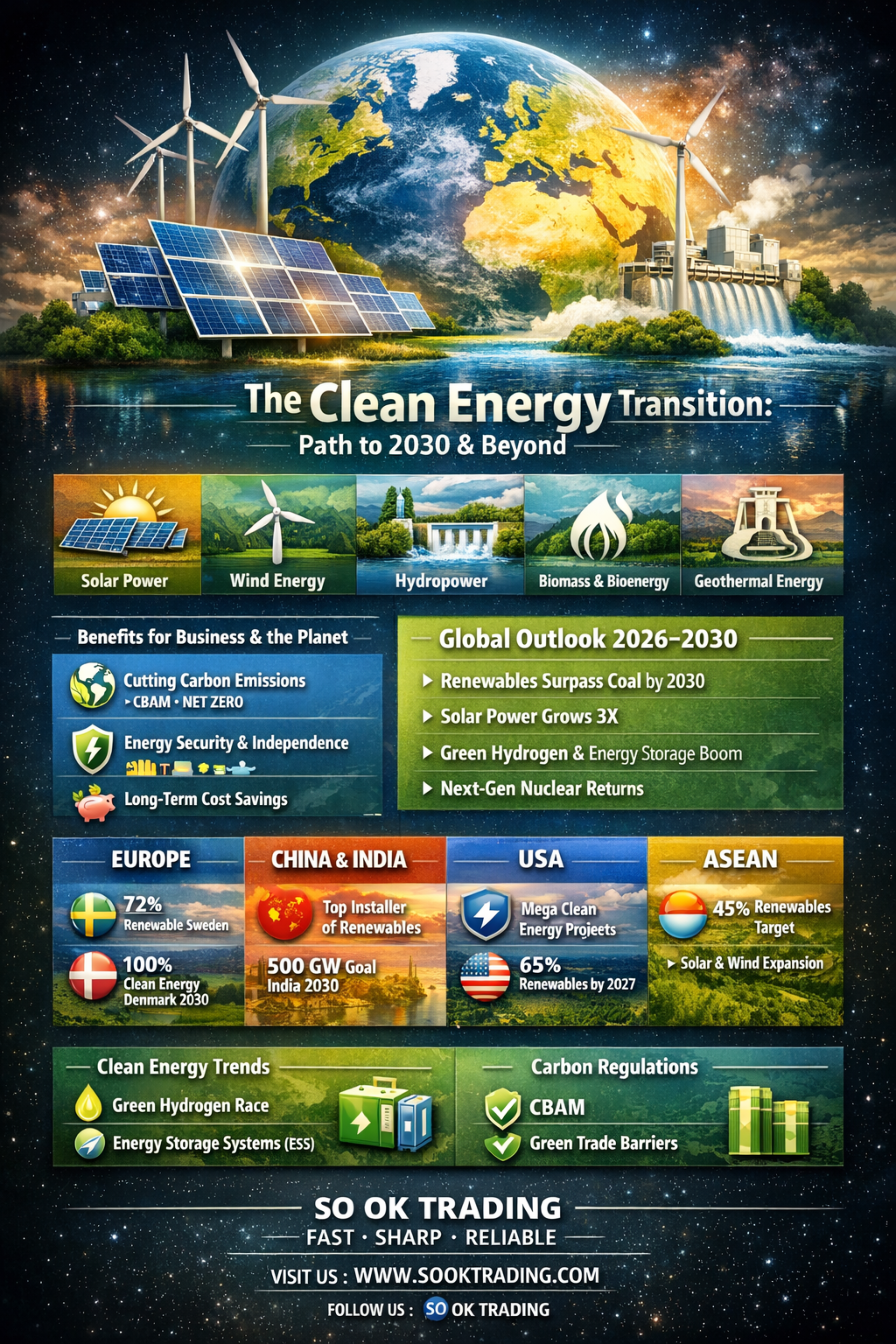
Key Types of Alternative Energy
Solar PV – The star of growth, lower costs, rapid installation
Wind – Expanding massively both onshore and offshore
Hydropower – Dams and rivers remain vital energy bases in many countries
Biomass & Bioenergy – Converting agricultural waste and biofuels into energy
Geothermal – Stable energy, available year-round
Nuclear – Returning as a stabilizing energy source in many nations
Benefits for Business & the Planet
Reduce greenhouse gas emissions, protect the environment — CBAM • NET ZERO • GREEN ENVIRONMENT
Strengthen energy security, reduce reliance on imports
One-time investment, long-term low costs (sunlight and wind are free resources)
Global Outlook 2026–2030
Renewables surpass coal by 2030
Solar power grows 3X by 2030
Energy storage batteries and green hydrogen become “game changers”
Next-generation nuclear returns to reinforce stability
Regional Trends
Northern Europe – Leaders in renewable efficiency
Sweden: 72% renewable electricity
Denmark: Targeting 100% clean energy by 2030
Iceland: 100% geothermal heating for households
China – The global market driver
Largest installer of new renewables (half of global additions in 2026)
Dominates offshore wind and pumped-storage hydropower
India – Fastest-growing market
Targeting 500 GW non-fossil energy by 2030
Record investment of over $101 billion in 2026
United States – Clean energy megaprojects
Large-scale solar projects meeting 65% demand growth by 2027
Massive investment in utility-scale energy storage
Latin America – Hydropower and biomass
Brazil: 93.6% renewable electricity
Chile: Emerging as a major exporter of green hydrogen
Southern Europe – Steady clean energy growth
Spain: Nearly 57% clean electricity
Portugal: 71% renewable share
ASEAN – A new energy hub
Target: 45% renewables by 2030
Thailand & Vietnam: Expanding solar farms and rooftop PV
Indonesia & Philippines: Developing large-scale wind farms
Laos: Exporting hydropower to Singapore via ASEAN Power Grid
Japan – GX 2040 Vision
Target: 40–50% renewables by 2040
Nuclear revival (20–22%)
Heavy investment in offshore wind and co-firing (ammonia + hydrogen)
Global Trends
Green Hydrogen Race – Competing to decarbonize heavy industry
Energy Storage Systems (ESS) – Solving intermittency challenges
Green Trade Barriers (CBAM) – EU carbon tariffs forcing global factories to adopt clean energy
✨ Conclusion The world is truly entering the “Clean Power Era.” By 2030, renewables will dominate global electricity generation, shaping the future of economies and trade. Those who adapt quickly will be the winners in the new energy game.
SO OK TRADING: Your Business Partner FAST • SHARP • RELIABLE VISIT US AT: WWW.SOOKTRADING.COM FACEBOOK: SO OK TRADING