Share

“Naphtha: The Lifeblood of Global Industry — From Byproduct to Strategic Material, Driving Plastics, EVs, and a Sustainable Future” SO OK TRADING | 2 May 2026
Last updated: 2 May 2026
1783 Views

 Naphtha: From Byproduct to “Strategic Material” of Global Industry
SO OK TRADING | 2 May 2026

 
What is Naphtha
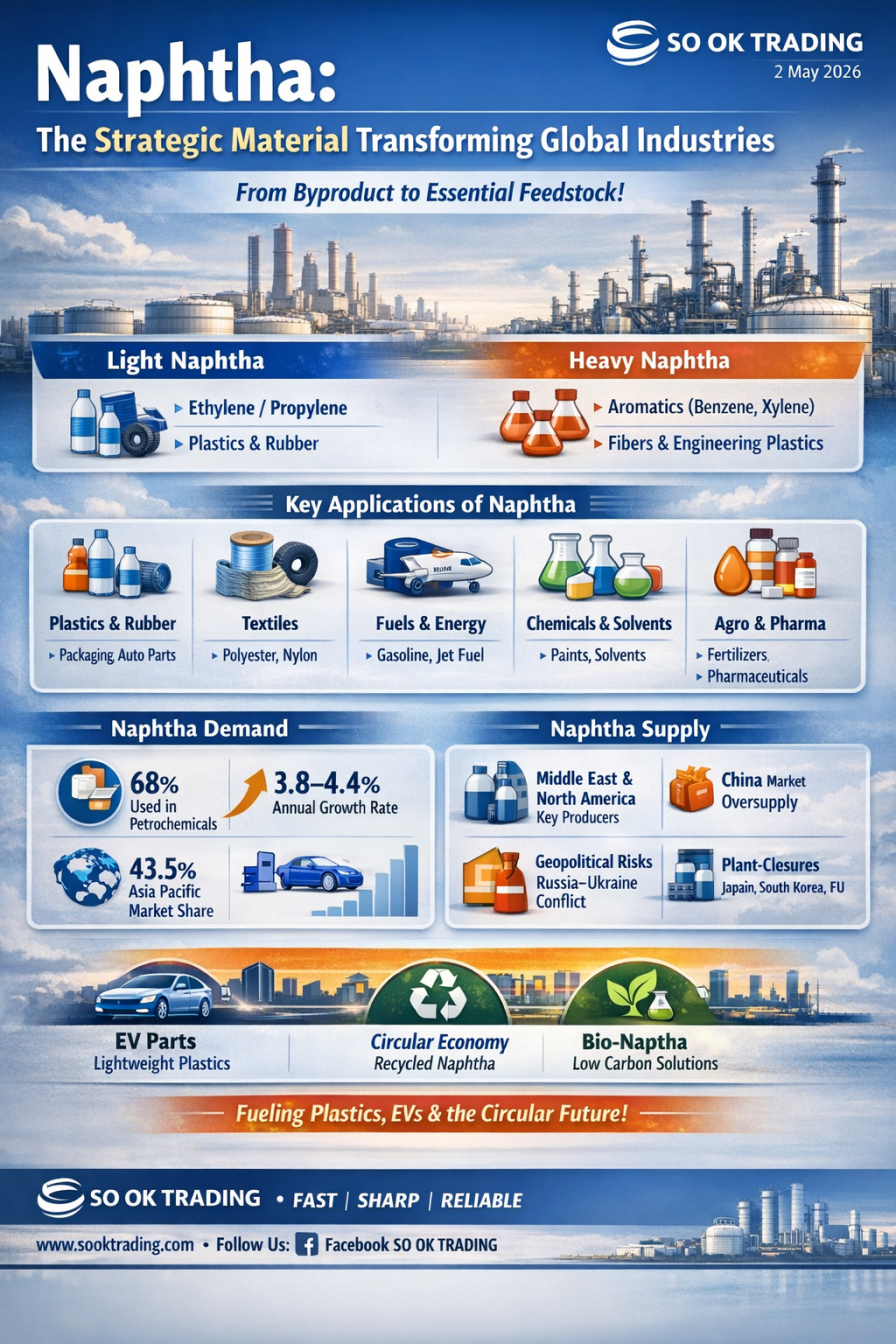
Naphtha is a liquid hydrocarbon product derived from crude oil refining. It is highly volatile, flammable, and contains 5–12 carbon atoms. Once considered a mere byproduct, today it plays a crucial role in petrochemicals, plastics, textiles, fuels, and the fast-growing electric vehicle (EV) industry.

 
Types of Naphtha
Light Naphtha: Boiling point 30–90°C, carbon number 5–6 → Produces ethylene and propylene → Packaging plastics, synthetic rubber
Heavy Naphtha: Boiling point 90–200°C, carbon number 6–12 → Produces aromatics (benzene, xylene) → Synthetic fibers, engineering plastics
 
Applications of Naphtha
Plastics & Synthetic Rubber: PE, PP → Plastic bags, PET bottles, food films, car bumpers, tires
Textiles & Fibers: Polyester, Nylon → Clothing, fishing nets, ropes
Fuels & Energy: Octane booster in gasoline, lighter fuel, aviation fuel
Industrial Chemicals: Solvents in paints, varnishes, adhesives, cleaning agents
Agriculture & Others: Ammonia production → Urea fertilizer, pharmaceutical and cosmetic ingredients
 
Demand
68% of global naphtha is consumed in petrochemicals
CAGR 3.8–4.4% growth projected until 2030
Asia-Pacific (China, India) holds 43.5% of global market share
Pressure: Low cracker margins, some plants switching to LPG
Support: Strong demand for food packaging, beverages, and electronics plastics
 
Supply
Major producers: Middle East, North America
China: Massive capacity expansion → Oversupply, price and spread pressure
Risks: Middle East conflicts, Russia–Ukraine war → Supply disruptions
Structural adjustments: Japan, South Korea, EU closing or downsizing old plants
 
Usage Trends (2025–2026)
Thailand: Market recovery driven by tourism and consumption, though household debt remains a drag → Demand from plastics and packaging
EV & Lightweighting: Engineering plastics from naphtha increasingly used in auto parts → bumpers, consoles, wire insulation
Circular Economy: Chemical recycling → Recycled naphtha with quality equal to virgin plastic
Bio-Naphtha: Producers blending bio-feedstock to reduce carbon footprint
 
Major Players in Thailand
PTT GC: Integrated production from naphtha to plastic resins
SCGC: Focus on circular naphtha and engineering plastics
IRPC: Specialty plastics for automotive and electronics
Thai Oil (TOP): Produces naphtha from crude refining for petrochemical plants
 
Market Battle: Naphtha vs Bioplastics
Price: Naphtha-based plastics remain cheaper (economies of scale)
Performance: Bioplastics still less durable
Adaptation: Producers blending bio-feedstock → Bio-Naphtha
 
Conclusion
✨ Naphtha is transforming from “fuel” into a “strategic material” driving the plastics and EV industries of the future. Demand is fueled by plastics and EVs, while supply faces pressure from China’s overcapacity and geopolitical risks.

 
SO OK TRADING — Your Trusted Business Partner FAST • SHARP • RELIABLE www.sooktrading.com | Facebook: SO OK TRADING

Related Content
Underground Superpower – Australia: Dissecting the Billion-Dollar Global Aluminum Supply Chain, from upstream mining to Thailand’s automotive industry!
Australia: The Underground Superpower Driving the Global Supply Chain Did you know? Behind the world’s heavy industries, electric vehicles (EVs), and the clean energy transition, there is one nation acting as the “backbone,” continuously supplying upstream raw materials. That nation is Australia. From the iron ore riches of Pilbara to becoming the world’s No.1 lithium producer, and now the rising hub of low‑carbon aluminium (Green Aluminium) highly sought after in European markets, Australia is no longer just a miner of raw resources. It is stepping up as a key player shaping global economic and geopolitical directions through its vast mineral wealth. From Pilbara’s iron ore powering global steelmaking to the Green Aluminium projects driving the metals revolution, Australia is transforming natural resources into engines of innovation and sustainability. In this article, SO OK TRADING takes you deep into Australia’s major mining regions, the industry giants leading the charge, and the booming economic indicators, while also highlighting the new role of Australia in the global aluminium supply chain — where Thailand plays a crucial part in automotive and electrical industries. Australia — From Minerals to Global Power. Every piece of metal that leaves Australia is not just raw material, but a “force of the future” driving the world forward with resilience and sustainability.
13 Jul 2026
“SO OK TRADING: Clean Energy for the Future — RDF3 & Wood Pellet | FAST • SHARP • RELIABLE Driving Sustainable Business Growth”
Clean Energy for a Sustainable Future In an era where the world is striving to reduce carbon emissions and maximize energy efficiency, SO OK TRADING is proud to be your trusted partner in clean energy. With our high-quality products — RDF3 (Refuse Derived Fuel 3) and Wood Pellet — we deliver biomass fuels that balance both environmental responsibility and economic value. We are committed to providing alternative energy solutions that lower production costs while creating long-term value for your business. Backed by a precise logistics system, we guarantee on-time delivery, consistent quality, and competitive pricing to ensure your operations run smoothly and efficiently. FAST | SHARP | RELIABLE — this is not just our motto, but the principle we live by, ensuring every client can rely on SO OK TRADING’s international standards.
15 Jul 2026
“Oil Shortage Crisis: Oil Prices Boil! Global Shock, Thailand Hit Hard — Oil as the Catalyst of the World Economy : Article by SO OK TRADING : April 6, 2026”
Global Oil Price Crisis: A Turning Point for the World and Thailand’s Economy On April 6, 2026, the world is facing the largest oil price crisis in years. Brent and WTI crude prices have surged to $110–114 per barrel, driven by escalating tensions in the Middle East and the closure of the Hormuz Strait — a vital route that carries over 20% of global energy shipments. The impact is spreading worldwide — from China, Japan, and South Korea to Thailand, where diesel prices have already exceeded 50 THB per liter and may reach 60 THB in April. This surge is pushing inflation higher and slowing economic growth. SO OK TRADING provides a comprehensive analysis of this crisis: the driving factors, its impact on Thailand’s economy, and the outlook for Q2 2026, helping businesses and entrepreneurs prepare for this major transformation in the global energy landscape. SO OK TRADING : FAST • SHARP • RELIABLE Your trusted business partner in every global market situation
6 Apr 2026
This website uses cookies for best user experience, to find out more you can go to our Privacy Policy and Cookies Policy
Powered By MakeWebEasy Logo MakeWebEasy