Share

Gold Soars, Silver Rises, Dollar Weakens: After Iran Fully Reopens the Strait of Hormuz, Easing Middle East War Concerns – April 18, 2026

Last updated: 18 Apr 2026
2940 Views

Gold and Silver Surge, Dollar Weakens”: After Iran Fully Reopens the Strait of Hormuz Following Israel–Lebanon Ceasefire — Article by SO OK TRADING | April 18, 2026

 
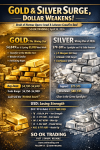
Gold – The Shining Star
Global gold spot prices have climbed above $4,849 per ounce, with over 80% of analysts bullish, expecting a test of $5,038 next week.

Key Drivers: Middle East ceasefire, weaker US dollar, and expectations of Fed easing.
Strategy:

Long-term buyers: Accumulate at $4,730–$4,690.
Short-term traders: Operate within $4,750–$4,980. Conclusion: Gold remains the “hottest asset” with strong potential to hit $5,000 soon.
 
Silver – Rising Star of 2026
Latest prices stand at $79–$81 per ounce. Despite a pullback from January’s record high of $121.64, silver continues to shine in 2026.

Key Drivers: Strong demand from EV and solar industries, six consecutive years of supply shortages.
Forecasts:

J.P. Morgan: Average $81 this year.
Citibank: Target $110 in H2.
LiteFinance: Year-end range $95–$105.
Technical Levels: Support $72–$75, Resistance $88–$95. Conclusion: Silver is firmly in the spotlight, driven by green industry demand and investor interest.
 
US Dollar – Showing Weakness
The US Dollar Index (DXY) has slipped to 99, signaling weakness as ceasefire agreements ease safe-haven demand.

Thai Baht: 32.12/USD, strengthening alongside gold.
Next Week’s Range: 31.60–32.60/USD.
Major Currency Moves (April 18, 2026):

Yen: 158.64/USD – stronger on safe-haven demand.
Euro: 1.177/USD – supported by European recovery.
Yuan: 6.817/USD – stable to slightly stronger.
Won: 1,467/USD – stronger on capital inflows.
Singapore Dollar: 1.270/USD – narrow range.
Pound: 1.352/USD – firm on UK labor market strength.
Aussie Dollar: 0.717/USD – boosted by commodity prices.
 
Investor Takeaways
Gold: Clear uptrend, potential to reach $5,000.
Silver: The rising star, powered by EV and solar demand.
Dollar: Weakening, making precious metals more attractive.
Marketing Narrative: “2026 is the Year of Gold and Silver” — a weaker dollar is pushing precious metals back into the spotlight as safe-haven assets.

 
SO OK TRADING Your Trusted Business Partner FAST • SHARP • RELIABLE www.sooktrading.com Facebook: SO OK TRADING

Related Content
 “Metal Power Transforming the World: Aluminum, Copper, Nickel & Rare Earths Igniting Innovation and Driving the EV Revolution” Article by SO OK TRADING · March 19, 2026
“The Metal and Rare Earths War: The Hidden Power Behind the EV Revolution” Electric vehicles (EVs) are not driven by electricity alone. They are powered by aluminum, copper, nickel, and rare earths — the economic metals that are becoming the beating heart of global EV innovation. The latest article from SO OK TRADING provides an in‑depth analysis: - How these fundamental metals shape EV batteries and electrical systems - How rare earths like Neodymium, Dysprosium, and Praseodymium enable high‑torque, compact motors - How global trends from 2025–2030 will reshape the use of metals and rare earths - How leading automakers — Tesla, BMW, Renault, Nissan, BYD, and Toyota — are innovating to reduce dependence on rare earths
19 Mar 2026
ALUMINUM PRICE TREND 2026
An analysis of the aluminum market in 2026 indicates a likely continued market deficit and upward price pressure, driven by constrained supply and resilient demand from green energy sectors. However, significant volatility is expected due to policy uncertainties and the potential for new Indonesian supply to eventually balance the market. Key Drivers and Projections for 2026 Supply Side Analysis Capacity Constraints: China's primary aluminum output is approaching its self-imposed 45 million-tonne capacity cap, limiting global supply growth. Power Challenges: Smelters outside of China face intense competition for power from energy-intensive sectors like AI data centers, which are willing to pay higher prices for long-term contracts. This has kept significant capacity offline in Europe and the US. Production Disruptions: Outages and potential shutdowns at existing smelters in Iceland and Mozambique further tighten the market. Scrap Supply Pressure: The EU's planned implementation of the Carbon Border Adjustment Mechanism (CBAM) and potential scrap export tariffs in spring 2026 are expected to impact global scrap flows, creating regional shortages and price volatility. New Capacity: Indonesia is a key source of new supply, with several projects in the pipeline. However, analysts suggest the pace of the ramp-up may be slower than expected due to infrastructure and policy challenges, meaning it is unlikely to fully offset near-term tightness. Demand Side Analysis Green Transition Demand: Demand from "green" sectors such as solar panels, new energy vehicles, and energy transition infrastructure remains strong, providing fundamental support for the market. Substitution Effect: Aluminum's wide price discount relative to copper has encouraged substitution in electrical applications, acting as a tailwind for demand and prices. Construction and Automotive: The construction and automotive industries continue to be major consumers, with growing demand for lightweight, low-carbon aluminum products. Price Forecasts and Volatility The market is expected to remain in a deficit in 2026, with estimates ranging from 200,000 to 600,000 tonnes. This structural tightness is leading most analysts to forecast sustained or rising prices. Bullish Views: Analysts at Bank of America project prices of $3,000/tonne as early as 2026. J.P. Morgan also expects prices to approach $3,000/tonne in Q1 2026. ING forecasts an average price of $2,900/tonne for the year. Bearish/Conservative Views: Goldman Sachs is an outlier, forecasting prices to decline to $2,350/tonne by Q4 2026, anticipating a market surplus later in the year. SMM forecasts a "high first, then lower" pattern, with prices finding equilibrium in the $2,700–$2,800/tonne range by year-end. Premiums: Regional premiums, particularly the US Midwest premium, are expected to remain high and volatile due to tariffs and regional supply dynamics, creating a disconnect from the LME benchmark price. In essence, 2026 is projected to be a year of high volatility where participants need to focus on scenario readiness rather than relying on a single price forecast, as geopolitical and energy policies significantly influence regional supply and costs
31 Dec 2025
Twin Storms Shaking the World: The Naphtha–Fertilizer Crisis — Turning Point into the High-Cost Era, Plastics & Food Prices Surge Worldwide Written by SO OK TRADING April 10, 2026
The Naphtha & Fertilizer Crisis: Two Storms Shaking the World & ASEAN In April 2026, the world faces a double shock — a severe shortage of Naphtha and chemical fertilizers triggered by the Hormuz Strait conflict. From skyrocketing plastic costs to soaring food prices, this crisis is reshaping global supply chains and pushing ASEAN into a new High-Cost Era. But amid disruption lies opportunity:
10 Apr 2026
This website uses cookies for best user experience, to find out more you can go to our Privacy Policy and Cookies Policy
Powered By MakeWebEasy Logo MakeWebEasy