Share

“Supply Shock Shakes the World: ADC12 & A6063 — Middle East Supply Vanishes, Premiums Surge, The Critical Variables of Global Industry”
Last updated: 21 Apr 2026
219 Views

 Aluminum Market Update – April 21, 2026
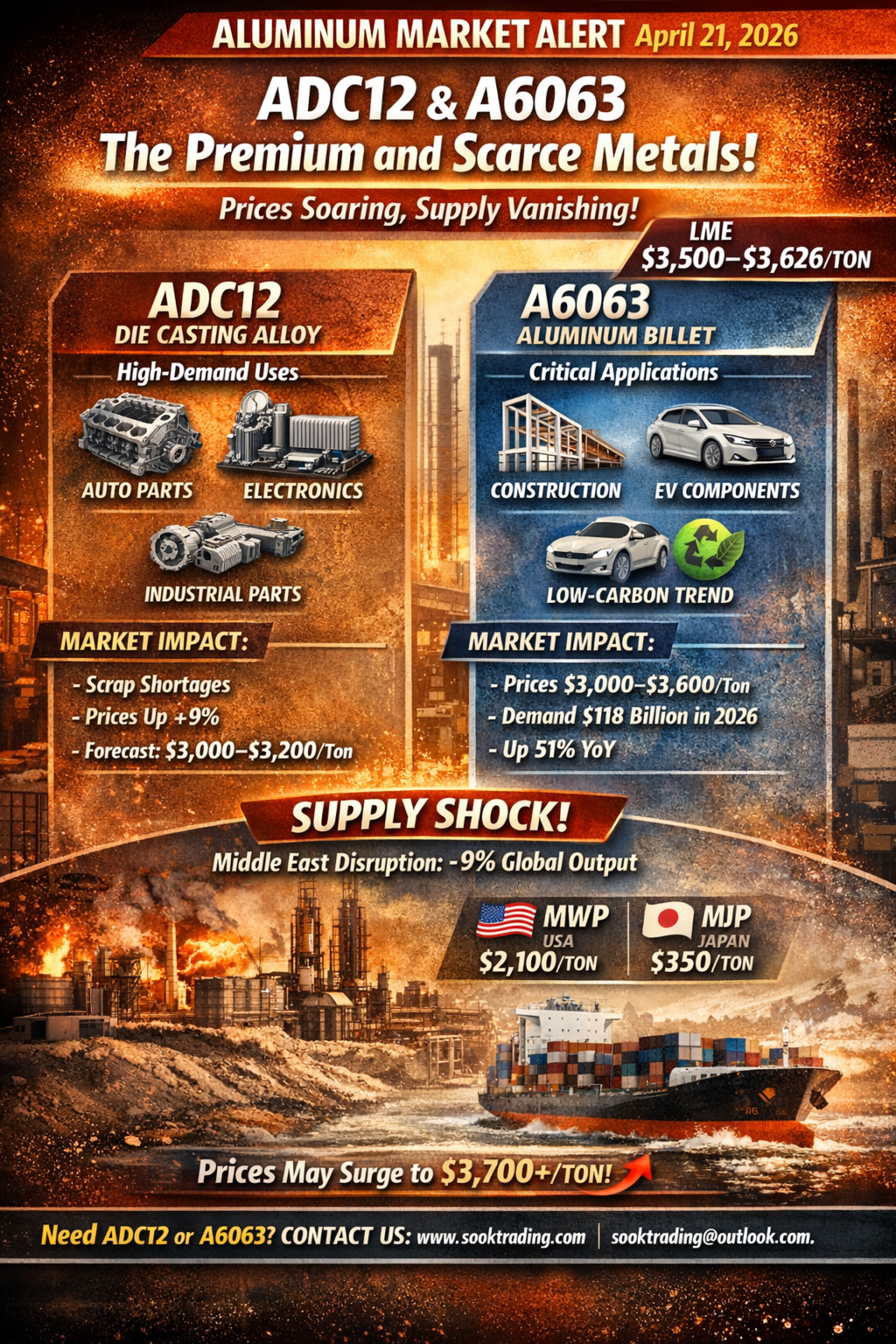
ADC12 & A6063: Scarce and Expensive Metals Driving Global Industry

The global aluminum market in April 2026 is under intense pressure. Rising energy costs, Middle East supply disruptions cutting nearly 8–9% of global output, and strict U.S. import tariffs have pushed LME prices to $3,500–$3,626/ton. Regional premiums have surged to record highs, making ADC12 and A6063 both scarce and costly.

 
ADC12 – Core Alloy for Die Casting
Applications:

Automotive: Engine blocks, gear cases, cylinder heads, EV lightweight components
Electronics: Heat sinks, casings, precision parts
Industrial: Corrosion-resistant machinery components
Market Situation:

Demand recovery in Asia and Thailand remains slow, but EV production is a strong driver
Prices in India have risen over 9% since early 2026
Scrap shortages continue to tighten supply and keep prices elevated
Outlook: Expected to remain volatile, with forecasts around $3,000–$3,200/ton this year

 
A6063 – Essential for Construction & EVs
Applications:

Construction/Architecture: Window and door frames, energy-efficient structures
EV Manufacturing: Extrusion profiles for lightweight frames
Electrical/Industrial: Tubes, heat sinks, conductive structures
Market Situation:

Prices at a 4-year high ($3,000–$3,600/ton, +51% YoY)
Global demand projected to reach $118 billion in 2026, growing 7–8% annually
Europe’s CBAM policy boosts demand for Low-Carbon Billet, favoring recycled and clean-energy aluminum
 
Premiums & Price Direction
Midwest Premium (MWP): Surpassed $2,100/ton, an all-time high, driven by 50% import tariffs and domestic shortages
Main Japanese Port (MJP): Reached $350–353/ton, the highest in 11 years. Could climb to $400–500/ton in Q3 if Middle East tensions persist
Large price gaps are pulling supply toward the U.S. and Europe, tightening Asian markets further
 
Middle East Supply Shock
Smelters in the UAE, Bahrain, and Qatar have declared Force Majeure after attacks, cutting global production by nearly 9%. Japan, reliant on Middle Eastern imports for over 70% of its aluminum, is hit hardest. Prices may test $3,700–$3,800/ton if the conflict continues.

 
Strategic Takeaways
ADC12: Secure recycled supply chains to reduce costs and mitigate risks
A6063: Leverage the Low-Carbon Billet trend to capture European export opportunities
Premiums: Asian buyers must monitor arbitrage flows draining supply to the U.S.
Supply Shock: Companies with old stock hold a strong advantage in today’s “scarce and expensive” market
 
For inquiries on ALUMINUM INGOT ADC12 and ALUMINUM BILLET A6063, please contact: www.sooktrading.com sooktrading@outlook.com

SO OK TRADING — FAST • SHARP • RELIABLE


Related Content
ALUMINUM PRICE TREND 2026
An analysis of the aluminum market in 2026 indicates a likely continued market deficit and upward price pressure, driven by constrained supply and resilient demand from green energy sectors. However, significant volatility is expected due to policy uncertainties and the potential for new Indonesian supply to eventually balance the market. Key Drivers and Projections for 2026 Supply Side Analysis Capacity Constraints: China's primary aluminum output is approaching its self-imposed 45 million-tonne capacity cap, limiting global supply growth. Power Challenges: Smelters outside of China face intense competition for power from energy-intensive sectors like AI data centers, which are willing to pay higher prices for long-term contracts. This has kept significant capacity offline in Europe and the US. Production Disruptions: Outages and potential shutdowns at existing smelters in Iceland and Mozambique further tighten the market. Scrap Supply Pressure: The EU's planned implementation of the Carbon Border Adjustment Mechanism (CBAM) and potential scrap export tariffs in spring 2026 are expected to impact global scrap flows, creating regional shortages and price volatility. New Capacity: Indonesia is a key source of new supply, with several projects in the pipeline. However, analysts suggest the pace of the ramp-up may be slower than expected due to infrastructure and policy challenges, meaning it is unlikely to fully offset near-term tightness. Demand Side Analysis Green Transition Demand: Demand from "green" sectors such as solar panels, new energy vehicles, and energy transition infrastructure remains strong, providing fundamental support for the market. Substitution Effect: Aluminum's wide price discount relative to copper has encouraged substitution in electrical applications, acting as a tailwind for demand and prices. Construction and Automotive: The construction and automotive industries continue to be major consumers, with growing demand for lightweight, low-carbon aluminum products. Price Forecasts and Volatility The market is expected to remain in a deficit in 2026, with estimates ranging from 200,000 to 600,000 tonnes. This structural tightness is leading most analysts to forecast sustained or rising prices. Bullish Views: Analysts at Bank of America project prices of $3,000/tonne as early as 2026. J.P. Morgan also expects prices to approach $3,000/tonne in Q1 2026. ING forecasts an average price of $2,900/tonne for the year. Bearish/Conservative Views: Goldman Sachs is an outlier, forecasting prices to decline to $2,350/tonne by Q4 2026, anticipating a market surplus later in the year. SMM forecasts a "high first, then lower" pattern, with prices finding equilibrium in the $2,700–$2,800/tonne range by year-end. Premiums: Regional premiums, particularly the US Midwest premium, are expected to remain high and volatile due to tariffs and regional supply dynamics, creating a disconnect from the LME benchmark price. In essence, 2026 is projected to be a year of high volatility where participants need to focus on scenario readiness rather than relying on a single price forecast, as geopolitical and energy policies significantly influence regional supply and costs
31 Dec 2025
This website uses cookies for best user experience, to find out more you can go to our Privacy Policy and Cookies Policy
Powered By MakeWebEasy Logo MakeWebEasy