Share

Global Lead Price Outlook 2026: Trends and Industrial Insights
Last updated: 11 Jan 2026
11363 Views

Here’s the full English version of your content, polished into a professional business style suitable for reports, websites, or client presentations:


Lead (Pb) Price Situation in the LME Market and Industrial Applications

Latest Price Overview

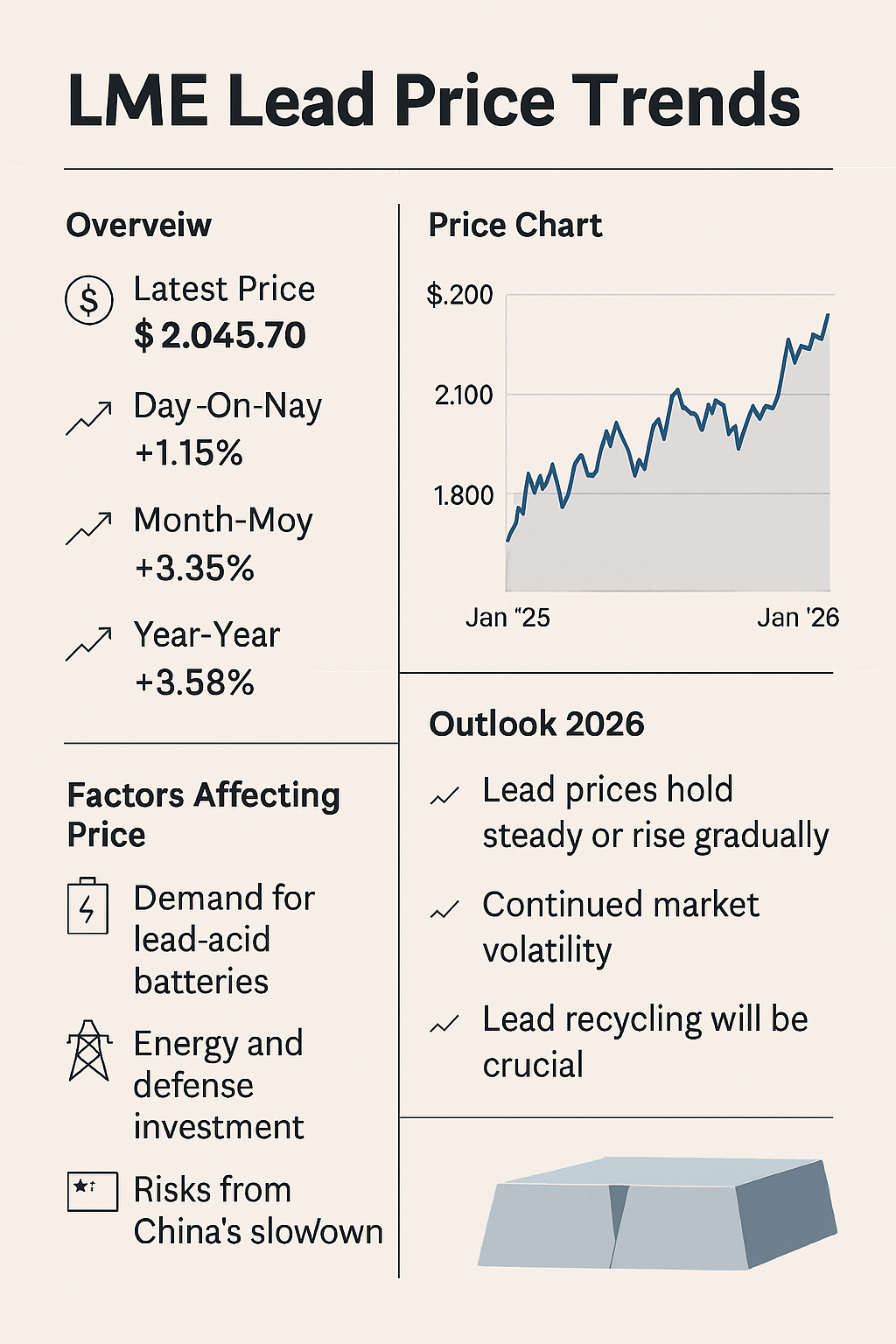
Latest Price (January 9, 2026): 2,045.70 USD/MT
Daily Change: +1.15% (vs. January 8, 2026)
Monthly Change: +3.35% (vs. December 2025)
Yearly Change: +3.58% (vs. 2025 average of 1,970 USD/MT)
➡️ Lead prices have rebounded from the 1,950–1,970 USD/MT range to above 2,040 USD/MT in early 2026, reflecting a gradual recovery in the base metals market.


January 2026 Price Forecast

Floor: 2,020 USD/MT
Mid-range: 2,060 USD/MT
Ceiling: 2,150 USD/MT
➡️ Prices in January are likely to shift upward, with a possible trading range of 2,050–2,080 USD/MT.

 
2026 Annual Price Forecast

Floor: ~2,000 USD/MT
Mid-range: 2,050–2,100 USD/MT
Ceiling: 2,200–2,250 USD/MT
➡️ Lead prices in 2026 are expected to rise by 5–10%, though not as sharply as copper or aluminum.

 
⚙️ Key Factors Influencing Prices

Lead-acid battery demand: Automotive and UPS systems remain the primary drivers.
Energy and defense investment: Strong demand from electricity, AI, and defense-related projects.
China’s economy: Slowing growth may dampen demand, but India and the Middle East are expected to offset with rising consumption.
Environmental regulations: Stricter controls on production and recycling → higher costs and limited supply.
 

Industrial Applications of Lead

Lead Ingots (Pure Lead):
Used in batteries, chemicals, construction materials, and electronics.
Remelted Lead Blocks (Recycled Lead):
Produced from scrap lead and used batteries → cost-effective, environmentally friendly, and stabilizes supply.
 

✅ Recommendations for Industry

Lead prices are expected to rise moderately, less volatile than other non-ferrous metals.
Companies using Lead Ingots or Remelted Lead Blocks should:
Closely monitor raw material costs.
Secure inventory to mitigate risks of shortages or price swings.
Diversify sourcing and increase recycled lead usage to reduce exposure to global market volatility.
✨ Recycling will be a key factor in stabilizing the lead industry in 2026, supporting both cost efficiency and sustainability.
 

SOOK TRADING – Specialist in Lead and Industrial Metals

Strengths of SOOK TRADING

Global market expertise: Continuous analysis of LME lead prices and other non-ferrous metals.
Diverse product portfolio:
Lead Ingots (Pure Lead) – for batteries, chemicals, power, and electronics.
Remelted Lead Blocks (Recycled Lead) – for cost reduction and sustainable production.
International standards: Products tested and certified to meet global quality benchmarks.
Multilingual communication: Serving clients in Thai, Chinese, Japanese, Korean, and English → bridging business gaps and building trust.
 

Why Choose SOOK TRADING

Competitive pricing: Based on LME benchmarks, tailored to client needs.
Stable supply: Offering both virgin and recycled materials → reducing risks from market volatility.
Comprehensive services: From consultation and raw material sourcing to international export.
Credibility: Trusted by partners across multiple countries.
 

Offer for Industrial Clients

If you are in battery, energy, electronics, construction, or defense industries,
SOOK TRADING is your trusted partner for lead and industrial metals.

Contact SOOK TRADING today for special pricing and strategic consultation on stable and sustainable raw material sourcing.


SOOK TRADING – Confidence in Lead and Industrial Metal Quality

We supply both Lead Ingots and Remelted Lead Blocks with international standards, fair pricing, and professional service, trusted by clients worldwide.


Related Content
ALUMINUM PRICE TREND 2026
An analysis of the aluminum market in 2026 indicates a likely continued market deficit and upward price pressure, driven by constrained supply and resilient demand from green energy sectors. However, significant volatility is expected due to policy uncertainties and the potential for new Indonesian supply to eventually balance the market. Key Drivers and Projections for 2026 Supply Side Analysis Capacity Constraints: China's primary aluminum output is approaching its self-imposed 45 million-tonne capacity cap, limiting global supply growth. Power Challenges: Smelters outside of China face intense competition for power from energy-intensive sectors like AI data centers, which are willing to pay higher prices for long-term contracts. This has kept significant capacity offline in Europe and the US. Production Disruptions: Outages and potential shutdowns at existing smelters in Iceland and Mozambique further tighten the market. Scrap Supply Pressure: The EU's planned implementation of the Carbon Border Adjustment Mechanism (CBAM) and potential scrap export tariffs in spring 2026 are expected to impact global scrap flows, creating regional shortages and price volatility. New Capacity: Indonesia is a key source of new supply, with several projects in the pipeline. However, analysts suggest the pace of the ramp-up may be slower than expected due to infrastructure and policy challenges, meaning it is unlikely to fully offset near-term tightness. Demand Side Analysis Green Transition Demand: Demand from "green" sectors such as solar panels, new energy vehicles, and energy transition infrastructure remains strong, providing fundamental support for the market. Substitution Effect: Aluminum's wide price discount relative to copper has encouraged substitution in electrical applications, acting as a tailwind for demand and prices. Construction and Automotive: The construction and automotive industries continue to be major consumers, with growing demand for lightweight, low-carbon aluminum products. Price Forecasts and Volatility The market is expected to remain in a deficit in 2026, with estimates ranging from 200,000 to 600,000 tonnes. This structural tightness is leading most analysts to forecast sustained or rising prices. Bullish Views: Analysts at Bank of America project prices of $3,000/tonne as early as 2026. J.P. Morgan also expects prices to approach $3,000/tonne in Q1 2026. ING forecasts an average price of $2,900/tonne for the year. Bearish/Conservative Views: Goldman Sachs is an outlier, forecasting prices to decline to $2,350/tonne by Q4 2026, anticipating a market surplus later in the year. SMM forecasts a "high first, then lower" pattern, with prices finding equilibrium in the $2,700–$2,800/tonne range by year-end. Premiums: Regional premiums, particularly the US Midwest premium, are expected to remain high and volatile due to tariffs and regional supply dynamics, creating a disconnect from the LME benchmark price. In essence, 2026 is projected to be a year of high volatility where participants need to focus on scenario readiness rather than relying on a single price forecast, as geopolitical and energy policies significantly influence regional supply and costs
31 Dec 2025
“Global Aluminum Market After the Peace Accord – A Turning Point Toward New Balance in Price and Supply”
Global Aluminum Market After the Peace Accord – In‑Depth Analysis Price and Supply Outlook as of June 20, 2026 By SO OK TRADING Following the breakthrough peace agreement between the U.S. and Iran and the reopening of the Hormuz Strait, the global metals market reacted immediately. Aluminum prices, which had surged past $3,700/MT, dropped sharply to $3,400/MT within a week — a classic “knee‑jerk drop” reflecting the disappearance of the geopolitical risk premium. But this is not a permanent downturn. The market is entering a phase of “adjustment toward a new balance”, with short‑term pressures and long‑term drivers coexisting.
20 Jun 2026
“Gold Surges into the Supercycle: A Golden Opportunity to Accumulate — Catch the Buy on Dip Wave Before Breaking $5,000 in the Final Quarter of 2026”
“Gold Surges into the Supercycle: Buy on Dip Before Breaking $5,000” SO OK TRADING | August 28, 2026 The global gold market (XAU/USD) is now entering a critical turning point of the “Gold Supercycle.” After reaching a three‑month high of $4,690 per ounce, prices have slightly corrected and are consolidating within the $4,580–$4,600 range. Although inflationary pressure and dollar strength have eased, the overall market structure remains firmly bullish. Key macro drivers—including U.S. stimulus measures, geopolitical tensions, and central banks’ continued accumulation of gold reserves—are providing strong support for the uptrend. September–October 2026 is widely seen as a “golden opportunity” for investors to gradually accumulate during this consolidation phase, before prices surge toward the year‑end target of $4,900–$5,100 per ounce. ✨ SO OK TRADING FAST • SHARP • RELIABLE Your Trusted Business Partner
28 Aug 2026
This website uses cookies for best user experience, to find out more you can go to our Privacy Policy and Cookies Policy
Powered By MakeWebEasy Logo MakeWebEasy