Share

“Global Aluminum Shock 2026: Supply Shock Shakes Thailand’s Economy – High for Longer with Recycling as the New Hero” BY SO OK TRADING April 27, 2026
Last updated: 27 Apr 2026
117 Views

Global Aluminum Crisis 2026: When Supply Shock Shakes the World and Thailand

Imagine the world walking on a grand stage called the “global metals market.” Suddenly, the spotlight goes out—because giant smelters in Bahrain and the UAE are attacked. This Supply Shock is the opening act that forces the entire world to pay attention.

 
Ignition of the Crisis
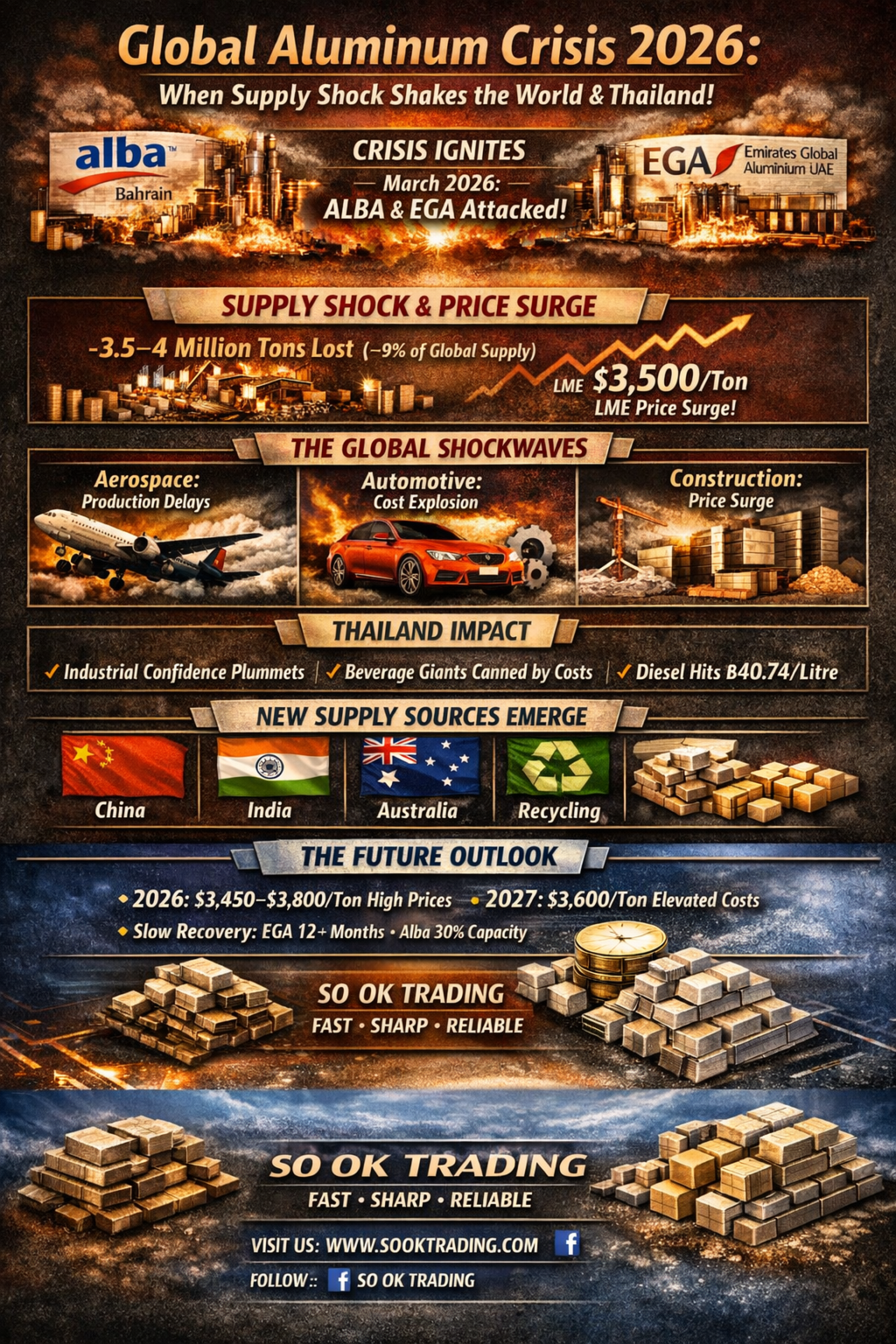
In mid-March 2026, Alba (Aluminium Bahrain) and EGA (Emirates Global Aluminium) were attacked, wiping out 3.5–4 million tons of production capacity—about 5–6% of global demand. The Strait of Hormuz was shut down like an iron curtain blocking global trade.

Prices surged immediately: LME jumped 6% to $3,492–3,500 per ton
Premium-grade shortage: Aerospace and automotive industries requiring high-quality aluminum faced severe disruption
 
Shockwaves Across the Globe
Aerospace: Aircraft production lines risk halting due to the loss of high-grade metal
Automotive: Component costs soared, forcing some companies to delay new model launches
Construction: Contractors locked into old prices faced instant losses
 
Thailand in the Battlefield
Thailand was not spared from the tremors:

Industrial Confidence Index plunged to 88.6
Beverage cans: CBG and OSP pressured by packaging costs
Construction materials: Aluminum section prices rose 15–30%
Transportation costs: Diesel prices spiked to 40.74 THB/liter (+36%)
 
When Middle Eastern Supply Collapses, the World Seeks Alternatives
China: Export up +12.8%, cheaper than global market
India: Expanding production capacity
Australia: Key alumina supplier
Canada: Low-carbon aluminum powered by hydroelectricity
ASEAN: Vietnam, Indonesia, Malaysia expanding production bases
Recycling: Scrap aluminum uses only 5% of the energy required for new production
 
The Uncertain Future of Aluminum
2026: Prices expected at $3,450–3,800 per ton
2027: Stabilization begins, but average remains high at $3,600 per ton
Recovery is slow: EGA requires at least 12 months for repairs, while Alba operates at only 30% capacity. Market structure shifts: China and India may become new supply centers, while recycling emerges as the “hero” of the industry.

 
Conclusion: High for Longer
This is not a temporary crisis. Supply will not return to normal until at least 2027. Businesses must adapt quickly:

Secure alternative import sources
Invest in circular economy and recycling
Manage inventories tightly to withstand prolonged high prices
✨ Ultimately, those who adapt fastest will be the winners in this global economic game.

 
Notes
EGA (Emirates Global Aluminium): The largest aluminum producer in the UAE, a major player in the premium global market
Alba (Aluminium Bahrain): One of the world’s largest aluminum smelters
Together, they account for about 9% of global production, or roughly 7 million tons annually. The attacks therefore shook not just the region but the entire global supply chain.

 
SO OK TRADING: Your Business Partner SO OK TRADING: FAST SHARP RELIABLE Visit us: WWW.SOOKTRADING.COM Facebook: SO OK TRADING


Related Content
Aluminum Scrap, Copper Scrap Usage and it  background
Aluminum and copper scrap are vital for new products, with aluminum used in lightweight automotive/aerospace parts, packaging (cans), and construction (siding, windows) for its strength-to-weight ratio, while copper excels in electrical wiring, plumbing, and electronics due to its superior conductivity and corrosion resistance, with both metals significantly reducing energy and resources compared to virgin material. Aluminum Scrap Usage Transportation: Car parts, airplane components, trains (reducing weight for fuel efficiency). Packaging: Beverage cans, foil, food containers (lightweight, non-toxic). Construction: Window frames, roofing, siding, structural elements. Electronics: Casings, heat sinks. Copper Scrap Usage Electrical: Wiring (household, industrial), motors, generators, transformers (best conductor). Plumbing: Pipes, fittings (corrosion-resistant). Electronics & Renewables: Circuit boards, solar panels, wind turbines, EVs (high demand). Industrial: Machinery, heat exchangers, decorative items (as brass). Key Benefits of Recycling Both Energy Savings: Significantly less energy needed than mining new ore. Resource Conservation: Reduces mining impact and conserves natural resources like bauxite. Circular Economy: Creates a sustainable loop, especially crucial for growing green tech demand.
25 Dec 2025
เกร็ดความรู้ การใช้งาน ALUMINUM INGOT (อลูมิเนียม INGOT) P1020 A7
Aluminum Ingot P1020 , A7 อลูมิเนียมเป็นหนึ่งในรูปแบบทั่วไปของโลหะผสมอลูมิเนียมที่ใช้ในอุตสาหกรรมสมัยใหม่ การผสมผสานคุณสมบัติที่เป็นเอกลักษณ์ของอลูมิเนียมทำให้เป็นวัสดุที่มีคุณค่าสำหรับการใช้งานที่หลากหลาย รวมถึงการก่อสร้าง การบินและอวกาศ การขนส่ง และสินค้าอุปโภคบริโภค ในบทความนี้ เราจะพิจารณากระบวนการผลิตแท่งอลูมิเนียมอย่างละเอียดมากยิ่งขึ้น กระบวนการผลิตแท่งอลูมิเนียมเริ่มต้นด้วยการสกัดแร่บอกไซต์ แร่นี้จะถูกบดเป็นผงละเอียดก่อนแล้วจึงผสมกับโซเดียมไฮดรอกไซด์ในกระบวนการที่เรียกว่ากระบวนการไบเออร์ สารละลายที่ได้จะถูกบำบัดด้วยความร้อนและความดันเพื่อสร้างอะลูมิเนียมไฮดรอกไซด์ ซึ่งจะถูกทำให้แห้งเพื่อผลิตผงอะลูมินาจากนั้นนำผงอลูมินามาผสมกับไครโอไลต์ ซึ่งเป็นแร่ธาตุหายากที่ทำหน้าที่เป็นฟลักซ์ ส่วนผสมจะถูกวางในเซลล์อิเล็กโทรไลต์ขนาดใหญ่ที่เต็มไปด้วยเกลือหลอมเหลว และกระแสไฟฟ้าจะถูกส่งผ่านเซลล์ กระบวนการนี้เรียกว่ากระบวนการ Hall-Héroult ทำให้อะลูมิเนียมออกไซด์แยกตัวออกจากออกซิเจน เหลือแต่อโลหะอะลูมิเนียมบริสุทธิ์ จากนั้นโลหะอลูมิเนียมจะถูกเทลงในแม่พิมพ์เพื่อสร้างรูปทรงลิ่ม แม่พิมพ์มักทำจากเหล็กหรือกราไฟต์และมีหลายขนาดและรูปร่าง แท่งอโลหะจะถูกทำให้เย็นและแข็งตัว จากนั้นนำออกจากแม่พิมพ์และตัดตามความยาว (Aluminum Slab) ก่อนที่แท่งอโลหะจะสามารถนำมาใช้ในอุตสาหกรรมได้ จะต้องผ่านกระบวนการต่อไป โดยทั่วไปแล้วจะละลายและหล่อเป็นรูปแบบเฉพาะสำหรับการใช้งานเฉพาะ ซึ่งอาจเกี่ยวข้องกับการผสมอลูมิเนียมกับอโลหะอื่นเพื่อให้ได้คุณสมบัติเฉพาะ เช่น ความแข็งแรง ความทนทานต่อการกัดกร่อน หรือการทนความร้อน แท่งอะลูมิเนียมมีขนาดตั้งแต่ไม่กี่ปอนด์ไปจนถึงหลายตัน ขึ้นอยู่กับการใช้งาน โดยปกติแล้วจะจัดส่งในปริมาณมากไปยังผู้ผลิต ซึ่งจะนำไปแปรรูปเป็นผลิตภัณฑ์ที่หลากหลายต่อไป (Aluminum Ingot, Aluminum Billet, Aluminum Slab) ETC. โดยสรุปแล้ว การผลิตแท่งอะลูมิเนียมเป็นกระบวนการที่ซับซ้อนซึ่งเกี่ยวข้องกับการเปลี่ยนแปลงทางเคมีและกายภาพหลายขั้นตอน จำเป็นต้องมีความเข้าใจอย่างลึกซึ้งเกี่ยวกับวัสดุศาสตร์และหลักการทางวิศวกรรม เช่นเดียวกับแรงงานที่มีทักษะในการใช้งานอุปกรณ์ที่ซับซ้อนที่ใช้ในกระบวนการ แท่งอลูมิเนียมมีบทบาทสำคัญในอุตสาหกรรมสมัยใหม่ และความสามารถรอบด้านและความน่าเชื่อถือทำให้เป็นวัสดุที่ขาดไม่ได้สำหรับการใช้งานที่หลากหลาย ตั้งแต่เครื่องครัว ไปจนถึง เครื่องบิน และ ชิ้นส่วนในยานอวกาศ
28 Nov 2025
This website uses cookies for best user experience, to find out more you can go to our Privacy Policy and Cookies Policy
Powered By MakeWebEasy Logo MakeWebEasy