Share

“Global Aluminum Shock 2026: Supply Shock Shakes Thailand’s Economy – High for Longer with Recycling as the New Hero” BY SO OK TRADING April 27, 2026
Last updated: 27 Apr 2026
1746 Views

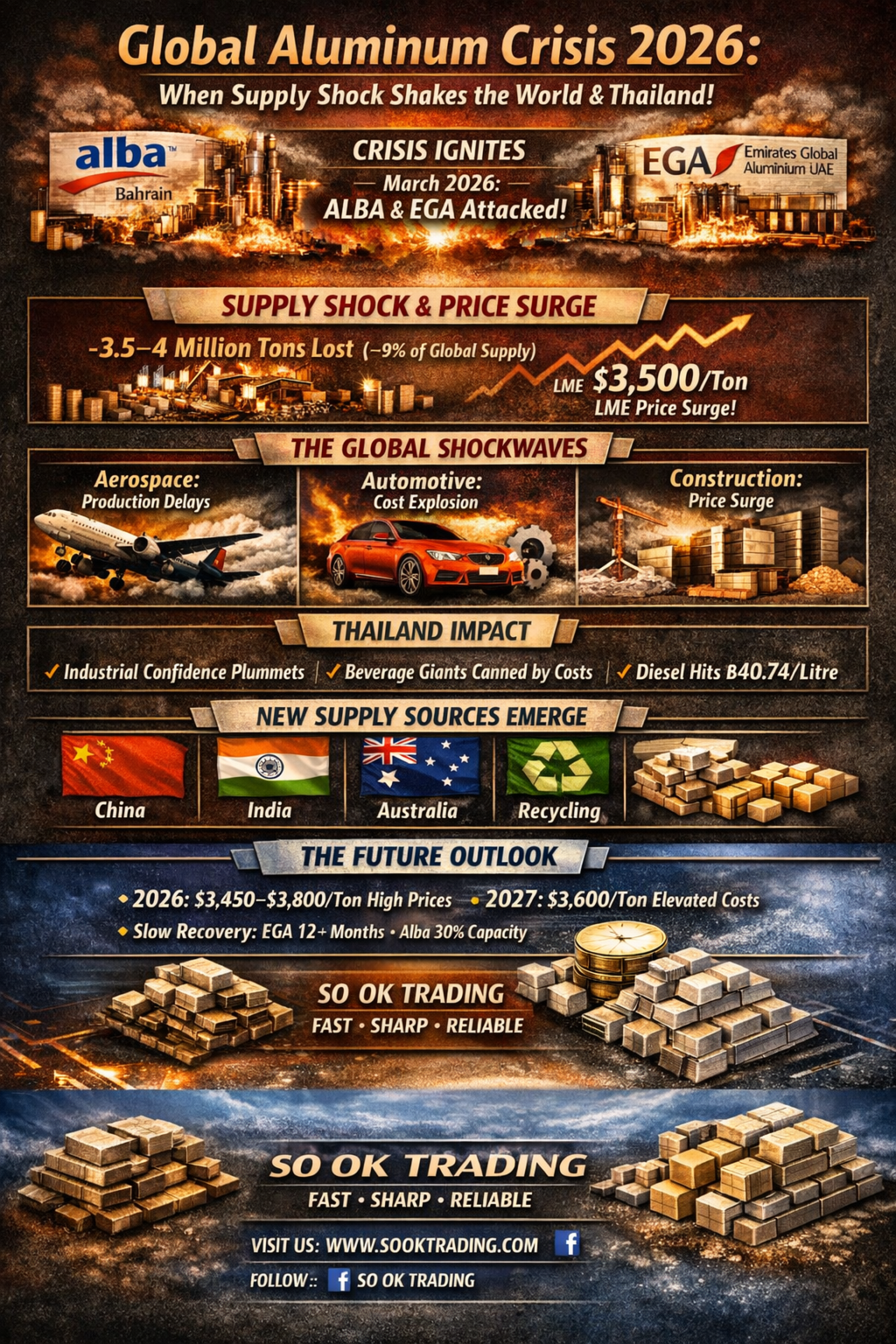
Global Aluminum Crisis 2026: When Supply Shock Shakes the World and Thailand

Imagine the world walking on a grand stage called the “global metals market.” Suddenly, the spotlight goes out—because giant smelters in Bahrain and the UAE are attacked. This Supply Shock is the opening act that forces the entire world to pay attention.

 
Ignition of the Crisis
In mid-March 2026, Alba (Aluminium Bahrain) and EGA (Emirates Global Aluminium) were attacked, wiping out 3.5–4 million tons of production capacity—about 5–6% of global demand. The Strait of Hormuz was shut down like an iron curtain blocking global trade.

Prices surged immediately: LME jumped 6% to $3,492–3,500 per ton
Premium-grade shortage: Aerospace and automotive industries requiring high-quality aluminum faced severe disruption
 
Shockwaves Across the Globe
Aerospace: Aircraft production lines risk halting due to the loss of high-grade metal
Automotive: Component costs soared, forcing some companies to delay new model launches
Construction: Contractors locked into old prices faced instant losses
 
Thailand in the Battlefield
Thailand was not spared from the tremors:

Industrial Confidence Index plunged to 88.6
Beverage cans: CBG and OSP pressured by packaging costs
Construction materials: Aluminum section prices rose 15–30%
Transportation costs: Diesel prices spiked to 40.74 THB/liter (+36%)
 
When Middle Eastern Supply Collapses, the World Seeks Alternatives
China: Export up +12.8%, cheaper than global market
India: Expanding production capacity
Australia: Key alumina supplier
Canada: Low-carbon aluminum powered by hydroelectricity
ASEAN: Vietnam, Indonesia, Malaysia expanding production bases
Recycling: Scrap aluminum uses only 5% of the energy required for new production
 
The Uncertain Future of Aluminum
2026: Prices expected at $3,450–3,800 per ton
2027: Stabilization begins, but average remains high at $3,600 per ton
Recovery is slow: EGA requires at least 12 months for repairs, while Alba operates at only 30% capacity. Market structure shifts: China and India may become new supply centers, while recycling emerges as the “hero” of the industry.

 
Conclusion: High for Longer
This is not a temporary crisis. Supply will not return to normal until at least 2027. Businesses must adapt quickly:

Secure alternative import sources
Invest in circular economy and recycling
Manage inventories tightly to withstand prolonged high prices
✨ Ultimately, those who adapt fastest will be the winners in this global economic game.

 
Notes
EGA (Emirates Global Aluminium): The largest aluminum producer in the UAE, a major player in the premium global market
Alba (Aluminium Bahrain): One of the world’s largest aluminum smelters
Together, they account for about 9% of global production, or roughly 7 million tons annually. The attacks therefore shook not just the region but the entire global supply chain.

 
SO OK TRADING: Your Business Partner SO OK TRADING: FAST SHARP RELIABLE Visit us: WWW.SOOKTRADING.COM Facebook: SO OK TRADING

Related Content
Deep Dive into Global Trends after the Fed’s Statement: When Gold Soars and the Thai Baht Hits Its Strongest Level in a Year January 29, 2026 — By SO OK TRADING
“When the Fed chooses to ‘hold,’ but the market doesn’t hold back! Here’s the full snapshot of asset prices after the latest rate decision. If you’re holding gold or planning to exchange yen/yuan, this post is a must-read.” Following last night’s Fed announcement, where will gold, silver, and the Thai baht head next? Check the latest updates and get ready to navigate the volatility.
29 Jan 2026
“Rare Earth Recycling: Transforming Clean Energy Industry — Neodymium & Dysprosium, Keys to the Future”
♻️ Rare Earth Recycling: Neodymium & Dysprosium — Industry of the Future SO OK TRADING | July 20, 2026 As the world transitions toward clean energy and electrification, Neodymium (Nd) and Dysprosium (Dy) have become central to modern industry. These rare earth elements are widely used in electric vehicle (EV) motors, wind turbines, hard disk drives, speakers, and high‑performance headphones. Recycling rare earths not only reduces mining and electronic waste, but also saves 60–80% more energy compared to new production while ensuring long‑term stability of the global supply chain. Cutting‑edge recycling technologies such as Hydrometallurgy, Pyrometallurgy, and HPMS (Hydrogen Processing of Magnet Scrap) are transforming resource management into cleaner and more efficient systems. The industry is projected to grow at an average rate of 10–15% annually between 2026 and 2035. Thailand is also moving decisively into this field. Research initiatives from the Department of Primary Industries and Mines (DPIM), Suranaree University of Technology, and Chulalongkorn University are advancing rare earth recovery. In addition, collaboration with Japanese private companies is driving the development of EV motor magnet recycling plants, while the Chatree REE Mine is expected to supply up to 5% of global demand by 2026. The rare earth recycling industry is no longer just an “environmental option” — it has become a strategic foundation for economic resilience and clean energy security, shaping the future of both the world and Thailand in the coming decade. SO OK TRADING FAST • SHARP • RELIABLE
20 Jul 2026
“2026 Global & Thai Economy Outlook: AI, Clean Energy, and the Rise of Strategic Commodities” Article by SO OK TRADING
2026 is shaping up to be a pivotal year for both the global and Thai economies. The world is being driven by Artificial Intelligence (AI) and Clean Energy, alongside the rise of strategic commodities such as gold, silver, copper, and aluminum. While global growth continues, risks from trade wars and geopolitical tensions remain strong headwinds. Thailand, meanwhile, is still in a transition phase, where attracting more Foreign Direct Investment (FDI) and boosting Research & Development (R&D) are critical to avoid falling behind. In this article, SO OK TRADING explores the 2026 outlook for the global and Thai economies, highlighting new opportunities across rising industries — from digital technology and integrated healthcare to clean energy and niche lifestyle markets that are expanding rapidly. 2026 marks a pivotal transition for the global and Thai economies. Driven by Artificial Intelligence (AI) and Clean Energy, the world is witnessing the rise of strategic commodities — gold, silver, copper, and aluminum. While global growth continues, Thailand remains in transition, seeking FDI and stronger R&D to capture opportunities in medical hub, green manufacturing, and lifestyle markets.
17 Feb 2026
This website uses cookies for best user experience, to find out more you can go to our Privacy Policy and Cookies Policy
Powered By MakeWebEasy Logo MakeWebEasy