“Aluminum Scrap: Tangible Energy, Transforming Green Industry, and the Way Forward to Net Zero” Knowledge of Aluminum Recycling & Future Directions SO OK TRADING | 8 MAY 2026
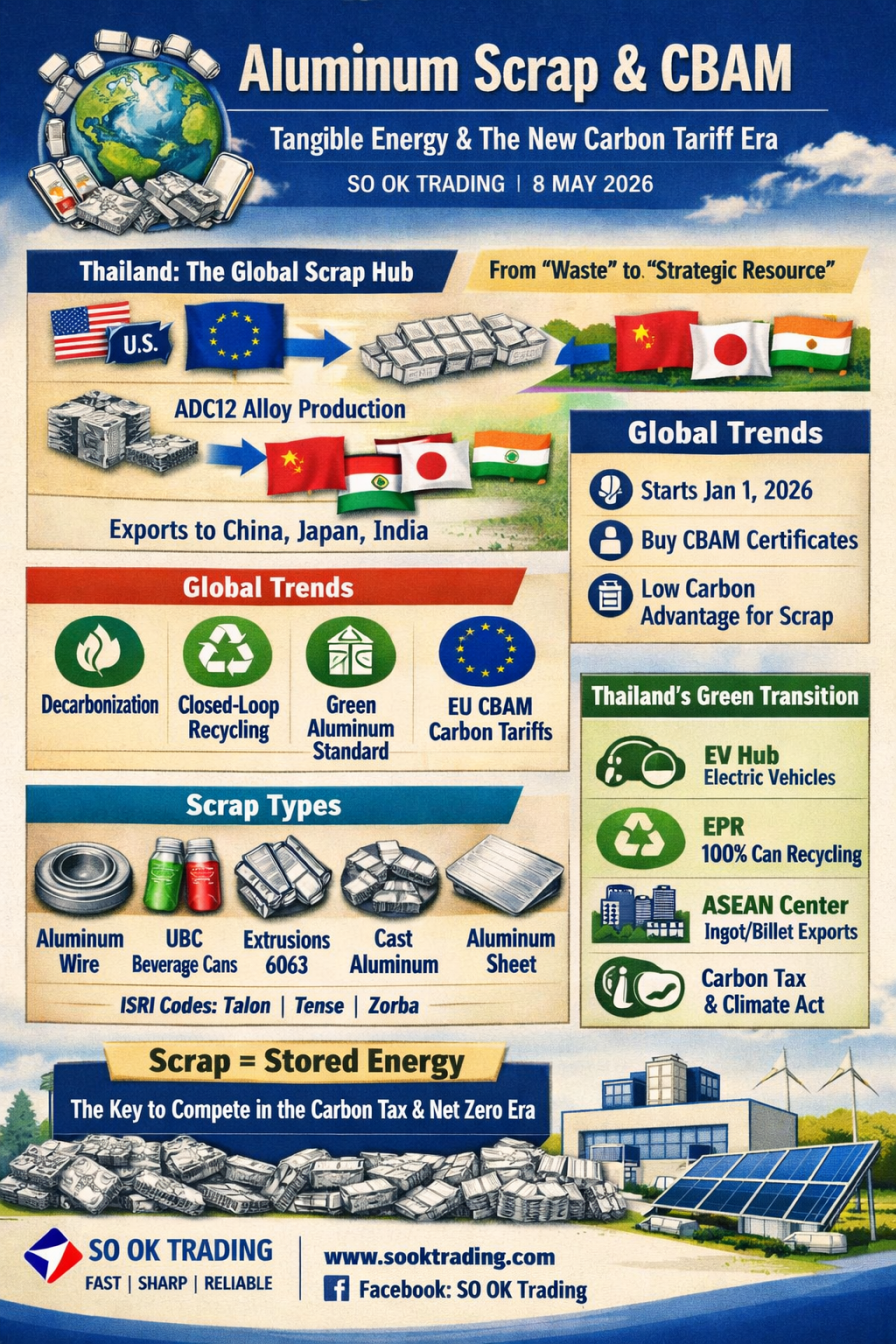
✨ Aluminum Scrap – Tangible Energy & The New Carbon Tariff Wall Aluminum is a metal that can be recycled endlessly without losing quality, saving 90–95% of energy compared to new production from bauxite ore. This is why aluminum scrap is being elevated from “waste” to a strategic resource driving the circular economy and the transition to Green Industry.
Thailand’s Role in the Global Market
Import Hub – Thailand ranks among the top importers from the U.S. and Europe, supplying domestic smelters.
ADC12 Alloy Production – A casting alloy in high demand across ASEAN.
Exports to China, Japan, India – Recycled products from Thailand are recognized in global markets.
Global Trends
Decarbonization – Cutting carbon by using scrap instead of primary aluminum.
Closed-loop Recycling – Apple, Tesla, Coca-Cola aim for 100% recycled aluminum.
Green Aluminum Standard – Future trade will emphasize low carbon footprint.
EU CBAM – Carbon tariffs push manufacturers toward scrap to reduce costs.
Trends in Thailand
EV Hub – Electric vehicles use 2–3 times more aluminum than combustion cars.
EPR (Extended Producer Responsibility) – Nearly 100% can-to-can recycling.
Green Industry Transition – Smelters install solar panels and high-efficiency furnaces.
ASEAN Center – Imports scrap from the U.S./EU, melts into ingots/billets, exports to China and Japan.
♻️ Types of Aluminum Scrap
Aluminum Wire – Highest purity, used in electrical and electronics.
Extrusions (6063) – Door/window frames, re-melted into billets.
UBC (Used Beverage Cans) – Fastest recycling loop, back into new cans.
Cast Aluminum – Auto parts, wheels, re-cast into new components.
Aluminum Sheet – Roofing, gutters, cookware, reused in construction and packaging.
Global trade also uses ISRI codes such as Talon (clean wire), Tense (auto castings), Zorba (mixed shredded scrap) to set clear standards.
⚙️ Key Industries Using Scrap in Thailand
Packaging (Can-to-Can) – Aluminum loop recycling cans back into cans.
Automotive & EV – Castings and sheets reduce EV weight.
Construction – Extrusions and sheets melted into billets for building structures.
Electrical & Electronics – Pure aluminum wire recycled into cables and cooling components.
CBAM – Europe’s New Carbon Wall
Starting January 1, 2026, the EU will impose real carbon tariffs on imports:
Exporters must buy CBAM Certificates to offset embedded emissions.
Scrap aluminum has huge advantages with low carbon emissions, meaning lower or no tariffs.
Stricter rules now include pre-consumer scrap to close loopholes of underreported carbon.
Environmental Taxes in Thailand
Thailand is also adapting to compete globally:
Carbon Excise on Fuel – Began in 2025 at 200 THB per ton CO₂eq.
Climate Change Act – Expected in 2026, including MRV systems and possible direct carbon tax on production.
Impact on Scrap – Prices will rise as factories demand scrap to reduce carbon footprint and require traceability.
⚡ Scrap = Tangible Energy
Holding aluminum scrap equals holding massive electricity savings. CBAM and carbon taxes are transforming scrap from “waste” into a competitive weapon for global manufacturers. Thailand has the chance to become the ASEAN hub for importing, sorting, smelting, and exporting to major markets like China, Japan, and Europe.
Aluminum scrap is not just recycling — it is the key to survival in the Carbon Tax & Net Zero era.
SO OK TRADING – Your Business Partner FAST | SHARP | RELIABLE www.sooktrading.com Facebook: SO OK TRADING