“Bioenergy: Transforming Waste from Fields into Global Power, Driving a Billion-Dollar Market – Bioenergy 2030, The Green Energy the World Needs. Invest Today for a Sustainable Future with SO OK TRADING” : April 5, 2026
Last updated: 5 Apr 2026
2209 Views
Bioenergy: The Renewable Energy Becoming the “Heart” of the Future World Article by SO OK TRADING | April 5, 2026
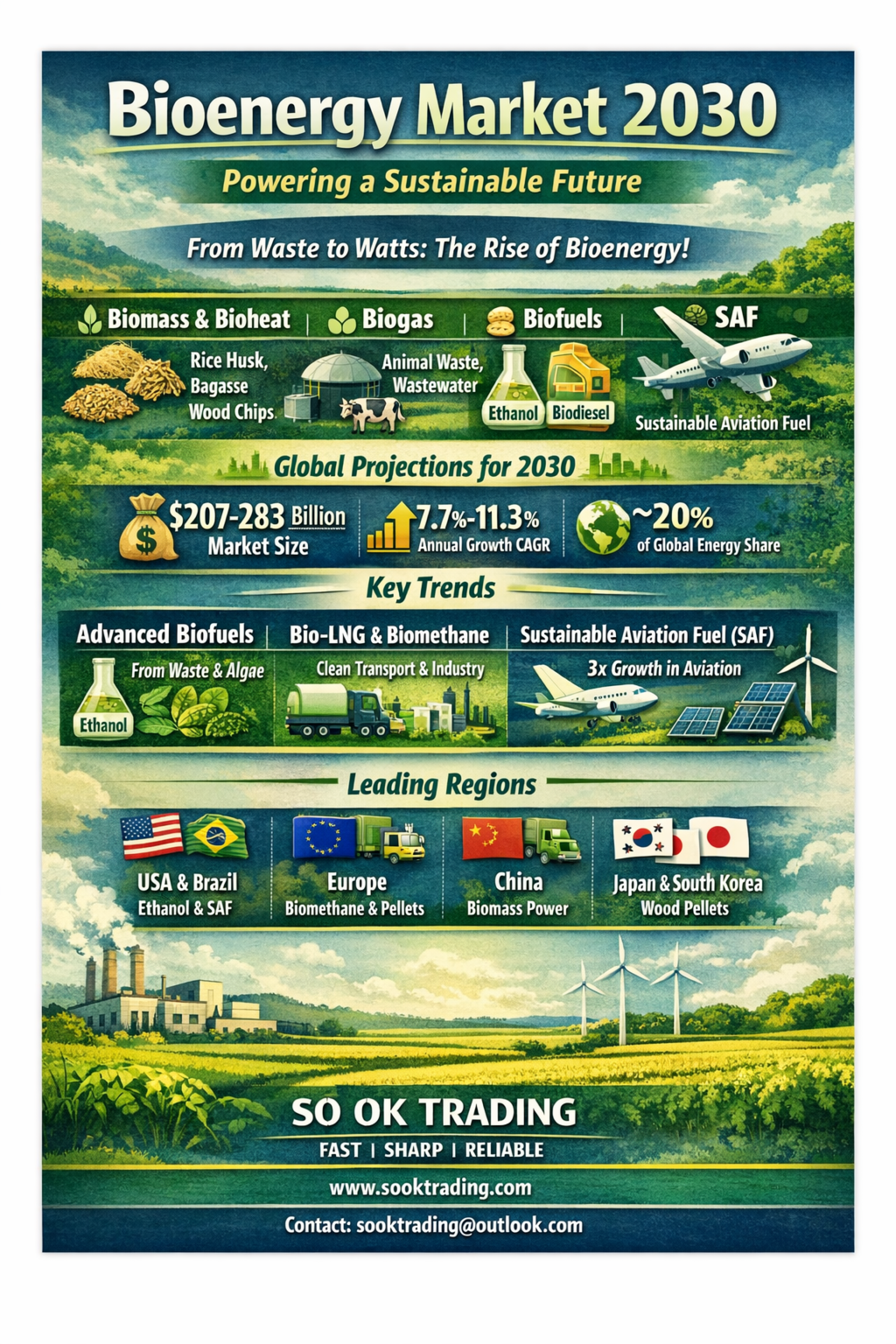
Bioenergy is no longer just an alternative energy source — it is being elevated into a “key engine” for reducing greenhouse gas emissions, especially in industries that are difficult to electrify such as aviation, heavy transport, and manufacturing. Its unique appeal lies in the use of natural resources and agricultural residues, turning waste into clean energy while reducing environmental impact.
Main Forms of Bioenergy
Biomass Power & Heat: Burning rice husks, bagasse, and wood chips to produce steam for turbines
Biogas: Anaerobic digestion of animal waste and wastewater to generate methane for cooking or electricity
Liquid Biofuels:
Ethanol: Produced from sugarcane, cassava, and corn
Biodiesel: Produced from palm oil and animal fats
Global Trends Toward 2030
Advanced Biofuels: Derived from waste and algae, reducing food competition
SAF (Sustainable Aviation Fuel): The star of aviation, tripling in growth within a year
Bio-LNG & Biomethane: Emerging fuels for heavy transport and industry in Europe and America
Flexible Bioenergy: Enhancing grid stability alongside solar and wind power
2030 Projections
Market Size: USD 207–283 billion
CAGR: 7.7–11.3% annually
Global Energy Share: Rising from 13% to nearly 20%
Thailand’s Situation
2024: Bioenergy accounted for over 50% of all renewable energy
PDP 2024: Targeting 51% clean energy share by 2037
Thailand remains ASEAN’s leader in biomass and biogas
Popular Fuels: Ethanol vs Wood Pellets
Ethanol:
Main markets: USA and Brazil
Trend: Increasing use in SAF production despite EV reducing demand in cars
Wood Pellets:
Main markets: Europe, Japan, South Korea
Trend: Rising prices due to demand exceeding fast-growing wood supply
New materials: Straw pellets, palm shells
RDF-3 vs Solar vs Wind
RDF-3 (Refuse-Derived Fuel): Rising star in cement plants and waste-to-energy facilities, providing 24-hour power
Solar Cells: Easy to install, lowest cost, suitable for homes and large farms
Wind Turbines: Stable growth, especially offshore wind delivering massive electricity
Global Overview
USA: Ethanol and SAF for aviation
Europe: Biomethane and wood pellets replacing gas and coal
China: Biomass power and waste-to-energy
Japan & South Korea: Massive imports of wood pellets
Australia: Developing biomethane and algae-based fuels
Middle East: Producing biogas and bio-hydrogen
Africa: Transitioning from firewood to clean cookstoves
Bioenergy is the “energy of the future,” driving sustainability in aviation, transport, and electricity generation. Thailand has strong potential to become the regional hub for bioenergy.
SO OK TRADING: Your Business Partner SO OK TRADING: FAST • SHARP • RELIABLE Visit us at: www.sooktrading.com For inquiries: SOOKTRADING@outlook.com
Bioenergy is no longer just an alternative energy source — it is being elevated into a “key engine” for reducing greenhouse gas emissions, especially in industries that are difficult to electrify such as aviation, heavy transport, and manufacturing. Its unique appeal lies in the use of natural resources and agricultural residues, turning waste into clean energy while reducing environmental impact.
Main Forms of Bioenergy
Biomass Power & Heat: Burning rice husks, bagasse, and wood chips to produce steam for turbines
Biogas: Anaerobic digestion of animal waste and wastewater to generate methane for cooking or electricity
Liquid Biofuels:
Ethanol: Produced from sugarcane, cassava, and corn
Biodiesel: Produced from palm oil and animal fats
Global Trends Toward 2030
Advanced Biofuels: Derived from waste and algae, reducing food competition
SAF (Sustainable Aviation Fuel): The star of aviation, tripling in growth within a year
Bio-LNG & Biomethane: Emerging fuels for heavy transport and industry in Europe and America
Flexible Bioenergy: Enhancing grid stability alongside solar and wind power
2030 Projections
Market Size: USD 207–283 billion
CAGR: 7.7–11.3% annually
Global Energy Share: Rising from 13% to nearly 20%
Thailand’s Situation
2024: Bioenergy accounted for over 50% of all renewable energy
PDP 2024: Targeting 51% clean energy share by 2037
Thailand remains ASEAN’s leader in biomass and biogas
Popular Fuels: Ethanol vs Wood Pellets
Ethanol:
Main markets: USA and Brazil
Trend: Increasing use in SAF production despite EV reducing demand in cars
Wood Pellets:
Main markets: Europe, Japan, South Korea
Trend: Rising prices due to demand exceeding fast-growing wood supply
New materials: Straw pellets, palm shells
RDF-3 vs Solar vs Wind
RDF-3 (Refuse-Derived Fuel): Rising star in cement plants and waste-to-energy facilities, providing 24-hour power
Solar Cells: Easy to install, lowest cost, suitable for homes and large farms
Wind Turbines: Stable growth, especially offshore wind delivering massive electricity
Global Overview
USA: Ethanol and SAF for aviation
Europe: Biomethane and wood pellets replacing gas and coal
China: Biomass power and waste-to-energy
Japan & South Korea: Massive imports of wood pellets
Australia: Developing biomethane and algae-based fuels
Middle East: Producing biogas and bio-hydrogen
Africa: Transitioning from firewood to clean cookstoves
Bioenergy is the “energy of the future,” driving sustainability in aviation, transport, and electricity generation. Thailand has strong potential to become the regional hub for bioenergy.
SO OK TRADING: Your Business Partner SO OK TRADING: FAST • SHARP • RELIABLE Visit us at: www.sooktrading.com For inquiries: SOOKTRADING@outlook.com


Related Content

Global Economy Sep–Oct 2026: Navigating Geopolitical Storms and Transitioning into a New Era
The global economy in September–October 2026 stands at a critical turning point in the “Post-Globalization” era. Supply chains and trade rules are being restructured amid ongoing geopolitical tensions and volatile monetary policies.
The IMF and UN have revised global GDP growth forecasts down to 2.5–3.0%, reflecting a phase of “subdued expansion” that now relies heavily on new drivers such as AI and clean energy.
While the world faces energy crises, inflationary pressures, and renewed interest rate hikes, Asia—particularly ASEAN and India—has emerged as the new epicenter of global growth.
Thailand itself is at a crossroads of economic restructuring and is set to play a pivotal role on the global stage as host of the IMF–World Bank Annual Meetings 2026. Under the framework of the “Bangkok Blueprint,” Thailand will help shape the future of the global economy, focusing on digital transformation, AI, climate finance, and strategies for aging societies.
✨ Stay tuned for in-depth analysis and global economic insights from SO OK TRADING
FAST • SHARP • RELIABLE
23 Sept 2026
Impact of the 2026 Gulf War: As Oil Prices Surge, CBAM Takes Effect, and the World Accelerates Toward Net Zero
With fossil fuels becoming a global risk, Wood Pellets (biomass fuel) are emerging as the new answer for industries worldwide.
✅ Oil prices soar to $125 → Businesses turn to renewable fuels
✅ CBAM enforcement begins → Factories must adapt to stay competitive
✅ Net Zero by 2050 → Wood Pellets truly help reduce greenhouse gas emissions
✅ Thailand’s strong potential → Production, exports, and domestic use strengthen energy security
8 Mar 2026
