Share

“Deep Dive into the Aluminum Market 2026: Price Breakthrough, Supply Crisis, and the Future of Clean Energy — From Basic Metal to Strategic Metal” Article by SO OK TRADING April 2, 2026
Last updated: 2 Apr 2026
3184 Views

 
Impact: Automotive and construction industries worldwide face soaring costs and shortages
China’s Limitation: Production capped at 45.5 million tons, preventing additional supply to the market
 
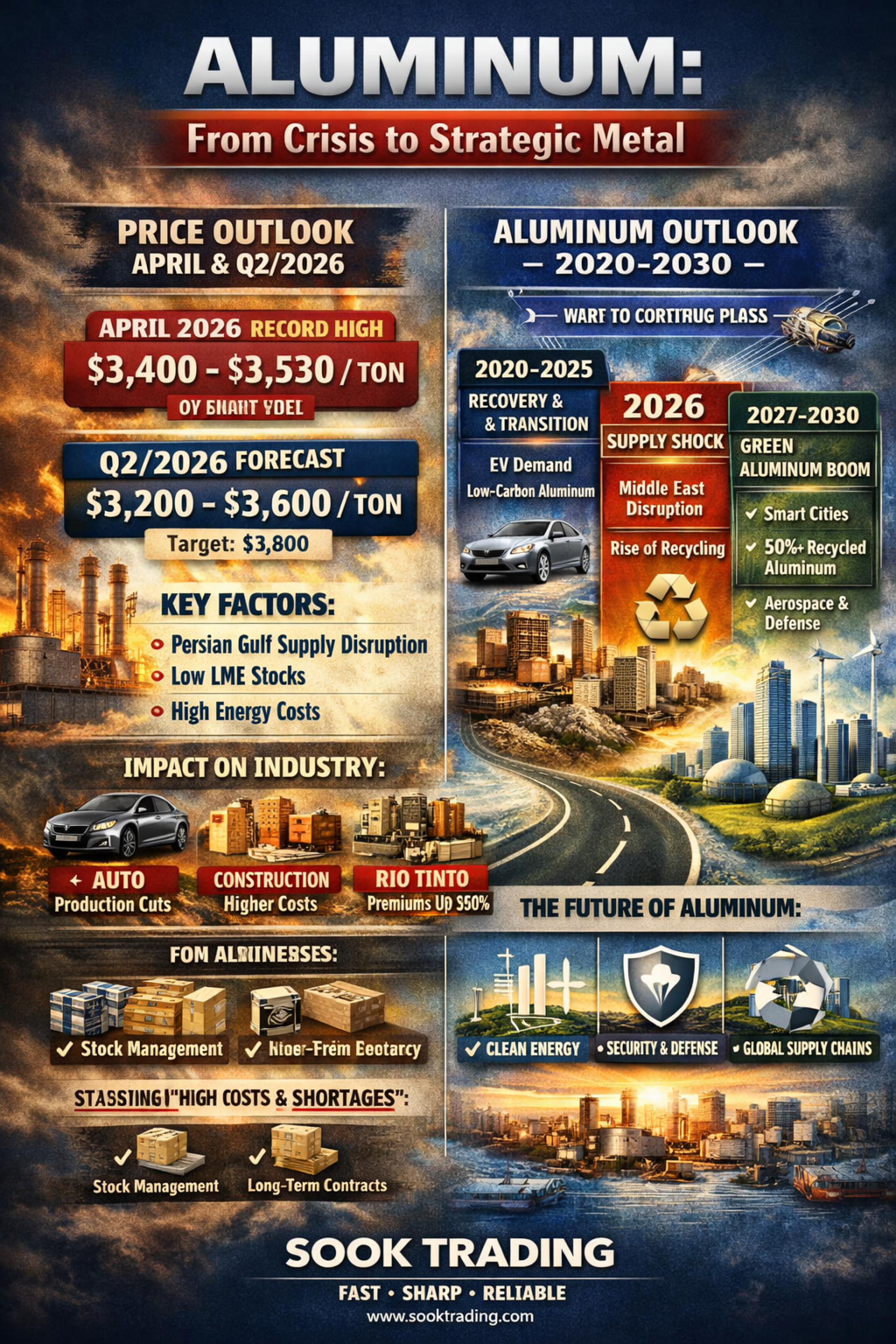
Aluminum Price Outlook – Q2/2026 (April–June)
Average Price: $3,200–$3,600/ton
Key Resistance: $3,800 if conflicts continue
Supply Gap: Persian Gulf smelters not yet fully recovered, creating a 5–10% global supply shortfall
Seasonal Demand: Q2 is the high season for construction projects worldwide, including Thailand
Impact in Thailand: Retail aluminum profiles and sheets expected to rise another 5–10% by May–June
 
Insights from Mining & Producers
Rio Tinto: Set Q2/2026 premiums for Japanese customers at $350/ton, up 79% from Q1 (MJP Premium was $215–220/ton)
EGA & Alba: Smelters in Abu Dhabi and Bahrain suffered severe damage, forcing declarations of Force Majeure
Observation: Producers are using “premium pricing” to reflect transport risks and production disruptions
 
Outlook 2020–2030: Aluminum’s Path to Becoming a “Strategic Metal”
2020–2025: Recovery & Transition COVID-19 slowed demand temporarily, but packaging and electronics rebounded quickly. EVs and clean energy became key drivers. Push for low-carbon aluminum aligned with Net Zero goals.
2026: The Supply Shock Year Demand remains strong, but supply disruptions from the Middle East dominate. Automotive and aerospace industries shift toward recycled aluminum and long-term contracts.
2027–2030: The Green Aluminum Boom Demand surges from Smart Cities and global power grids. Circular Economy makes recycled aluminum the industry standard (40–50% of total usage). Aerospace and defense sectors require more specialized aluminum grades.
 
Price Forecast Summary
April 2026: Record highs at $3,400–$3,530/ton
Q2/2026: Prices expected to remain elevated at $3,200–$3,600/ton, with potential to test $3,800
The Next Decade: Aluminum will evolve from a “basic metal” into a “strategic metal” vital for clean energy, security, and global economic stability
For businesses relying on aluminum as raw material: stock management and long-term contracts are essential strategies to navigate a market defined by “high costs and shortages.”

 
SO OK TRADING: Your Trusted Business Partner
FAST • SHARP • RELIABLE

Visit us: www.sooktrading.com Inquiries & quotations: sooktrading@outlook.com

Related Content
“Copper Rising 2026: From War to Clean Energy – The Metal Reshaping Our World | SO OK TRADING”
Copper – The Metal of the Clean Energy Era, Becoming the Heart of the Global Economy In April 2026, the global copper market is hotter than ever — prices have surged to multi‑year highs, driven by the pressures of war in the Middle East, energy crises, and massive demand from emerging technologies such as AI, EVs, and Solar Cells. Copper is no longer just an industrial metal; it has become a crucial “indicator” of the world’s transition toward clean energy. In this article, SO OK TRADING takes you deep into the latest copper price trends, analyzes the impacts of war and energy, and shares insights from leading financial institutions on how copper will continue to be recognized as the “metal of the future” in 2026.
28 Apr 2026
Aluminum Recycling the Circle and How it work
Aluminium is the most abundant metal in the earth’s crust. Approximately 75% of aluminium ever produced is still in use today as it can be recycled endlessly without compromising any of its unique properties or quality. Aluminium’s lifecycle provides significant benefits through recycling, saving 95% of the energy it would take to make new aluminium metal. More information on recycling may be found here. Recycling aluminium has five steps: Step 1: Collecting Scrap There are two categories of aluminium scrap: New Scrap New Scrap is surplus material that arises during the manufacture and fabrication of aluminium products, up to the point where they are sold to the final consumer. For example, off cuts of aluminium sheet or extrusions are considered new scrap. Sometimes, this new scrap can be safely recycled by aluminium smelters as its composition is known. Old Scrap Old Scrap is material that has been used by the consumer and subsequently discarded. For example, used beverage cans, window frames, electrical cabling and car cylinder heads are all considered old scrap. Aluminium smelters are unable to safely accept this old scrap as its composition is usually unknown and it can be contaminated. Scrap aluminium is also collected from the community – from households, scrap merchants, local and regional authorities, etc. Step 2: Sorting Scrap The scrap is then sorted – grouping all coated (painted or lacquered) aluminium together, and grouping all uncoated aluminium together. Paper, plastic and other non-aluminium recycling needs to be removed. Step 3: Crushing The sorted aluminium is then crushed into bales – by compacting the aluminium scrap, it reduces freight, storage and handling costs Step 4: Remelting Uncoated scrap is loaded directly into a large furnace called a remelter, where it is heated at high temperatures and turned into molten form. If the scrap aluminium is coated, it is processed through a gas fired rotary furnace to remove any coating and then transferred to the remelter. Step 5: Casting The molten aluminium is cast at a temperature of just over 700°C to form ingots
13 Nov 2025
This website uses cookies for best user experience, to find out more you can go to our Privacy Policy and Cookies Policy
Powered By MakeWebEasy Logo MakeWebEasy