Share

“Copper Rising 2026: From War to Clean Energy – The Metal Reshaping Our World | SO OK TRADING”
Last updated: 28 Apr 2026
415 Views

“Copper Usage Trends and Price Analysis – Impacts of War and Clean Energy” By SO OK TRADING : April 28, 2026

 
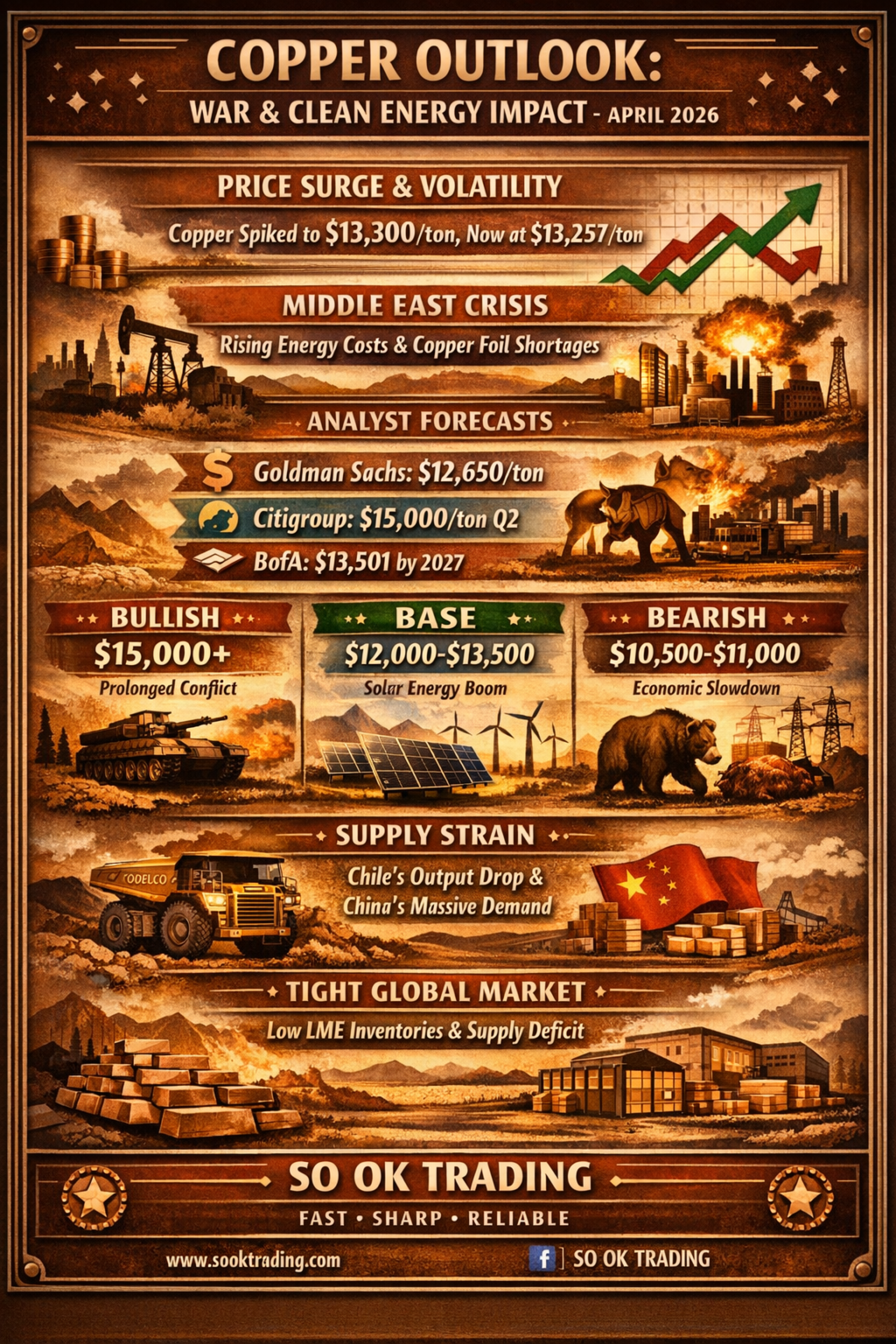
Price Surge and Volatility
In April 2026, the global copper market was shaken by war, energy crises, and surging demand from new technologies. By mid‑April, copper prices soared to $13,300 per ton, rising more than 6.4% in just one week. Investors watched closely as if witnessing a dramatic climax. Toward the end of the month, prices eased slightly to $13,257 per ton, reflecting caution amid Middle East tensions.

 
War Driving Costs
The Middle East conflict has been the “key factor” pushing energy prices higher, which in turn drove copper production costs up sharply. At the same time, copper foil shortages sent prices up more than 30%, impacting PCB industries and global electronics supply chains. With supply constrained, LME copper prices have remained elevated.

 
Financial Institutions’ Forecasts
Goldman Sachs: Average price for 2026 projected at $12,650/ton, supported by mining and transport risks despite possible surplus.
Citigroup: Most bullish, forecasting prices could reach $15,000/ton in Q2, driven by massive demand from AI and data centers.
J.P. Morgan: Warns of profit‑taking amid Iran tensions, with support around $12,000/ton.
Bank of America: Raised its forecast, expecting prices to hit $13,501/ton by 2027, supported by clean energy investments.
 
Future Scenarios and Price Outlook
Bullish Case – Prolonged Energy War: Prices could break above $15,000/ton if energy transport routes are blocked.
Base Case – Solar Boom: Clean energy demand keeps prices in the $12,000–13,500/ton range.
Bearish Case – Stagflation: A global recession could drag prices down to $10,500–11,000/ton.
 
Chile – The World’s Largest Supplier Under Pressure
Chile, the top copper producer, faces soaring costs, sulfuric acid shortages, and labor protests, pushing production to a 9‑year low. State‑owned CODELCO has struggled to meet global demand, creating a supply deficit. As a result, average copper prices rose from $9,500/ton in 2025 to $12,400/ton in 2026, marking a structural price reset.

 
China – Consuming Half of Global Copper
China accounts for over 50% of global copper demand, shifting usage from real estate to EVs, solar, wind, batteries, and AI data centers. It is also accelerating recycling and building strategic reserves to secure industrial stability.

 
Global Demand-Supply Tensions
The world faces a structural imbalance: demand surging vs. supply constrained. New mines cannot keep pace, while LME inventories have fallen to historic lows. Prices remain highly sensitive to news, with little chance of breaking below the $12,000/ton support level in the near term.

 
Conclusion: Copper as the Stage of Transition
In 2026, copper stands at the crossroads of energy crisis and clean energy transition. In the short term, war drives volatility, but in the long run, solar cells, EVs, and AI will secure copper’s role as the metal of the future.

✨ April 2026 clearly shows that copper is at the heart of a new era of global transformation.

 
SO OK TRADING: Your Trusted Business Partner FAST • SHARP • RELIABLE www.sooktrading.com Facebook: SO OK TRADING


Related Content
ทิศทางการใช้ อลูมิเนียมในอนาคต (ปี2026) , ทิศทางราคาอลูมิเนียม และ สถานะการณ์ Carbon Footprint
ทิศทางในอนาคตของอลูมิเนียมไทยมุ่งเน้น ความยั่งยืน (Sustainability) และ เทคโนโลยีขั้นสูง (Advanced Technology) โดยจะเน้น อลูมิเนียมคาร์บอนต่ำ และ อลูมิเนียมรีไซเคิล เพื่อตอบโจทย์อุตสาหกรรมยานยนต์ไฟฟ้า (EV) และการก่อสร้างที่เป็นมิตรต่อสิ่งแวดล้อม พร้อมพัฒนา การเคลือบผิวใหม่ๆ และระบบเศรษฐกิจหมุนเวียน (Circular Economy) เช่น โครงการ Aluminium Loop เพื่อลดต้นทุน เพิ่มมูลค่า และรักษาความสามารถในการแข่งขันในตลาดโลก. แนวโน้มสำคัญ: การเติบโตในอุตสาหกรรมยานยนต์ไฟฟ้า (EV): รถ EV ต้องการใช้อลูมิเนียมเพิ่มขึ้นมากเพื่อลดน้ำหนัก ช่วยประหยัดพลังงานและเพิ่มระยะทางวิ่ง. ความต้องการอลูมิเนียมคาร์บอนต่ำ (Low-Carbon Aluminium): ตอบสนองมาตรการสิ่งแวดล้อมทั่วโลก (เช่น EU CBAM) โดยเฉพาะการใช้อลูมิเนียมรีไซเคิลสูง ซึ่งลดการปล่อยคาร์บอนได้มาก. เศรษฐกิจหมุนเวียน (Circular Economy): โครงการอย่าง "Aluminium Loop" ขับเคลื่อนการรีไซเคิลบรรจุภัณฑ์อลูมิเนียมครบวงจร เพื่อลดขยะและสร้างมูลค่า. นวัตกรรมการเคลือบผิว (Coating Innovations): การเคลือบผิวแบบใหม่ๆ เพื่อเพิ่มฟังก์ชัน เช่น ป้องกันแบคทีเรีย (Anti-microbial) ทำความสะอาดง่าย (Easy-to-clean) สร้างผิวสัมผัสใหม่. การก่อสร้างแบบสำเร็จรูปและโมดูลาร์ (Modular Construction): ใช้อลูมิเนียมมากขึ้นในการผลิตชิ้นส่วนสำเร็จรูปนอกสถานที่ เพื่อความแม่นยำและลดของเสีย. การบูรณาการพลังงานหมุนเวียน (Renewable Energy): ใช้อลูมิเนียมในโครงสร้างรองรับแผงโซลาร์เซลล์ และระบบพลังงานสะอาดอื่นๆ. ความท้าทาย: ต้นทุนพลังงาน & ห่วงโซ่อุปทาน: ความผันผวนของราคาพลังงานและความท้าทายในห่วงโซ่อุปทาน. การแข่งขัน: ประเทศคู่แข่งเร่งพัฒนาเทคโนโลยีรีไซเคิล ทำให้ไทยต้องพัฒนาต่อเนื่องเพื่อรักษาผู้นำ. โอกาส: ไทยมีศักยภาพด้านแรงงานฝีมือ และอุตสาหกรรมต้นน้ำ-กลางน้ำ-ปลายน้ำที่ครบวงจร. การปรับตัวสู่การผลิตคาร์บอนต่ำสร้างโอกาสทางธุรกิจใหม่ๆ โดยเฉพาะการเป็นผู้นำด้านอลูมิเนียมรีไซเคิล. สรุป: อลูมิเนียมไทยจะก้าวสู่ยุคใหม่ที่เน้น "เขียว" (Green) และ "ฉลาด" (Smart) โดยการรีไซเคิลและเทคโนโลยีจะเป็นหัวใจสำคัญในการสร้างการเติบโตและความยั่งยืน.
16 Dec 2025
Direction and Price Trends of Antimony Ingots 2021–2030 BY SO OK TRADING
Antimony Ingot Price (99.65% Sb) The latest price is approximately 25,450 USD/metric ton (FOB China, 99.65% purity), while in the European market it is around 34,000–35,500 USD/ton as of the end of December 2025, reflecting supply-side pressure and steady demand in the global market. - European Market (99.65% Sb): 34,000–35,500 USD/metric ton (Dec 31, 2025 – Rotterdam Price) *** Equivalent to about 1.15–1.2 million THB, which represents a decline from mid-2025 when prices peaked at 48,000–52,000 USD/MT, a direct consequence of China’s government-imposed export restrictions.
5 Jan 2026
Aluminum Scrap & UBC Scrap: White Gold in Recycling and the Circular Economy Industry Outlook – Thailand’s Aluminum Sector By SO OK TRADING
Thailand’s aluminum scrap market is entering an exciting new era. What was once considered “waste” has now become a strategic resource powering sustainability, circular economy models, and global technology industries. In particular, UBC (Used Beverage Can) scrap is emerging as a cornerstone of the circular economy, enabling closed-loop recycling and reducing carbon footprints. By 2026, Thailand is set to strengthen its role as a regional hub for aluminum recycling, transforming scrap from a low-value byproduct into “White Gold” for both domestic and international markets.
15 Feb 2026
This website uses cookies for best user experience, to find out more you can go to our Privacy Policy and Cookies Policy
Powered By MakeWebEasy Logo MakeWebEasy