Share

“Battery Recycling: From Old Waste to a Moving Gold Mine – Thailand Rising as ASEAN’s Future Hub” By SO OK TRADING
Last updated: 7 Mar 2026
3427 Views

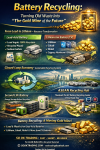
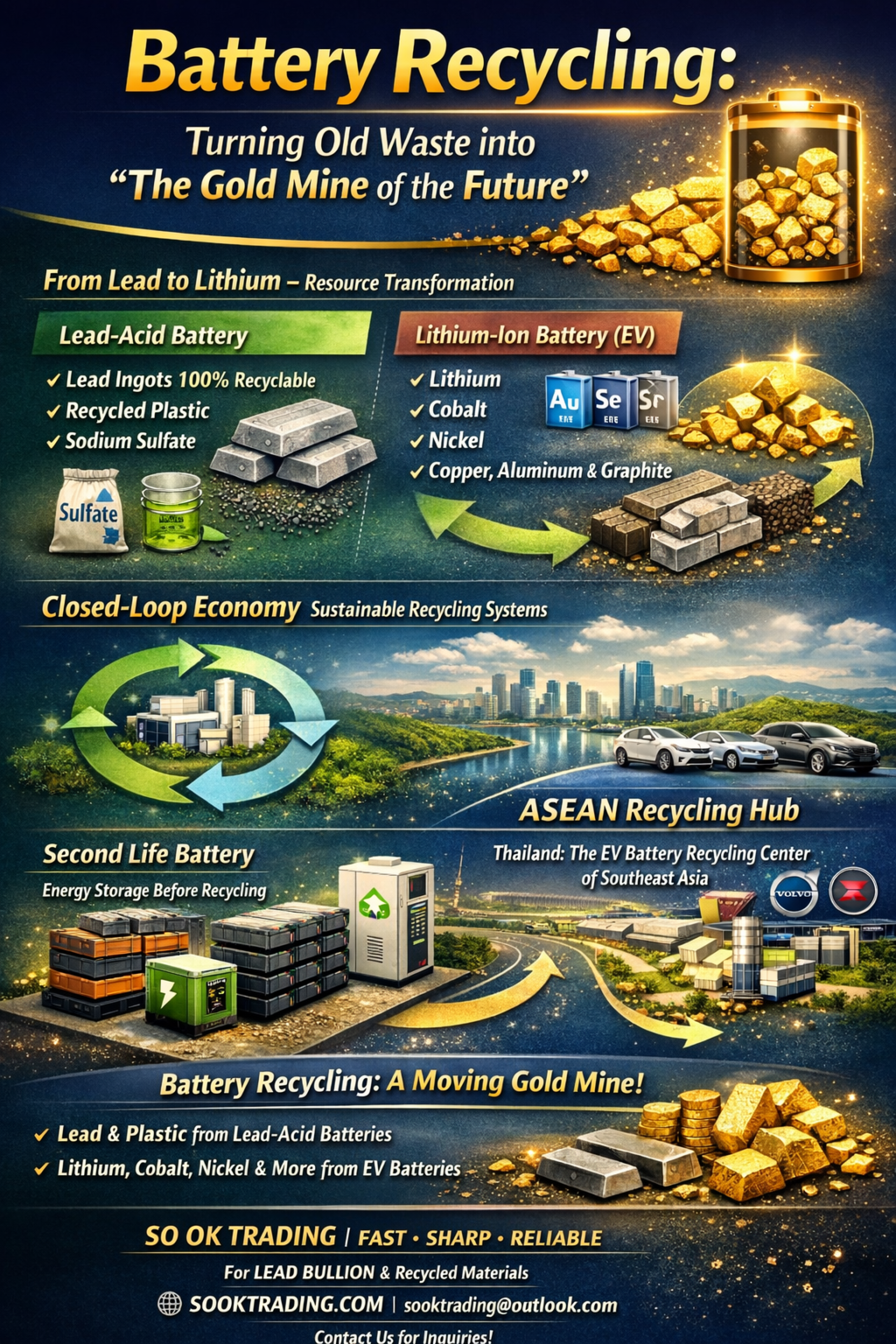
Battery Recycling: Turning Old Waste into the “Gold Mine of the Future”

Battery recycling is not just about disposing of hazardous waste.
It is about transforming “trash” into “precious resources” that can be reused endlessly.
Both lead-acid batteries (used in fuel-powered cars) and lithium-ion batteries (used in EVs) contain valuable metals that can be recovered, making this industry a future driver of both economic value and sustainability.


⚙️ From Lead to Lithium – A Major Transition

Lead-Acid Battery

Lead: Nearly 100% recoverable, remelted into ingots for unlimited reuse.
Polypropylene Plastic: Battery casings can be crushed, cleaned, and remade into plastic pellets.
Sulfuric Acid:
Neutralization → converted into clean water
Sodium Sulfate → used in detergents, glass, and textiles
Highlight: Almost 100% recyclable, the most stable system worldwide, and profitable through battery “trade-in.”

Lithium-Ion Battery (EV)

Lithium
Cobalt
Nickel
Manganese
Copper
Aluminum
Graphite
Highlight: Though complex, more than 90% of valuable metals can be recovered. Plus, “Second Life” use as energy storage systems (ESS) before recycling adds extra value.


♻️ Closed-Loop Economy – Endless Cycle

Thailand’s Department of Primary Industries and Mines (DPIM) has successfully developed EV battery prototypes using recycled domestic materials, reducing mineral imports and minimizing environmental impact.


⚡ Second Life Battery – Use Before Recycling

EV batteries degraded to 70–80% capacity can still serve as Energy Storage Systems for homes and factories before entering the recycling process.


Thailand as ASEAN’s Recycling Hub

Global automakers like Volvo Car Thailand have invested in repair and recycling centers in Thailand, in partnership with Singapore. Thailand is being positioned as the ASEAN hub for EV battery recycling.


EV 3.5 Policy – Attracting Advanced Technology

The Thai government, through BOI incentives, is bringing in advanced extraction technologies such as Black Mass, enabling efficient recovery of lithium, cobalt, and nickel.


✨ Conclusion

Old batteries are not waste — they are mobile mines full of precious resources:

Lead and plastics from lead-acid batteries
Lithium, cobalt, nickel, and rare metals from EV batteries
Battery recycling not only protects the planet but also generates massive economic value, pushing Thailand toward becoming the ASEAN center for battery recycling.


SO OK TRADING FAST • SHARP • RELIABLE
If you are interested in Lead Bullion produced from battery recycling, please contact us:

www.sooktrading.com
sooktrading@outlook.com


Related Content
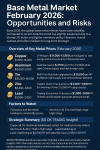
 Base Metals Market February 2026: When Volatility Turns into Opportunity - From Volatility to Opportunity: SO OK TRADING ’s In-Depth Analysis of the Base Metals Market: Aluminum, Copper, Zinc, Tin, Lead — The Latest Trends Investors Must Watch
Volatility is back—and base metals are in the spotlight. As February 2026 unfolds, global prices for copper, tin, aluminum, zinc, and lead are showing mixed signals. From clean energy demand to supply disruptions and monetary tightening, the forces shaping this market are anything but simple. At SO OK TRADING, we decode the noise and deliver clarity. This infographic reveals key price ranges, expert forecasts, and strategic insights to help investors navigate the turbulence—and spot the opportunities before they go mainstream.
3 Feb 2026
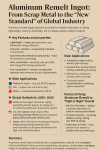
“Recycled Aluminum: From Scrap to Global Standard – Circular Economy Reshaping Industry with Aluminum Remelt – Remelt Revolution: Transforming the Metal Industry for Net Zero”
Recycled Aluminum: From Scrap to the New Global Standard As industries worldwide accelerate toward Net Zero and embrace the Circular Economy, Aluminum Remelt Ingots are no longer just an “alternative material.” They are becoming the main driver that every nation relies on for sustainability and economic competitiveness. With outstanding properties—lightweight, strong, corrosion-resistant, and excellent thermal and electrical conductivity—remelt ingots are now essential across diverse industries: automotive, construction, electronics, and packaging, all of which demand high-quality, eco-friendly materials. Most importantly, recycling aluminum consumes up to 95% less energy than producing primary aluminum, dramatically reducing both costs and carbon footprints. At the same time, global demand continues to rise, especially for ADC12, which is highly sought after in China, Japan, and Thailand, along with A356 and AC4B for automotive and high-strength applications. Global Shifts in 2025–2026 - China: Expanding production capacity to support electric vehicle (EV) manufacturing and construction, with stricter import standards for scrap aluminum. - United States: The world’s highest remelt usage (81%), driven by energy efficiency and carbon reduction, reinforced by strict tariffs under Section 232 (raised to 50%). - Japan: Fully dependent on imports and recycling, leveraging advanced sorting technologies and increasing the use of green aluminum in high-end automotive manufacturing. - Thailand: Rising as ASEAN’s scrap hub, exporting heavily to China and the U.S., with an aluminum can recycling rate of 86% and new circular economy initiatives such as the Aluminium Loop. From Scrap → To the Hero of Tomorrow Aluminum Remelt Ingots are rapidly evolving into the new global standard across industries. For those in the metals and manufacturing sectors, now is the time to adapt and seize opportunities in the global market.
21 Feb 2026
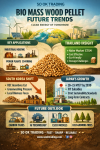
“Bio Mass Revolution: Wood Pellets Driving Clean Energy and Transforming Asia’s Industrial Future”
Bio Mass Wood Pellet: Clean Energy of the Future SO OK TRADING : 8 JUNE 2026 The world is accelerating toward Carbon Neutrality and reducing greenhouse gas emissions. In this transition, Wood Pellets (compressed biomass fuel) have evolved from being an “alternative fuel” to becoming a vital primary energy source across industries, power plants, and households. From industrial steam boilers and co-firing in power plants to residential heating in Europe and North America, Wood Pellets are emerging as the backbone of the new clean energy era. In Thailand, the market is still in its early stage but holds enormous potential. With abundant agricultural resources and production capacity, Thailand is well-positioned to become a key exporter — especially to Japan, where demand for high-quality Wood Pellets is rapidly increasing, supported by long-term contracts and strict sustainability standards. While South Korea’s market is slowing down, Japan has become the “new pillar” of Asia’s Wood Pellet industry, offering significant opportunities for Thai producers to expand and upgrade to international standards. The future of clean energy has already begun — and Wood Pellets are one of the essential keys driving the world toward sustainability
8 Jun 2026
This website uses cookies for best user experience, to find out more you can go to our Privacy Policy and Cookies Policy
Powered By MakeWebEasy Logo MakeWebEasy