“CBAM & Carbon Credit: Transforming Global Trade — From Cost to Opportunity, Adapting Early with Carbon Footprint as the Survival Blueprint for Thai Businesses in the Green Era”
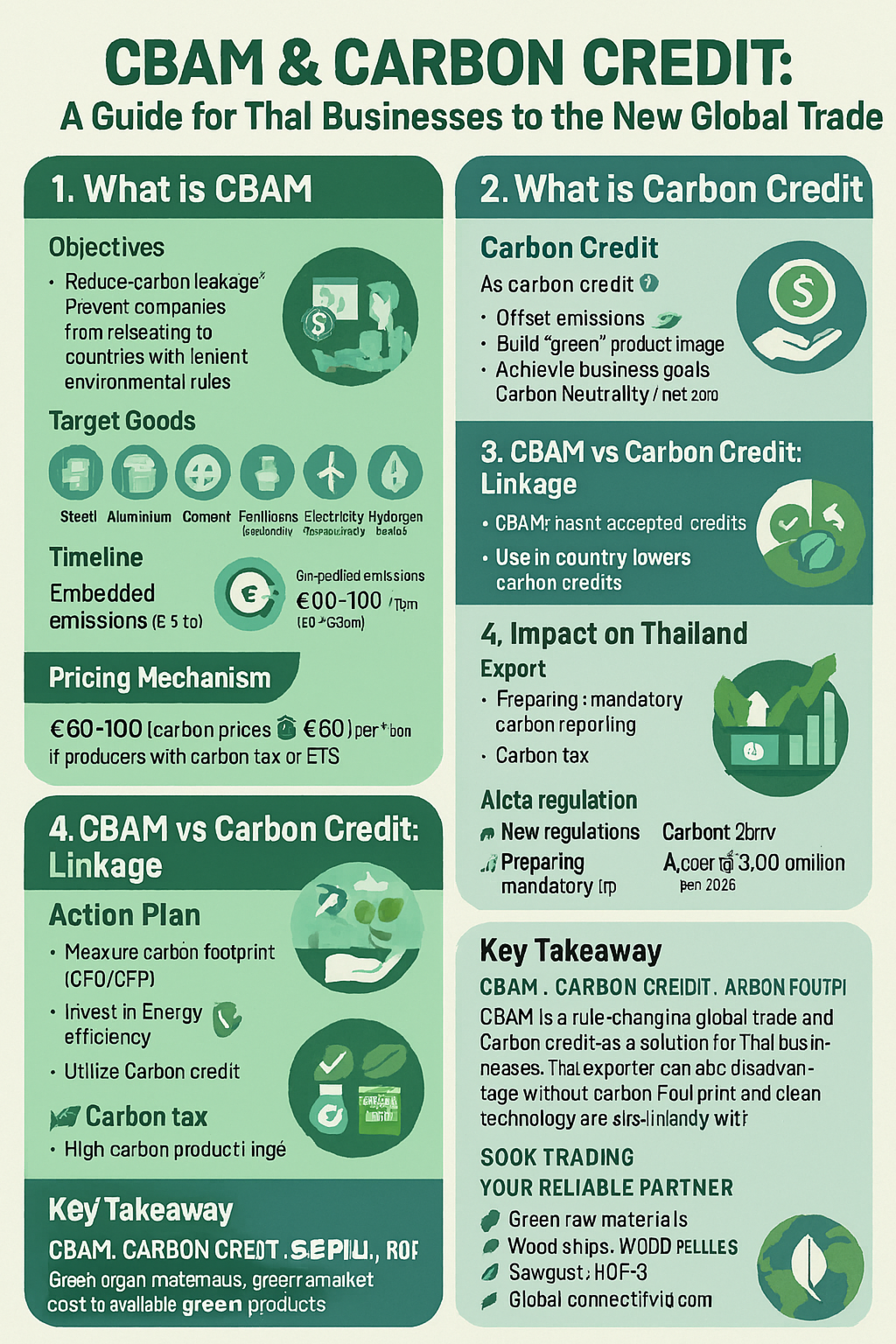
CBAM & Carbon Credit: A Guide for Thai Businesses to the New Global Trade
And “Carbon Footprint: The Blueprint for Future Business”
1. What is CBAM?
The Carbon Border Adjustment Mechanism (CBAM) is a new EU regulation that will be fully enforced starting January 1, 2026.
Objective: Reduce carbon leakage and prevent companies from relocating production to countries with weaker environmental rules.
Target Products (first 7 groups): Steel, aluminum, cement, fertilizers, electricity, hydrogen, and certain downstream products.
Timeline:
2023–2025: Quarterly reporting of embedded emissions.
2026 onwards: Importers must purchase CBAM Certificates based on EU ETS carbon prices.
Pricing Mechanism: EU ETS price (60–100 EUR/ton, approx. 2,300–3,800 THB). If the producing country has a carbon tax or ETS equivalent to EU standards, costs can be deducted.
2. What is Carbon Credit?
Carbon Credit = the right to reduce or sequester carbon dioxide (unit: tCO₂eq).
Examples: Forest planting, renewable energy, waste management.
Thailand’s authority: Thailand Greenhouse Gas Management Organization (TGO) → T-VER system.
Benefits:
Offset emissions.
Build a “green product” image.
Help businesses achieve Carbon Neutrality / Net Zero.
3. CBAM vs Carbon Credit: The Linkage
CBAM focuses on actual emission reductions, voluntary credits cannot directly offset CBAM.
Domestic carbon credit use reduces real emissions → lowers embedded emissions in CBAM reporting.
If Thailand implements a carbon tax or ETS, exporters can deduct these costs from CBAM obligations.
4. Impacts on Thailand
Exports: KResearch estimates ~28 billion THB impact in 2026 (3.8% of EU exports).
High-risk industries:
Steel (USD 95.1 million).
Aluminum (USD 56.7 million).
Additional costs: CBAM Certificates + MRV (Measurement, Reporting, Verification).
Domestic law: Climate Change Act to mandate carbon reporting.
Carbon Tax: Expected in 2025 at 200 THB/ton.
Market: Carbon credit market projected to grow from 64 million THB to 3 billion THB by 2026.
SMEs: Struggle due to limited funds and technology.
Supply Chain: Even non-exporters may be required to provide carbon data to larger companies.
Positive impacts: Technology upgrades, low-carbon products (e.g., Low Carbon Rice) as new global selling points.
5. Carbon Price Gap: Thailand vs EU
EU ETS: 60–100 EUR (2,300–3,800 THB/ton).
Thailand T-VER: 100–200 THB/ton.
→ Thai exporters will face significantly higher costs once CBAM is enforced.
6. Adaptation Strategies (Action Plan)
Measure carbon footprint (CFO/CFP).
Invest in energy efficiency (e.g., solar rooftop).
Use domestic carbon credits to strengthen “green product” branding.
Monitor Thailand’s carbon tax policy.
7. Carbon Footprint: The New Business Indicator
CFO (Organization): Scope 1, 2, 3 emissions.
CFP (Product): Life cycle assessment of product emissions.
Why it matters:
Essential for EU exports.
Cost reduction by identifying high-emission points.
Builds consumer trust.
8. Thailand’s Outlook (2026)
Mandatory carbon reporting.
Carbon tax enforcement.
Rising carbon credit prices, expanding market.
TGO upgrading credits for international trade.
Key Takeaway
CBAM is the new global trade rule. Carbon Credit is the adaptation tool. Carbon Footprint is the blueprint for future business.
Without early measurement and clean technology investment, Thai exporters risk losing competitiveness. But by turning crisis into opportunity, Thailand can create low-carbon products and secure a sustainable position in the global market.
SO OK TRADING: YOUR RELIABLE PARTNER
We supply green energy raw materials: Wood Chips, Pellets, Saw Dust, RDF3.
Contact us: sooktrading@outlook.com
www.sooktrading.com
Would you like me to now condense this into a short, catchy English social media caption (for LinkedIn/F