Share

“Wood Pellets: From Waste to Future Energy — From Husk to Kilowatt, Thai Pellets Turn Residues into Value” Article by SO OK TRADING
Last updated: 10 Feb 2026
1504 Views

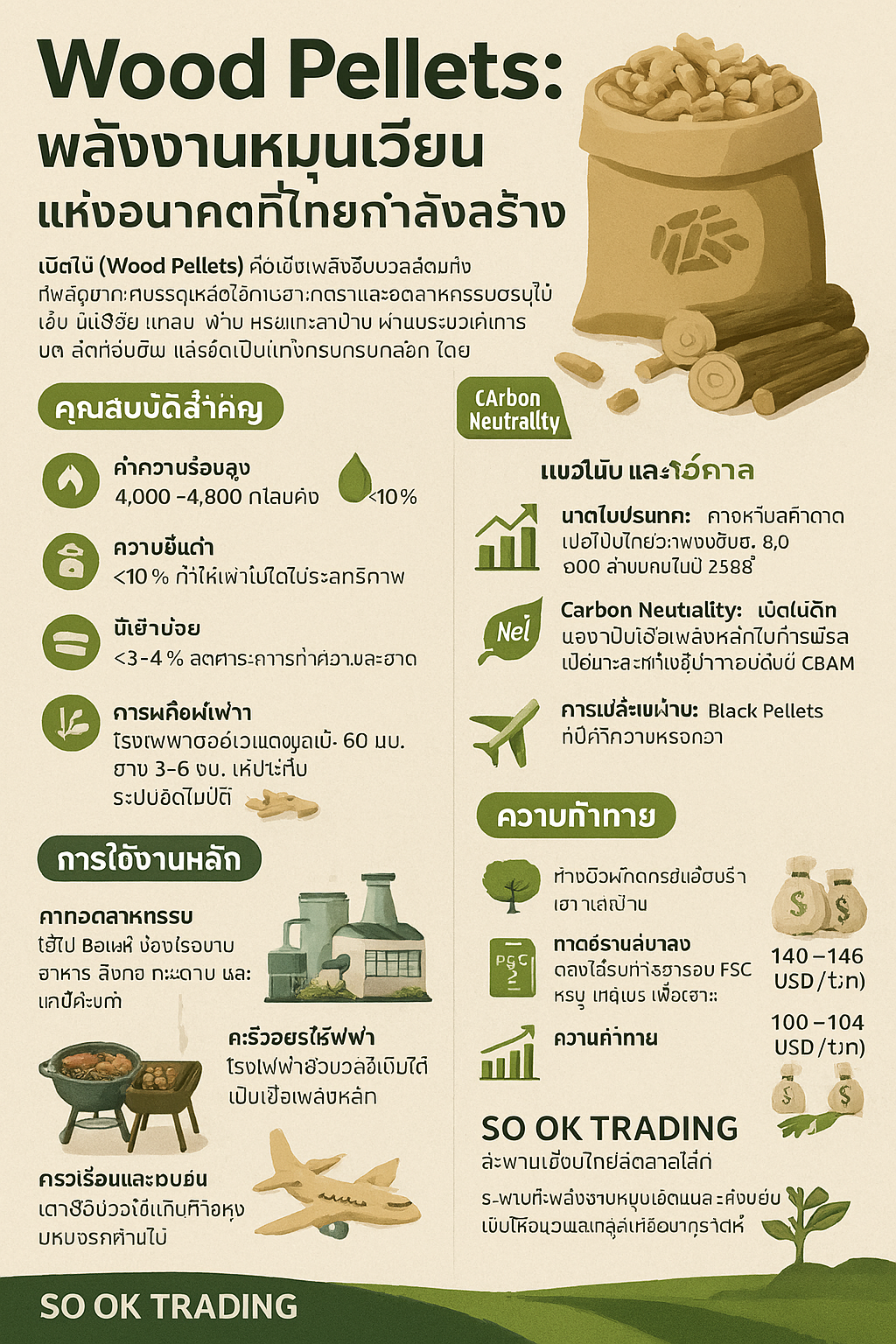
Wood Pellets: The Future of Renewable Energy Thailand is Building

Wood Pellets are biomass fuel made from agricultural and forestry residues such as sawdust, rice husks, straw, or palm shells. These materials are crushed, dried, and compressed into cylindrical pellets, with natural lignin acting as a binder. The result is a fuel with high calorific value, low moisture, low ash content, and consistent size.

This is why wood pellets are seen as the “star” of renewable energy in an era where the world is moving toward Carbon Neutrality and Net Zero.


Key Properties

High calorific value: 4,000–4,300 kcal/kg
Low moisture: <10%, ensuring efficient and stable combustion
Low ash content: <3–4%, reducing cleaning requirements
Standard size: Diameter 6–10 mm, length 3–6 cm, suitable for automated systems
 

⚙️ Main Applications

Industrial Use: Boilers in food, textile, paper, and chemical industries, replacing fossil fuels like coal and fuel oil
Power Generation: Biomass power plants and co-firing with coal (e.g., Mae Moh power plant in Thailand)
Residential & Community: Biomass stoves, pellet grills for barbecue and smoking, animal bedding
Export: Thailand is a major producer in ASEAN, with Japan and South Korea as key markets
 

Trends and Opportunities

Domestic Market: Expected to reach 8 billion THB by 2025, up from 1.3 billion THB in 2021
Carbon Neutrality: Considered a key fuel for achieving Net Zero by 2065
Fuel Transition: Large factories shifting from fossil fuels to wood pellets, responding to EU CBAM measures
Innovation: Development of Black Pellets with higher calorific value and moisture resistance, nearly 100% coal replacement
Export Growth: South Korea accounts for 80% of Thai exports, with Japan’s demand steadily increasing
 

⚠️ Challenges

Raw Material Supply: Ensuring sufficient rubber wood, fast-growing trees, and agricultural residues
International Standards: FSC or ENplus certification required for entry into Japanese and European markets
Competition: Competing with Vietnam, a major exporter with lower production costs
Price Volatility: Japan pays higher (140–146 USD/ton) compared to South Korea (100–104 USD/ton) due to stricter quality standards
 

SO OK TRADING: The Bridge Connecting Thailand to Global Markets

In an era where renewable energy and sustainability are at the heart of the global economy, SO OK TRADING stands as a trusted exporter of premium Thai products — from high-quality fruits and rice to metals and clean energy such as wood pellets


Related Content
“Thailand’s Silicon Metal: From Quartz to AI Chips, Driving Aluminum &amp; Automotive Industries, and Powering the Clean Energy and Green Future the World Needs”
“Silicon Metal – The New Heart of Global Technology and Clean Energy” SO OK TRADING | June 6, 2026 Silicon Metal is rapidly emerging as a rising star in the global market, powering the industries of the future — from solar panels and electric vehicles (EVs) to AI chips. Thailand stands out as one of the most advantaged players, having been exempted from U.S. CVD tariffs and recognized worldwide as a transparent and competitive producer
6 Jun 2026
“Global Raw Material Crisis: Hormuz Eases, Energy Landscape Transforms — Oil Plunges, Naphtha Softens, Fertilizer Remains Costly”
Global Raw Material Crisis: From Middle East Conflict to the Recovery of Energy and Industrial Markets SO OK TRADING | April 18, 2026 After the tension in the Strait of Hormuz that sent oil and raw material prices soaring, the world is now witnessing clear signs of easing and recovery. Crude oil prices have dropped sharply, naphtha is gradually stabilizing though still costly, and chemical fertilizers remain expensive. Yet the overall direction is a tangible return to balance. ⛽ Oil: Prices fell immediately after Iran reopened the Strait of Hormuz ⚗️ Naphtha: Supply is returning, but full recovery will take time
18 Apr 2026
เกร็ดความรู้ การใช้เชื้อเพลิงชีวภาพในภาคอุตสาหกรรม  By SO OK
เกร็ดความรู้ เชื้อเพลิงชีวภาพ ในภาคอุตสาหกรรม การใช้เชื้อเพลิงชีวภาพในภาคอุตสาหกรรมช่วยลดต้นทุนและมลภาวะ โดยนำวัตถุดิบทางการเกษตร (เช่น ฟางข้าว ซังข้าวโพด) ของเสียจากโรงงาน (เช่น น้ำเสีย) และพืชพลังงาน (เช่น สาหร่าย) มาผลิตเป็นพลังงานชีวมวล (เม็ดเชื้อเพลิง) ก๊าซชีวภาพ (Biogas) ไบโอดีเซล และเอทานอล เพื่อใช้ทดแทนเชื้อเพลิงฟอสซิลในหม้อไอน้ำ โรงไฟฟ้า และยานยนต์ ซึ่งสนับสนุนเศรษฐกิจ BCG ลดการพึ่งพาพลังงานภายนอก และสร้างความมั่นคงด้านพลังงาน. ประโยชน์หลัก: ลดต้นทุนและพึ่งพาเชื้อเพลิงฟอสซิล: แทนที่ถ่านหิน น้ำมันเตา ด้วยพลังงานหมุนเวียน. ลดมลพิษ: ลดฝุ่น PM 2.5 กลิ่น และก๊าซเรือนกระจก. เพิ่มมูลค่าเกษตรกรรม: สร้างรายได้จากผลผลิตทางการเกษตรเหลือใช้ (Zero Burn). สร้างความมั่นคงทางพลังงาน: เพิ่มสัดส่วนการใช้พลังงานหมุนเวียนในประเทศ. รูปแบบการใช้งานในอุตสาหกรรม: เชื้อเพลิงชีวมวล (Biomass Fuel): นำฟางข้าว ซังข้าวโพด กากอ้อย มาอัดเป็นเม็ด (Energy Pellet) ใช้เป็นเชื้อเพลิงในหม้อเผาของโรงงาน (เช่น โรงงานปูนซีเมนต์). ก๊าซชีวภาพ (Biogas): เกิดจากการย่อยสลายสารอินทรีย์ในน้ำเสีย หรือของเสียจากโรงงานและฟาร์มสัตว์ นำมาใช้ผลิตไฟฟ้าหรือทดแทนแก๊ส LPG ได้. ไบโอดีเซล (Biodiesel) และเอทานอล (Ethanol): ผลิตจากพืชน้ำมัน (ปาล์ม) และพืชหัว (มันสำปะหลัง อ้อย) ใช้ผสมในน้ำมันดีเซลและเบนซิน (แก๊สโซฮอล์). พลังงานจากสาหร่าย (Algae Biofuel): สาหร่ายเติบโตเร็ว ดูดซับคาร์บอนได้ดี นำมาผลิตเป็นไบโอดีเซลและเชื้อเพลิงอื่นๆ. ตัวอย่างอุตสาหกรรมที่ใช้: อุตสาหกรรมปูนซีเมนต์/ก่อสร้าง: ใช้ชีวมวล (ฟางข้าว) แทนถ่านหิน. อุตสาหกรรมอาหาร: ใช้ก๊าซชีวภาพจากน้ำเสียเป็นพลังงาน. อุตสาหกรรมเคมีภัณฑ์และวัสดุชีวภาพ (Bio-based Industry): ใช้พืชผลทางการเกษตรเป็นวัตถุดิบหลักในการผลิตสารเคมี, PLA (Polylactic Acid). การพัฒนาอุตสาหกรรมเชื้อเพลิงชีวภาพเป็นส่วนสำคัญของโมเดลเศรษฐกิจ BCG (Bio-Circular-Green Economy) ของไทย เพื่อขับเคลื่อนสู่เป้าหมาย Net Zero และเพิ่มศักยภาพการแข่งขันของประเทศ. การพัฒนาเพื่อการ เชื้อเพลิงชีวภาพ มีหลากหลายประเภท ทั้งไม้สับ ไม้อัดแท่ง ไม้อัดแท่งสีดำ กะลาปาล์ม กะลามะพร้าว และเศษวัสดุทางการเกษตร ช่วยลดมลพิษ สนับสนุนเศรษฐกิจหมุนเวียน.
7 Dec 2025
This website uses cookies for best user experience, to find out more you can go to our Privacy Policy and Cookies Policy
Powered By MakeWebEasy Logo MakeWebEasy