Share

“Wood Pellets: From Waste to Future Energy — From Husk to Kilowatt, Thai Pellets Turn Residues into Value” Article by SO OK TRADING
Last updated: 10 Feb 2026
293 Views

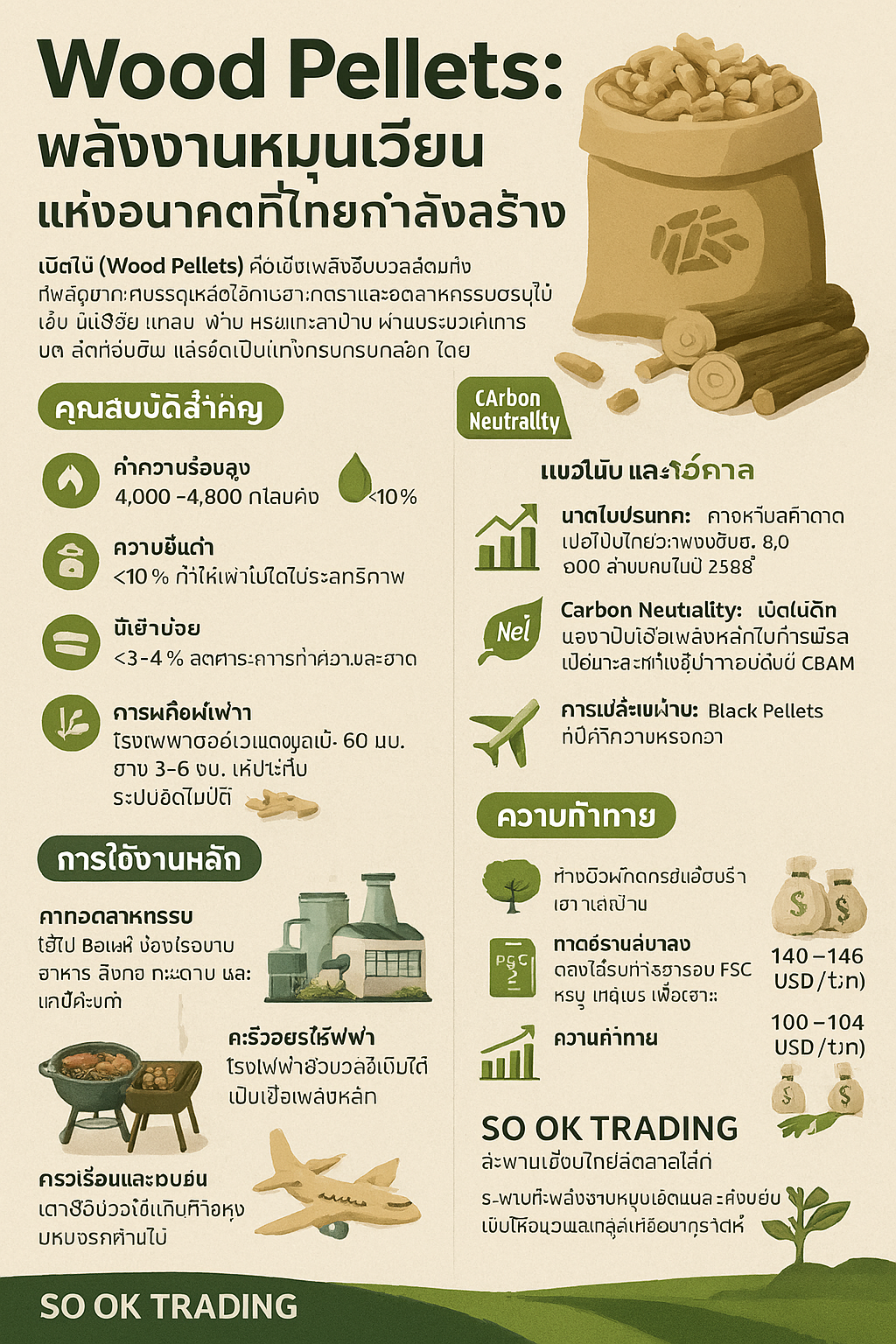
Wood Pellets: The Future of Renewable Energy Thailand is Building

Wood Pellets are biomass fuel made from agricultural and forestry residues such as sawdust, rice husks, straw, or palm shells. These materials are crushed, dried, and compressed into cylindrical pellets, with natural lignin acting as a binder. The result is a fuel with high calorific value, low moisture, low ash content, and consistent size.

This is why wood pellets are seen as the “star” of renewable energy in an era where the world is moving toward Carbon Neutrality and Net Zero.


Key Properties

High calorific value: 4,000–4,300 kcal/kg
Low moisture: <10%, ensuring efficient and stable combustion
Low ash content: <3–4%, reducing cleaning requirements
Standard size: Diameter 6–10 mm, length 3–6 cm, suitable for automated systems
 

⚙️ Main Applications

Industrial Use: Boilers in food, textile, paper, and chemical industries, replacing fossil fuels like coal and fuel oil
Power Generation: Biomass power plants and co-firing with coal (e.g., Mae Moh power plant in Thailand)
Residential & Community: Biomass stoves, pellet grills for barbecue and smoking, animal bedding
Export: Thailand is a major producer in ASEAN, with Japan and South Korea as key markets
 

Trends and Opportunities

Domestic Market: Expected to reach 8 billion THB by 2025, up from 1.3 billion THB in 2021
Carbon Neutrality: Considered a key fuel for achieving Net Zero by 2065
Fuel Transition: Large factories shifting from fossil fuels to wood pellets, responding to EU CBAM measures
Innovation: Development of Black Pellets with higher calorific value and moisture resistance, nearly 100% coal replacement
Export Growth: South Korea accounts for 80% of Thai exports, with Japan’s demand steadily increasing
 

⚠️ Challenges

Raw Material Supply: Ensuring sufficient rubber wood, fast-growing trees, and agricultural residues
International Standards: FSC or ENplus certification required for entry into Japanese and European markets
Competition: Competing with Vietnam, a major exporter with lower production costs
Price Volatility: Japan pays higher (140–146 USD/ton) compared to South Korea (100–104 USD/ton) due to stricter quality standards
 

SO OK TRADING: The Bridge Connecting Thailand to Global Markets

In an era where renewable energy and sustainability are at the heart of the global economy, SO OK TRADING stands as a trusted exporter of premium Thai products — from high-quality fruits and rice to metals and clean energy such as wood pellets


Related Content
Steel Industry Outlook 2026: Gradual Recovery with Rising Price Potential BY SOOK TRADING
Steel Industry Outlook 2026: Gradual Recovery with Rising Price Potential The year 2026 marks a turning point for the global steel industry. After hitting its lowest point in 2025, the market is entering a “new equilibrium,” with demand gradually recovering and prices showing signs of stable upward movement. Global steel demand is forecast to grow 1.3%, reaching 1,773 million tons. India will be the main driver, with growth of 9% fueled by infrastructure investments in roads, railways, and energy. The United States and Europe are also expected to recover steadily, supported by interest rate cuts, clean energy projects, and the automotive sector—1.8% growth in the US and 3.2% in the EU. China, while still facing a slowdown in real estate, will see demand decline ease to -1%, supported by infrastructure projects and steel exports. Meanwhile, Southeast Asia and the Middle East are expected to contribute to diversified demand growth through infrastructure and energy investments. On the pricing side, steel bars (Rebar) are expected to average 16,000–17,000 THB/ton (450–530 USD/MT). Iron ore costs are projected at 83–95 USD/ton, with new supply from Guinea and Australia helping to stabilize input costs. Although trade barriers in the US and EU may keep domestic prices above global levels, the market is moving toward a more stable balance. In Thailand, steel demand is expected to grow modestly, driven by construction and automotive industries, with a base of 16.2 million tons in 2025. However, cheap Chinese steel could account for up to 50% of the market, putting pressure on local producers. Thai businesses must adapt by developing value-added specialty products, enhancing quality standards, and targeting premium and niche export markets such as ASEAN, the Middle East, and Africa. SO OK Trading: Partnering Thai Steel with Global Markets SO OK Trading supports Thai steel producers with comprehensive solutions: - Market Connectivity: Linking Thai producers with buyers in China and East Asia through an extensive partner network and integrated rail–sea–road logistics. - Market Analysis & Pricing Strategy: Providing insights into steel and iron ore price trends, with index-linked pricing recommendations to reduce volatility. - Stable Contracts & Compliance: Assisting in contract structuring, export documentation, standards, and certifications to ensure reliable trade. - Customer Development: Delivering tailored technical and commercial proposals to meet the needs of Chinese buyers seeking specialty steel. SO OK Trading is more than an exporter—it is a trusted business partner, helping Thai steel enterprises compete with stability and sustainability in the global steel market.
15 Jan 2026
SOLAR FARM: ECO ENERGY FROM THE SUNSHINE (FUTURE ENERGY)
"โซลาร์ฟาร์มภาคประชาชน" ในไทยหมายถึงโครงการติดตั้งโซลาร์เซลล์บนหลังคาบ้านเพื่อผลิตไฟฟ้าใช้เอง และขายส่วนเกินเข้าระบบ ซึ่งมีเป้าหมายเพื่อส่งเสริมพลังงานสะอาดและลดค่าไฟ โครงการเหล่านี้ดำเนินการโดย กกพ. และหน่วยงานไฟฟ้า (กฟน., กฟภ.) และอาจมีการรับซื้อไฟฟ้าส่วนเกินในราคาพิเศษ เช่น 2.20 บาทต่อหน่วย เป็นระยะเวลา 10 ปี สำหรับผู้ที่สมัครและผ่านเกณฑ์ โครงการและการสนับสนุน โครงการโซลาร์เซลล์ภาคประชาชน: เป็นโครงการของคณะกรรมการกำกับกิจการพลังงาน (กกพ.) ที่ส่งเสริมการติดตั้งระบบโซลาร์เซลล์บนหลังคาบ้าน เป้าหมาย: เพิ่มกำลังการผลิตไฟฟ้าจากพลังงานแสงอาทิตย์ในภาคประชาชน หน่วยงานรับผิดชอบ: การไฟฟ้านครหลวง (MEA) และ การไฟฟ้าส่วนภูมิภาค (PEA) เป็นผู้ดำเนินการรับสมัครและเชื่อมต่อระบบ การรับซื้อไฟฟ้า: ในปี 2565 มีนโยบายรับซื้อไฟฟ้าจากโซลาร์รูฟท็อปในราคา 2.20 บาทต่อหน่วย เป็นระยะเวลา 10 ปี สำหรับผู้ใช้ไฟฟ้าในพื้นที่ของ MEA (กรุงเทพฯ, นนทบุรี, สมุทรปราการ) การสนับสนุนอื่นๆ: รัฐบาลไทยให้การสนับสนุนผ่านสิทธิประโยชน์ทางภาษีและเงินสนับสนุนการติดตั้ง เงื่อนไขและการสมัคร การยื่นคำขอ: ผู้สนใจต้องยื่นคำขอผ่านเว็บไซต์ของหน่วยงานไฟฟ้า การเชื่อมต่อระบบ: ต้องขออนุญาตเชื่อมต่อกับระบบโครงข่ายไฟฟ้าและติดตั้งอุปกรณ์ตามมาตรฐานของ MEA/PEA เพื่อความปลอดภัย รูปแบบการติดตั้ง: มี 2 แบบ คือติดตั้งเพื่อใช้เองภายในบ้าน และติดตั้งเพื่อขายไฟฟ้าเข้าระบบให้กับทางการไฟฟ้า ตัวอย่างโครงการ โครงการผลิตไฟฟ้าจากพลังงานแสงอาทิตย์ที่ติดตั้งบนหลังคา สำหรับภาคประชาชนประเภทบ้านอยู่อาศัย: เป็นโครงการที่ PEA ดำเนินการรับสมัคร โครงการ Solar ภาคประชาชน ปี 2565: MEA เปิดรับสมัครสำหรับผู้ใช้ไฟฟ้าในพื้นที่ที่รับผิดชอบ
1 Dec 2025
การ Supply วัตถุดิบเช้าโรงงาน แบบ LAST MILES: ประโยชน์ของผู้ประกอบการ (SO OK TRADING Can Provide This Type of Service)
าร Supply วัตถุดิบเข้าโรงงานแบบ Last-mile มีความสำคัญต่อการลดต้นทุน การเพิ่มประสิทธิภาพ และการรักษาความสามารถในการแข่งขัน โดยการจัดส่งวัตถุดิบจากจุดสุดท้ายไปยังโรงงานอย่างรวดเร็วและตรงตามเวลา จะช่วยลดค่าใช้จ่ายที่ไม่จำเป็น เช่น การเก็บสต็อกมากเกินไป, ลดความล่าช้าที่อาจเกิดขึ้นในกระบวนการผลิต, และทำให้การผลิตมีความยืดหยุ่นมากขึ้น เพื่อตอบสนองความต้องการของตลาด. ความสำคัญของการ Supply วัตถุดิบเข้าโรงงานแบบ Last-mile ลดต้นทุนการจัดเก็บวัตถุดิบ: การส่งวัตถุดิบแบบ Just-in-time ช่วยลดความจำเป็นในการสต็อกวัตถุดิบจำนวนมาก ซึ่งทำให้ลดต้นทุนค่าคลังสินค้าและค่าใช้จ่ายในการบริหารจัดการสต็อก. เพิ่มประสิทธิภาพการผลิต: การส่งวัตถุดิบที่จำเป็นในเวลาที่ต้องการ ช่วยป้องกันการหยุดชะงักของสายการผลิต และทำให้การผลิตเป็นไปอย่างราบรื่นและต่อเนื่อง. ตอบสนองความต้องการของตลาด: ช่วยให้โรงงานสามารถผลิตสินค้าได้รวดเร็วขึ้น เพื่อตอบสนองความต้องการของลูกค้าที่เปลี่ยนแปลงอยู่เสมอ. ลดความเสี่ยงจากความผันผวนของตลาด: ทำให้โรงงานสามารถปรับเปลี่ยนการผลิตได้ตามความต้องการของตลาดที่เปลี่ยนแปลง โดยไม่ต้องกังวลกับสต็อกวัตถุดิบที่ล้นเกิน. ใช้ประโยชน์จากเทคโนโลยี: การใช้เทคโนโลยีในการวางแผนเส้นทาง, การติดตามสถานะการขนส่งแบบเรียลไทม์, และการวิเคราะห์ข้อมูล สามารถช่วยลดความผิดพลาดและเพิ่มประสิทธิภาพการจัดส่งวัตถุดิบได้. SO OK Trading สามารถให้บริการ LAST MILE SUPPLY กับลูกค้าที่ใช้บริการ และ ยังสามารถช่วยบริหารจัดการสินค้าคงคลัง พร้อมทั้งประสานงานกับลูกค้า เพื่อการส่งมอบวัตถุดิบ เข้าสายการผลิตอย่างตรงตามเวลา ป้องกันปัญหาวัตถุดิบ ไม่เพียงพอต่อสารการผลิต และ การบริการนี้ยังไม่มีต้นทุนส่วนเพิ่มที่สูงเกินไป คู่ค้าของ SO OK TRADING สามารถแข่งขันในตลาดได้
3 Dec 2025
This website uses cookies for best user experience, to find out more you can go to our Privacy Policy and Cookies Policy
Compare product
0/4
Remove all
Compare
Powered By MakeWebEasy Logo MakeWebEasy