Share

Base Metals Market February 2026: When Volatility Turns into Opportunity - From Volatility to Opportunity: SO OK TRADING ’s In-Depth Analysis of the Base Metals Market: Aluminum, Copper, Zinc, Tin, Lead — The Latest Trends Investors Must Watch
Last updated: 3 Feb 2026
2055 Views

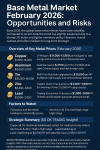
Base Metals Market – February 2026: Opportunities and Risks Investors Must Watch

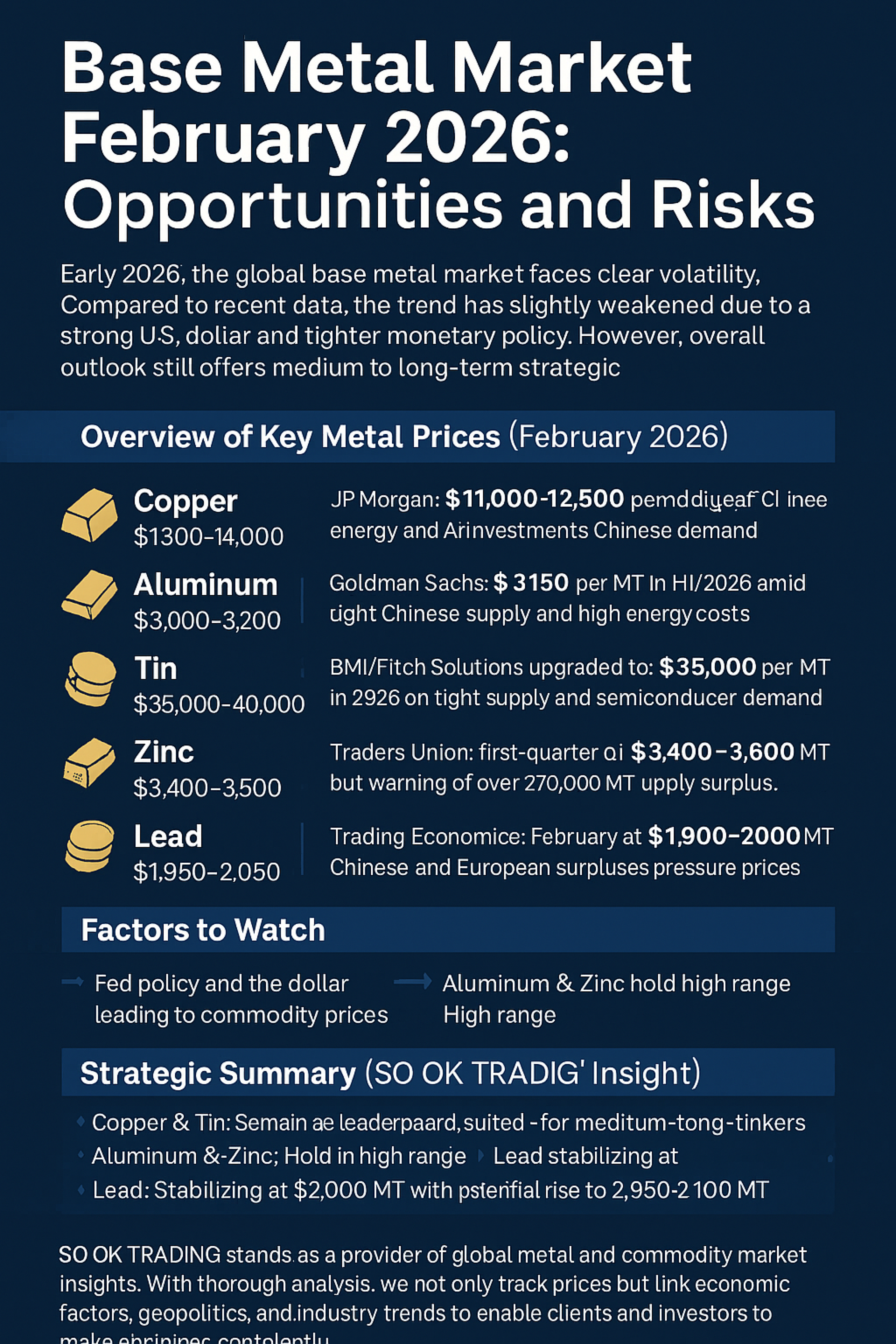
At the start of 2026, the global base metals market is facing clear volatility. Comparing past data with current prices (February 2–3, 2026), the overall trend has softened slightly, pressured by a stronger U.S. dollar and tighter monetary policy. Yet the broader picture still reflects strategic opportunities for medium- to long-term investors.


Key Metal Price Overview (February 2026)

Copper
Trading in the range of USD 13,000–14,000/MT.
JP Morgan forecasts an annual average of USD 11,000–12,500/MT, supported by clean energy and AI infrastructure investment, though Chinese demand remains a concern.
Aluminum
Trading in the range of USD 3,000–3,200/MT.
Goldman Sachs projects USD 3,150/MT for H1 2026, driven by tight Chinese supply and high energy costs.
Tin
Trading in the range of USD 36,000–40,000/MT.
BMI/Fitch Solutions upgraded its 2026 forecast to USD 35,000/MT, citing supply constraints and strong semiconductor demand.
Zinc
Trading around USD 3,400–3,500/MT.
Traders Union expects Q1 averages of USD 3,400–3,600/MT, but warns of a surplus exceeding 270,000 MT.
Lead
Trading in the range of USD 1,950–2,050/MT.
Trading Economics forecasts February averages of USD 1,900–2,000/MT, with oversupply from China and Europe exerting pressure.
 

Factors to Watch

Federal Reserve policy and U.S. dollar strength → Direct impact on commodity prices
EV and clean energy demand → Supporting copper and aluminum
Asian mine supply → Tin and zinc highly sensitive to production news
Geopolitical tensions → Driving risk-hedging purchases
 

Strategic Summary (SO OK TRADING Insight)

Copper & Tin: Continue to lead the market. Prices are unlikely to collapse—holding steady with potential upward moves.
Aluminum & Zinc: Holding firm in high ranges, better suited for hedging than speculation.
Lead: Stable around USD 2,000/MT, with potential to rise toward USD 2,050–2,100/MT.

About SO OK TRADING

SO OK TRADING stands as a trusted provider of global insights into metals and commodities. Our analysis goes beyond price tracking—we connect economic factors, geopolitics, and industry trends to empower clients and investors with confidence in their decisions.

“In a volatile world, base metals are the lifeblood of the global economy — and SO OK TRADING is the partner that helps you spot opportunities before anyone else.”


Related Content
“Tin: From Ordinary Metal to Strategic Resource — The Glue Connecting AI and Clean Energy of the Future”
✨ Tin: The Ordinary Metal Transformed into the “Metal of the Future” ✨ Once, tin was used only to coat food cans. Today, it has evolved into a strategic resource driving the digital economy and clean energy — from AI, semiconductors, EVs to next-generation batteries. Prices are soaring, demand is breaking records Tin is the “glue” connecting AI and data centers Tin is at the heart of battery innovation Tin is no longer just a basic metal. It is now a critical resource the world competes to secure — and it will shape the future of the global economy over the next two decades.
27 Feb 2026
SILVER PRICE TREND AND IT CONTINUE UPWARD ON VALUE FOR YEAR 2026
SILVER PRICE 2026 EVALUATION : The Bank of America believe silver will average around $56 in 2026, but could climb to a peak of $65. Robert Kiyosaki believes $75 can be reached, while analysts at CNBC even suggested $100 is achievable following a breakout above $50. Anyhow according to China Policy (start on 1 JAN 2026) on restrict SILVER to export this might create a shortage on Industry which use silver as raw material such as SEMI-CONDUCTER, ARMY HI-TECH WEAPON, SOLAR CELL, EV Car, This will be the pressure on SILVER PRICE To Increae from 72 USD/ONZE to more than 80 USD/ONZ within Early 2026
2 Jan 2026
เกร็ดความรู้ ซิลิคอน by SO OK
ซิลิคอน (Silicon) คือธาตุสารกึ่งตัวนำสำคัญที่พบมากบนเปลือกโลก (ในรูปซิลิกา) ใช้ทำชิปอิเล็กทรอนิกส์, แผงโซลาร์เซลล์, แก้ว, เซรามิก, และผสมโลหะ; ส่วน ซิลิโคน (Silicone) คือพอลิเมอร์ที่ใช้ทำกาวอุดรอยรั่ว, สารหล่อลื่น, เครื่องสำอาง, ยา, และอุปกรณ์การแพทย์ คุณสมบัติเด่นคือทนความร้อน, ทนสารเคมี, เป็นฉนวนไฟฟ้า, ยืดหยุ่น, และกันน้ำ แม้ชื่อคล้ายกัน แต่คือคนละอย่าง. เกร็ดความรู้เกี่ยวกับ ซิลิคอน (Silicon - Si) (ธาตุ) ธาตุสำคัญ: เป็นธาตุที่พบมากเป็นอันดับสองในเปลือกโลก (รองจากออกซิเจน) มักอยู่ในรูปซิลิก้า (Silicon Dioxide - SiO2) เช่น ทราย, ควอตซ์. หัวใจอิเล็กทรอนิกส์: ซิลิคอนบริสุทธิ์พิเศษ (Doped Silicon) เป็นหัวใจของวงจรรวม (IC) และเซมิคอนดักเตอร์ในคอมพิวเตอร์, สมาร์ทโฟน, และแผงโซลาร์เซลล์. โลหะผสม: ผสมกับอะลูมิเนียมเพื่อทำชิ้นส่วนรถยนต์ และผสมเหล็กเพื่อทำเหล็กกล้า. เกร็ดความรู้เกี่ยวกับ ซิลิโคน (Silicone - พอลิเมอร์สังเคราะห์) คุณสมบัติมหัศจรรย์: ทนร้อน/เย็นจัด, กันน้ำ, ยืดหยุ่น, เป็นฉนวนไฟฟ้า, ทนสารเคมี, ไม่ติดไฟ. งานก่อสร้าง: กาวซิลิโคนใช้อุดรอยต่อกระจก, หน้าต่าง, หลังคา, ป้องกันน้ำรั่วซึม. เครื่องสำอาง: ทำให้ผลิตภัณฑ์เกลี่ยง่าย, เงางาม, ติดทนนาน (เช่น ลิปสติก), นุ่มลื่น (เช่น แชมพู). ทางการแพทย์: ใช้ในอุปกรณ์ทางการแพทย์, และซิลิโคนเจลสำหรับแผลเป็น. ระวังโรคปอด: การสูดดมฝุ่นผงซิลิก้า (ซิลิคอนไดออกไซด์) เป็นเวลานานในงานก่อสร้าง (เช่น โม่หิน) อาจทำให้เป็นโรคปอดฝุ่นหิน (Silicosis) ได้. ข้อแตกต่างที่สำคัญ ซิลิคอน (Silicon - Si): ธาตุโลหะ (สารกึ่งตัวนำ). ซิลิโคน (Silicone): สารประกอบพอลิเมอร์สังเคราะห์ที่มาจากซิลิคอน (มีออกซิเจนและคาร์บอน) มีความยืดหยุ่นและใช้งานหลากหลายกว่า.
11 Dec 2025
This website uses cookies for best user experience, to find out more you can go to our Privacy Policy and Cookies Policy
Powered By MakeWebEasy Logo MakeWebEasy