Share

Cassava chips and pellets from Thailand are reaching far and wide — from China and the Middle East to global markets. Strong demand in animal feed, bioenergy, and industrial applications continues to position Thailand as a world leader in cassava exports.
Last updated: 24 Jan 2026
1209 Views

Situation and Outlook of Thailand’s Cassava Export Market in 2026

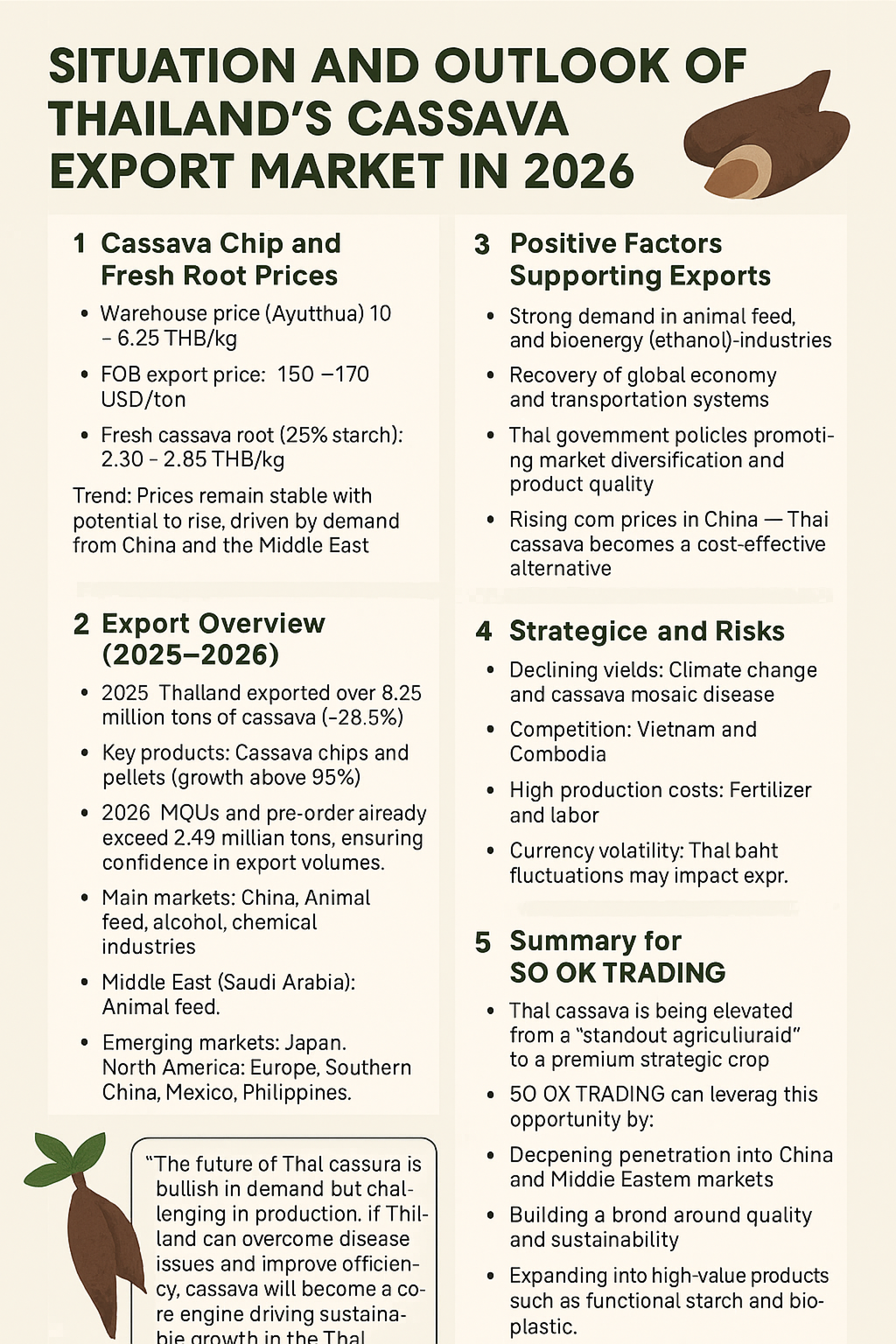
1. Cassava Chip and Fresh Root Prices

Warehouse price (Ayutthaya): 6.10 – 6.25 THB/kg
FOB export price: 160 – 170 USD/ton
Fresh cassava root (25% starch): 2.30 – 2.85 THB/kg
Trend: Prices remain stable with potential to rise, driven by demand from China and the Middle East
 

2. Export Overview (2025–2026)

2025: Thailand exported over 8.25 million tons of cassava (+26.53%)
Key products: Cassava chips and pellets (growth above 95%)
2026: MOUs and pre-orders already exceed 2.46 million tons, ensuring confidence in export volumes
Main markets:
China: Animal feed, alcohol, chemical industries
Middle East (Saudi Arabia): Animal feed
Emerging markets: Japan, North America, Europe, Southern China, Mexico, Philippines
 

3. Positive Factors Supporting Exports

Strong demand in animal feed and bioenergy (ethanol) industries
Recovery of global economy and transportation systems
Thai government policies promoting market diversification and product quality
Rising corn prices in China → Thai cassava becomes a cost-effective alternative
 

4. Challenges and Risks

Declining yields: Climate change and cassava mosaic disease
Competition: Vietnam and Cambodia
High production costs: Fertilizer and labor
Currency volatility: Thai baht fluctuations may impact exporters’ income
 

5. Strategic Outlook (2026–2027)

Market diversification: Reduce reliance on China (80–90%) by expanding into Saudi Arabia, Japan, and the EU
Product upgrading:
Functional starch for pharmaceuticals, cosmetics, and health foods
Bioplastic as eco-friendly plastic
Technology-driven production: Precision agriculture and disease-resistant varieties to boost yields
Continued investment: Ethanol, animal feed, chemicals, adhesives, paper
 

6. Summary by SO OK TRADING

Thai cassava is being elevated from a “standout agricultural product” to a “premium strategic crop.”
SO OK TRADING can leverage this opportunity by:

Deepening penetration into China and Middle Eastern markets
Building a brand around quality and sustainability
Expanding into high-value products such as functional starch and bioplastic
Positioning strategically: from “cassava exporter” to “global value creator in industry”
 

✨ Key Message

“The future of Thai cassava is bullish in demand but challenging in production. If Thailand can overcome disease issues and improve efficiency, cassava will become a core engine driving sustainable growth in the Thai agricultural economy.”


Related Content
“Renewable Revolution – Transforming Global Energy with Biomass and Solar Power: The Green Choice the World Embraces”
Alternative Energy – Biofuels The Game Changer Set to Replace Fossil Fuels and Coal The world is moving forward into the era of clean energy. Energy is no longer just the driving force of the economy—it is also the key to preserving environmental balance and securing the future of humanity. This transition is not merely about technology; it is about laying a new foundation for the global energy system, reshaping how we think about and use energy forever. Alternative energy sources such as Solar Cells and Wood Pellets are becoming central to electricity generation and industry worldwide, with costs steadily decreasing and efficiency rising significantly. While China and Europe are rapidly installing hundreds of gigawatts of renewable energy each year, Asian countries like Japan, South Korea, and Thailand are also accelerating their clean energy transition to achieve Net Zero Emissions within the coming decades. Today, SO OK TRADING is ready to be your trusted business partner in this new energy era. We provide comprehensive solar cell installation services and high-quality wood pellets for export, ensuring your business keeps pace with the global shift toward clean energy with confidence.
17 Apr 2026
Twin Storms Shaking the World: The Naphtha–Fertilizer Crisis — Turning Point into the High-Cost Era, Plastics & Food Prices Surge Worldwide Written by SO OK TRADING April 10, 2026
The Naphtha & Fertilizer Crisis: Two Storms Shaking the World & ASEAN In April 2026, the world faces a double shock — a severe shortage of Naphtha and chemical fertilizers triggered by the Hormuz Strait conflict. From skyrocketing plastic costs to soaring food prices, this crisis is reshaping global supply chains and pushing ASEAN into a new High-Cost Era. But amid disruption lies opportunity:
10 Apr 2026
“Global Raw Material Crisis: Hormuz Eases, Energy Landscape Transforms — Oil Plunges, Naphtha Softens, Fertilizer Remains Costly”
Global Raw Material Crisis: From Middle East Conflict to the Recovery of Energy and Industrial Markets SO OK TRADING | April 18, 2026 After the tension in the Strait of Hormuz that sent oil and raw material prices soaring, the world is now witnessing clear signs of easing and recovery. Crude oil prices have dropped sharply, naphtha is gradually stabilizing though still costly, and chemical fertilizers remain expensive. Yet the overall direction is a tangible return to balance. ⛽ Oil: Prices fell immediately after Iran reopened the Strait of Hormuz ⚗️ Naphtha: Supply is returning, but full recovery will take time
18 Apr 2026
This website uses cookies for best user experience, to find out more you can go to our Privacy Policy and Cookies Policy
Powered By MakeWebEasy Logo MakeWebEasy