SO OK TRADING'S MARKET INSIGHT | When the World Slows Down but Metal Demand Keeps Growing: Decoding the LME Ahead of the Next Commodity Recovery Cycle
SO OK TRADING'S MARKET INSIGHT | LME Outlook | December 2026
Supply Remains Tight as the Global Economy Enters a Cooling Phase
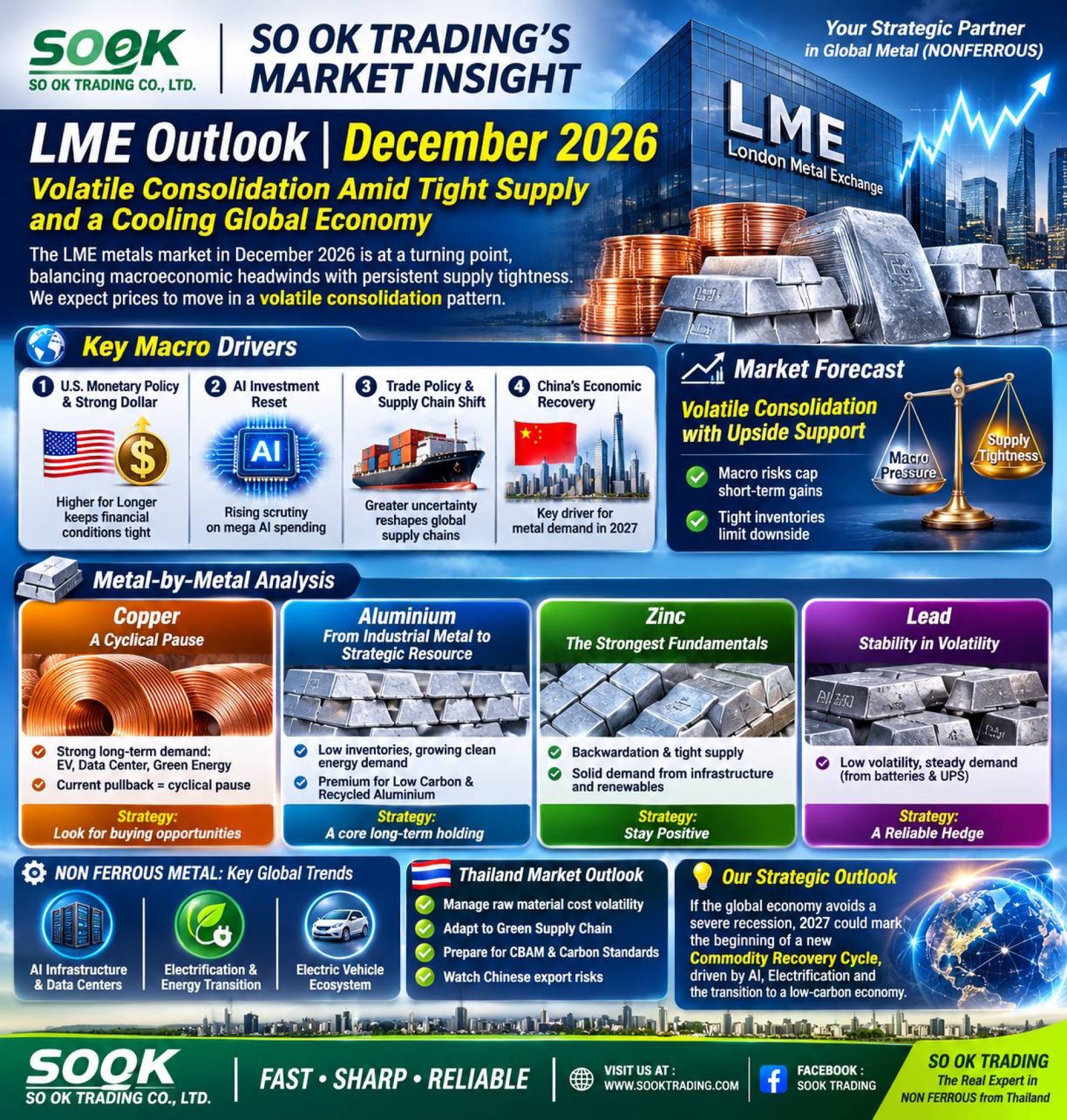
The global industrial metals market is approaching a critical inflection point in December 2026. On one side, markets continue to face macroeconomic headwinds; on the other, supply conditions remain tight across several key metal markets. Against this backdrop, LME base metals are expected to trade within a Volatile Consolidation environment, characterized by heightened volatility and ongoing price adjustments.
While elevated U.S. interest rates, a stronger U.S. dollar, and slowing global manufacturing activity continue to cap short-term upside, declining inventories across several major metals are providing underlying support and reducing the risk of a sharp market correction.
Key Macroeconomic Drivers Shaping the Market
1. U.S. Monetary Policy and Dollar Strength
Markets remain focused on the "Higher for Longer" narrative, reflecting expectations that U.S. policy rates may remain elevated for longer than previously anticipated.
This environment increases global financing costs, weighs on risk appetite, and reduces the attractiveness of commodities as an investment asset class.
2. Reassessing the Value of AI Infrastructure Investments
Over the past 18-24 months, AI and Data Center investments have been among the most important drivers of industrial metals demand.
However, investors are increasingly scrutinizing the return on investment from large-scale AI projects.
Although the long-term growth trajectory remains intact, near-term adjustments in market expectations could create additional volatility for metals closely linked to the AI theme, particularly Copper and Tin.
3. Trade Policies and Global Supply Chain Reconfiguration
Uncertainty surrounding international trade policies, tariffs, and increasingly stringent environmental regulations continues to accelerate the restructuring of global supply chains.
These developments have significant implications for metal flows, inventory management strategies, and raw material costs across multiple industries.
4. China's Economic Recovery
China remains the world's largest consumer of industrial metals.
As a result, trends in manufacturing activity, infrastructure spending, and government stimulus measures will play a critical role in determining global metal demand throughout 2027.
Analysis of Key Metals
Copper: A Cyclical Pause in a Structural Growth Story
Copper experienced significant selling pressure throughout November as investors moderated expectations surrounding AI-driven demand growth and adjusted to the prospect of prolonged high interest rates.
Nevertheless, supply-side fundamentals remain largely unchanged. Physical markets continue to exhibit tightness, while investment in Data Centers, Electric Vehicles, Smart Grids, and Renewable Energy continues to support long-term demand.
Strategic View
The recent weakness in Copper prices appears more consistent with a cyclical consolidation phase than the beginning of a long-term bearish trend.
Aluminium: From Industrial Metal to Strategic Resource
Although market tightness has eased somewhat following LME regulatory measures and incremental inventory growth, global stock levels remain significantly below long-term historical averages.
At the same time, demand from clean energy projects, power transmission infrastructure, electric vehicle manufacturing, and low-carbon development continues to provide strong support.
Strategic View
Aluminium is increasingly evolving from a traditional industrial metal into a Strategic Metal, essential to the global energy transition and decarbonization agenda.
In particular, Low-Carbon Aluminium and Recycled Aluminium are expected to command increasing premiums over the long term.
Zinc: The Strongest Fundamental Story in the Near Term
Zinc continues to stand out among base metals, supported by declining LME inventories, persistent backwardation, and constrained mine supply.
While China's property sector has yet to achieve a full recovery, demand from infrastructure projects, renewable energy investments, and galvanized steel production remains resilient.
Strategic View
Under current market conditions, Zinc maintains one of the healthiest supply-demand balances among industrial metals and is well-positioned to demonstrate greater price resilience than many of its peers.
Lead: Stability Amid Market Volatility
Lead remains the least volatile metal in the base metals complex despite the existence of a global market surplus.
Replacement battery demand, Data Center UPS systems, and telecommunications infrastructure continue to provide important sources of consumption.
Strategic View
For manufacturers seeking greater predictability in raw material costs, Lead remains one of the most stable and manageable metals within the industrial metals sector.
Non-Ferrous Metals Are Reshaping Global Demand Patterns
1. AI Infrastructure and Data Centers
The rise of AI represents more than a technological trend. It is creating substantial new demand for Copper, Aluminium, and other power-related metals.
The rapid expansion of hyperscale Data Centers worldwide is becoming one of the most powerful drivers of industrial metal consumption this decade.
2. Electrification and the Energy Transition
The shift toward clean energy, grid modernization, and renewable power generation continues to support long-term demand growth for Copper, Aluminium, and Zinc.
3. The Electric Vehicle Ecosystem
Although EV growth rates may moderate from peak levels, the industry's expansion remains firmly intact.
The EV ecosystem is expected to remain a key driver of industrial metals demand for years to come.
Implications for Thai Industry
Thai manufacturers are facing two critical challenges simultaneously.
The first is managing raw material costs amid elevated market volatility.
The second is adapting to the emergence of Green Supply Chains as a new global standard.
The European Union's Carbon Border Adjustment Mechanism (CBAM) and increasingly stringent carbon footprint requirements from international customers will create significant competitive advantages for companies capable of securing low-carbon and recycled raw materials.
At the same time, rising exports of semi-finished and finished products from China continue to pose margin pressures across multiple manufacturing sectors in Thailand.
Executive Outlook
The global metals market is transitioning from a speculation-driven cycle toward a more fundamentally driven valuation environment.
While macroeconomic pressures are likely to continue weighing on prices in the near term, supply constraints and long-term structural growth trends remain supportive of the sector's broader outlook.
Zinc currently offers the strongest near-term fundamentals, while Copper and Aluminium remain at the center of long-term global growth themes driven by AI Infrastructure, Electrification, and the Energy Transition. Lead, meanwhile, continues to stand out for its relative price stability.
If the global economy can avoid a severe recession, 2027 could mark the beginning of a new Commodity Recovery Cycle, driven by investments in AI Infrastructure, Electrification, Energy Transition initiatives, and the ongoing shift toward a low-carbon global economy.
SO OK TRADING
Your Trusted Business Partner
FAST | SHARP | RELIABLE
www.sooktrading.com
SOOK TRADING
SO OK TRADING: Thailand's Trusted Non-Ferrous Metals Specialist
Delivering expertise, reliability, and long-term value to the global non-ferrous metals industry.