SO OK TRADING'S EXECUTIVE INSIGHT | When Supply Becomes Power: Who Will Dominate the Global Aluminum Market After the Middle East Crisis? | 27 NOV 2026
SO OK TRADING'S EXECUTIVE INSIGHT
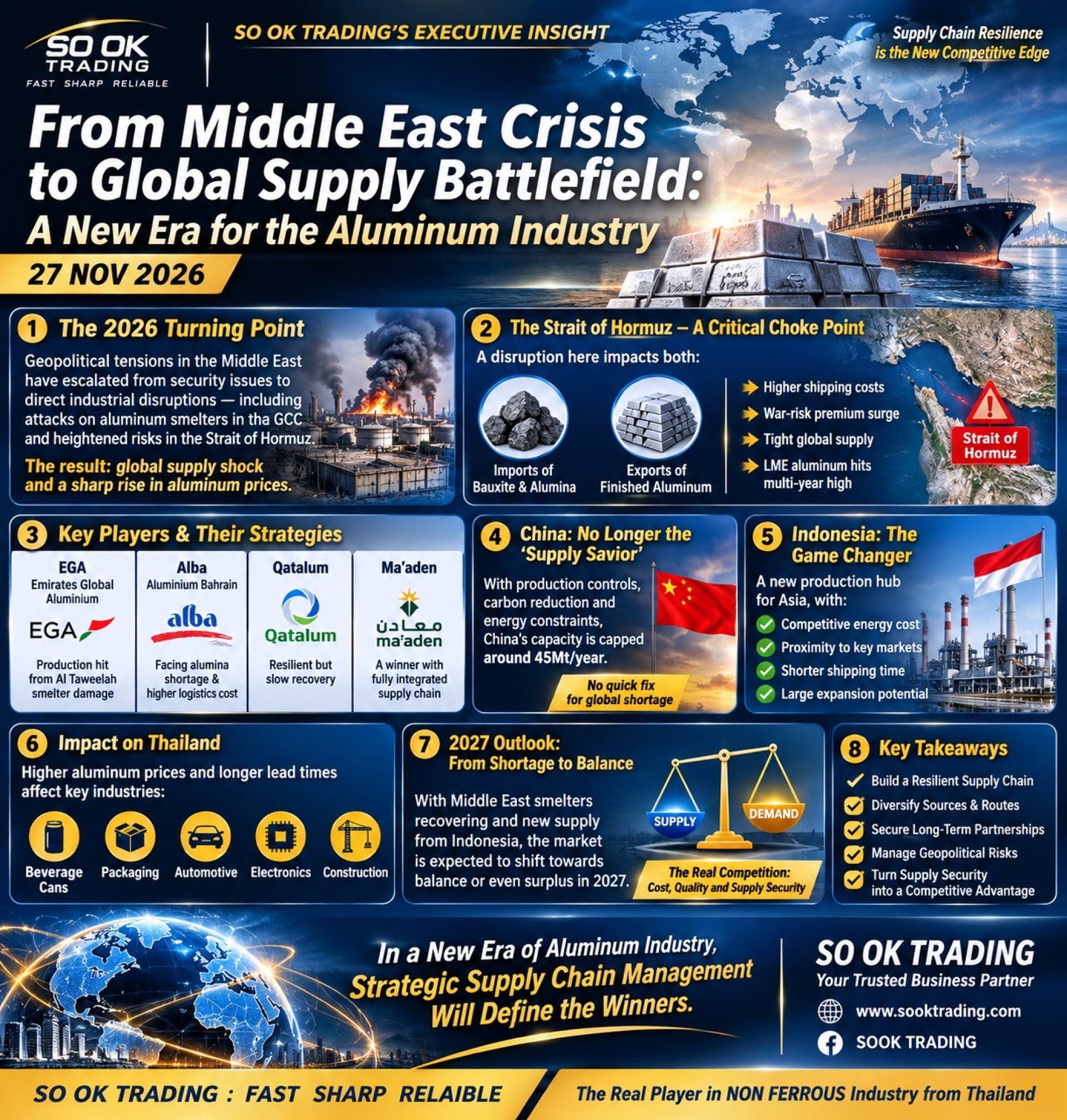
From the Middle East Crisis to the Global Supply Battlefield: How the Aluminum Industry Is Entering a New Era of Competition
27 NOV 2026
2026 marks a pivotal turning point for the global aluminum industry. As geopolitical tensions in the Middle East spilled beyond security concerns and directly impacted industrial operations, attacks on aluminum smelters across the Gulf Cooperation Council (GCC) countries and disruptions surrounding the Strait of Hormuz sent shockwaves through global supply chains unlike anything seen in recent years.
Although the Middle East accounts for only around 8–9% of global aluminum production, it serves as one of the world's most important export hubs, connecting markets across Asia, Europe, and North America. As regional supply became constrained, the impact spread rapidly throughout the entire value chain, from raw material suppliers and rolling mills to automotive component manufacturers, beverage can producers, construction firms, and energy-related industries.
While 2026 was defined by supply shortages, 2027 is shaping up to be a year of market rebalancing. More importantly, it may mark the beginning of a new competitive landscape where success is determined not only by production costs, but also by the ability to build resilient supply chains capable of withstanding geopolitical disruptions.
When the Strait of Hormuz Became a Turning Point for the Global Market
This crisis reinforced a critical lesson for modern industry: logistics risks can be just as damaging as the loss of production capacity.
The Strait of Hormuz, one of the world's most strategically important shipping routes, emerged as a major bottleneck for the aluminum industry.
The disruption affected both:
Imports of upstream raw materials such as bauxite and alumina
Exports of finished aluminum products to global markets
As shipping routes became constrained, many producers faced raw material shortages while freight rates, war-risk premiums, and logistics costs surged dramatically.
The result was the loss of several million tonnes of annual production capacity across the region, pushing the global aluminum market into immediate tightness and driving LME aluminum prices to their highest levels in years.
A Critical Reality Exposed by the Crisis
The world is not simply facing a shortage of production capacity.
It is increasingly confronting the risks associated with highly concentrated trade routes and critical logistics infrastructure.
EGA: A Supply Hub Turned Vulnerability
Emirates Global Aluminium (EGA), the largest aluminum producer in the Middle East, was directly impacted by damage to its Al Taweelah smelter.
Production disruptions significantly reduced export volumes and became one of the key drivers behind the sharp rise in global aluminum prices.
Although partial operations have resumed, a full return to pre-crisis production levels will require additional time and investment.
Alba and Qatalum: A Crisis Beyond Production Losses
Aluminium Bahrain (Alba) and Qatalum faced challenges that extended far beyond operational disruptions.
Key challenges included:
Alumina shortages
Rising logistics costs
Delivery uncertainties
Lengthy restart times for smelting operations
As a result, production recovery has remained gradual, with normalization expected to take several more quarters.
Ma'aden: The Structural Winner of the Crisis
If one company demonstrated the true value of Supply Chain Resilience during this crisis, it was Saudi Arabia's Ma'aden.
The company's key advantage lies in its fully integrated value chain, including:
Bauxite mining operations
Alumina refining facilities
Aluminum smelters
Aluminum rolling operations (MRC)
This vertically integrated model significantly reduces dependence on external raw material supplies and minimizes exposure to supply chain disruptions.
Despite higher logistics expenses, Ma'aden maintained operational continuity and delivered record financial performance while many competitors struggled with severe operational challenges.
The key lesson from Ma'aden is clear:
In today's business environment, competitive advantage is not defined solely by having the lowest cost structure. It is defined by the ability to maintain operational continuity during periods of disruption.
Why China Could Not Rescue the Market This Time
For more than two decades, China has served as the balancing force of the global aluminum market.
Whenever supply shortages emerged, China could rapidly increase production and stabilize market conditions.
However, the situation changed in 2026.
Production caps, carbon reduction policies, and energy constraints have pushed China's aluminum industry close to its policy-imposed capacity ceiling of approximately 45 million tonnes per year.
As a result, the market has lost its largest potential source of rapid supply growth, allowing shortages to persist longer than many analysts initially anticipated.
Implications for Thailand's Industrial Sector
For Thailand, the impact of the crisis extended far beyond higher metal prices.
1. Significant Increases in Raw Material Costs
At the peak of the disruption, aluminum prices surged above USD 3,500 per tonne, placing substantial cost pressure on industries including:
Beverage cans
Packaging materials
Automotive manufacturing
Home appliances
Construction and architectural products
2. Longer Lead Times
Extended delivery schedules forced companies to increase inventory levels, resulting in higher working capital requirements and additional financial costs.
3. Supply Concentration Risks
The crisis highlighted the dangers of relying heavily on a limited number of suppliers or regions, prompting many organizations to reassess their procurement and sourcing strategies.
A Major Turning Point: The World Is Moving Beyond the Peak of the Crisis
Although 2026 was characterized by supply shortages, the outlook for 2027 suggests a different market environment.
Recovery Across the Middle East
EGA continues restoring operations at Al Taweelah
Qatalum is steadily increasing utilization rates
Alba is gradually recovering export volumes
Ma'aden continues investing in expansion projects
At the same time, substantial new production capacity from Indonesia is entering the global marketplace.
Indonesia: The New Force Reshaping Asia's Aluminum Landscape
One of the most significant developments in the global aluminum sector is Indonesia's rapid emergence as a major production hub.
Supported by large-scale international investment, particularly from Chinese investors, Indonesia is positioning itself as a key aluminum production center for Asia.
Its competitive advantages include:
✅ Competitive energy costs
✅ Proximity to Asian consumption markets
✅ Shorter shipping routes compared with the Middle East
✅ Significant long-term expansion potential
For Thailand, Indonesia's rise could represent a strategic opportunity to diversify supply sources and strengthen long-term raw material security.
ALUMINUM Outlook 2027
From Supply Shortages to Cost Competition
Leading financial institutions and industry research firms increasingly expect the global aluminum market to transition from deficit conditions in 2026 toward balance, or even surplus, in 2027.
If that scenario materializes, the industry's central question will no longer be:
"Where can we secure aluminum supply?"
Instead, it will become:
"Who can consistently deliver high-quality aluminum at a competitive cost while maintaining reliable supply security?"
Conclusion
The 2026 Middle East aluminum crisis was far more than a commodity market disruption.
It represented a major stress test for global supply chains and exposed the vulnerabilities embedded within the modern industrial ecosystem.
As Middle Eastern production recovers, China remains constrained by capacity policies, and Indonesia emerges as a new manufacturing powerhouse, the global aluminum industry is entering a new era where competitive advantage will be determined not only by production scale and pricing, but also by risk management and supply chain resilience.
Over the next 12 to 24 months, the companies that manage supply risks most effectively will not simply survive market volatility. They may emerge as the dominant winners of the next industrial cycle.
SO OK TRADING believes this is the moment for executives to shift their focus from raw material procurement to strategic supply chain design.
In the post-crisis world, supply security and supply chain resilience will become some of the most powerful competitive advantages an organization can possess.
SO OK TRADING
Your Trusted Business Partner
FAST • SHARP • RELIABLE
VISIT US AT: www.sooktrading.com
FACEBOOK: SO OK TRADING
SO OK TRADING
Thailand's Trusted Expert in the Non-Ferrous Metals Industry