SO OK TRADING'S INSIGHT | LME Inventories at a 36-Year Low: From Supply Shortage to the Race for Aluminum Supply in 2027
SO OK TRADING'S INSIGHT | When LME Aluminium Inventories Hit a 36-Year Low: Is the Market Signaling a Supply Shortage or Preparing for a New Global Supply Cycle?
23 November 2026
The global aluminium market is experiencing one of its most striking economic contradictions in decades.
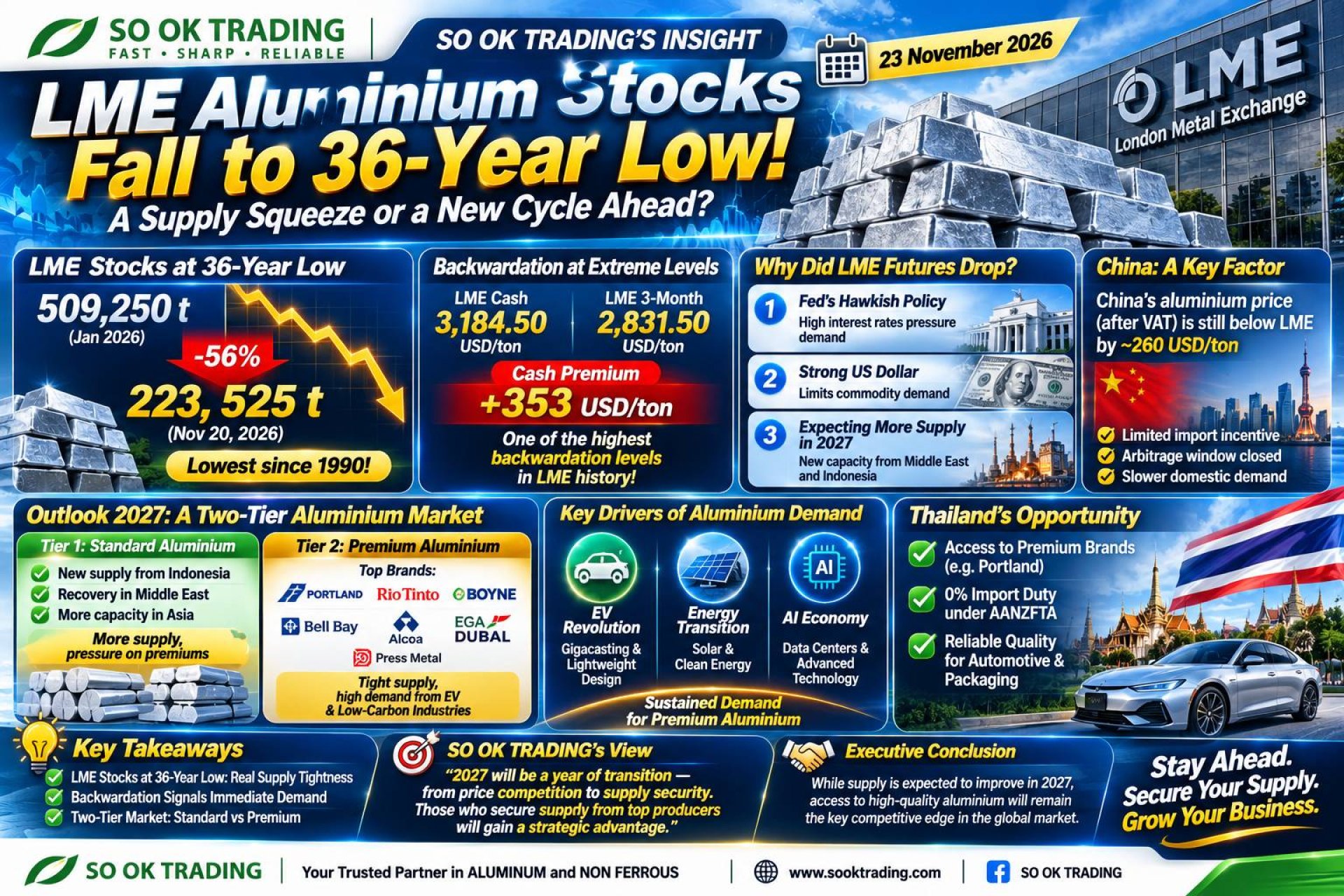
On one hand, aluminium inventories held in London Metal Exchange (LME) warehouses have fallen to approximately 223,525 metric tons, the lowest level since 1990 and the lowest in more than 36 years. This has created severe tightness in the physical market, leading to one of the most significant episodes of backwardation and short squeeze pressures seen in recent decades.
On the other hand, LME 3-Month aluminium prices have declined to their lowest levels in more than a year, reflecting the financial market's growing focus on the prospect of stronger global supply growth in 2027 rather than the immediate shortage facing the industry today.
This divergence is sending an important message to producers, industrial consumers, and importers worldwide:
The key risk in the aluminium market is shifting from a simple shortage of material to a competition for access to high-quality and reliable supply.
LME Inventories at a 36-Year Low: More Than a Number, a Sign of Structural Fragility
At the beginning of 2026, LME aluminium inventories stood at approximately 509,250 metric tons. Within less than a year, inventories declined by more than 56%, falling to just 223,525 metric tons.
However, the real issue extends far beyond inventory volume alone.
A large portion of the metal remaining in LME warehouses originates from Russia. Many buyers in Europe and North America face policy restrictions, commercial considerations, or risk management concerns regarding the acceptance of Russian-origin metal. As a result, the quantity of metal that is genuinely available for commercial circulation is substantially lower than official inventory figures suggest.
At the same time, Cancelled Warrants continue to increase, indicating that additional material is earmarked for withdrawal from the warehouse system, further reducing immediately available supply.
The result is a genuine Supply Squeeze, particularly for consumers seeking internationally accepted primary aluminium grades from major global producers.
The Most Severe Backwardation in Decades
The clearest consequence of this supply shortage has been the sharp increase in Cash Aluminium prices.
As of 20 November 2026
LME Cash: USD 3,184.50/MT
LME 3-Month: USD 2,831.50/MT
Cash Premium over 3-Month: USD 353/MT
This spread represents one of the most extreme backwardation structures ever recorded in the LME aluminium market.
Under normal circumstances, commodity markets typically trade in contango, where forward prices exceed spot prices due to financing and storage costs.
Today, however, buyers are willing to pay over USD 350 per ton simply to obtain metal immediately.
The implication is clear: the market's primary concern is no longer price, but availability.
Traders without physical metal are being forced to source material urgently, while industrial consumers are increasing inventories to secure production continuity. Together, these factors have significantly reduced liquidity in the physical supply chain.
The Market Paradox: Why Are Futures Prices Falling?
Despite severe tightness in the physical market, LME 3-Month prices have declined by nearly 8% within a single month.
Three key factors explain this development:
1. Expectations of Higher U.S. Interest Rates
Investors continue to believe that the Federal Reserve may maintain a restrictive monetary stance, keeping financing costs elevated and limiting future demand growth for industrial metals.
2. A Stronger U.S. Dollar
The continued strength of the Dollar Index has increased the cost of dollar-denominated commodities for global buyers, reducing purchasing power and putting pressure on demand.
3. Expectations of Additional Supply in 2027
The market increasingly views the 2026 supply deficit as a temporary phenomenon.
Smelters in the Middle East are expected to return to full operating capacity, while new production projects in Indonesia and other parts of Asia are anticipated to add significant volumes to the global market over the next year.
In other words:
The futures market is trading the future, while the physical market is dealing with today's reality.
China: A Critical Factor That Has Yet to Ease Global Tightness
Another important signal comes from the relationship between LME prices and the Shanghai Futures Exchange (SHFE).
Although Chinese aluminium prices appear higher than LME prices when VAT is included, SHFE prices fall below LME Cash levels by approximately USD 260 per ton after removing China's 13% VAT.
This indicates that:
Import economics into China remain unattractive.
The arbitrage window remains effectively closed.
Significant volumes of international aluminium are not flowing into China.
Global demand has yet to receive meaningful support from Chinese imports.
Meanwhile, China's domestic demand remains seasonally weak, causing SHFE prices to underperform relative to LME prices.
2027 Outlook: The Emergence of a Two-Tier Aluminium Market
The most important theme for 2027 is that while the overall market may return to balance or even surplus conditions, supply growth will not be distributed equally across all market segments.
A clear two-tier structure is emerging.
Tier 1: Standard Aluminium Market
This segment is expected to benefit from:
New smelting capacity in Indonesia
Production recovery in the Middle East
Additional supply growth across Asia
As a result, buyers are likely to enjoy greater sourcing flexibility, while regional premiums may face downward pressure.
Tier 2: Premium Aluminium Market
This segment includes leading brands such as:
Portland
Rio Tinto
Boyne
Bell Bay
Alcoa
EGA / Dubal
Press Metal
Even if LME prices soften, supply from these producers is expected to remain tight due to several structural factors:
Most smelters are already operating near full capacity.
Few major expansion projects are planned in the near term.
Significant production volumes are committed under long-term contracts.
Demand from EV manufacturing continues to expand.
Low-carbon aluminium demand is growing globally.
Packaging, beverage, and food industries continue to prioritize quality consistency and secure supply.
Implications for Thailand and Aluminium Ingot Consumers
For Thailand, the primary challenge is not simply securing aluminium, but securing premium-quality aluminium at competitive cost.
Portland Aluminium from Australia remains one of the most sought-after brands because it offers:
Consistent metal quality
Strong suitability for automotive and packaging applications
Zero import duty under AANZFTA
Wide acceptance across global supply chains
Although the Portland smelter has returned to full production capacity, spot availability remains limited because a significant portion of production has already been allocated under long-term agreements with major industrial consumers.
As a result, the challenge of obtaining premium material in Thailand may persist even if the global aluminium market moves into surplus territory.
Executive Conclusion
The decline in LME aluminium inventories to a 36-year low clearly demonstrates that the physical aluminium market remains exceptionally tight in the short term and highlights the underlying fragility of the global aluminium supply chain.
At the same time, financial markets are signaling that the current shortage cycle may be approaching its final stage, with substantial new supply expected to enter the market during 2027.
For executives, the key strategic question is therefore no longer limited to the direction of LME prices.
Instead, the focus should be on securing long-term access to high-quality and reliable sources of aluminium supply.
SO OK TRADING'S VIEW
2027 may mark the transition from an era of price competition to an era of supply security competition. Companies that can maintain allocation agreements with world-class producers and secure reliable access to premium aluminium will enjoy a significant strategic advantage, even as the broader market moves toward balance.
SO OK TRADING : Your Business Partner
SO OK TRADING : FAST • SHARP • RELIABLE
VISIT US AT: WWW.SOOKTRADING.COM
FACEBOOK: SO OK TRADING
SO OK TRADING
Thailand's Trusted Specialist in Aluminium and Non-Ferrous Metals
The Real Aluminium & Non-Ferrous Metals Expert from Thailand