SO OK TRADING'S INSIGHT | From Safe Haven to Liquidity Asset: Decoding the Gold and Silver Correction Ahead of a New Market Cycle in 2027 | 22 NOV 2026
SO OK TRADING'S INSIGHT
Gold & Silver Outlook 2027: How the Precious Metals Correction Is Reflecting a Transformation in the Global Financial System
22 NOV 2026
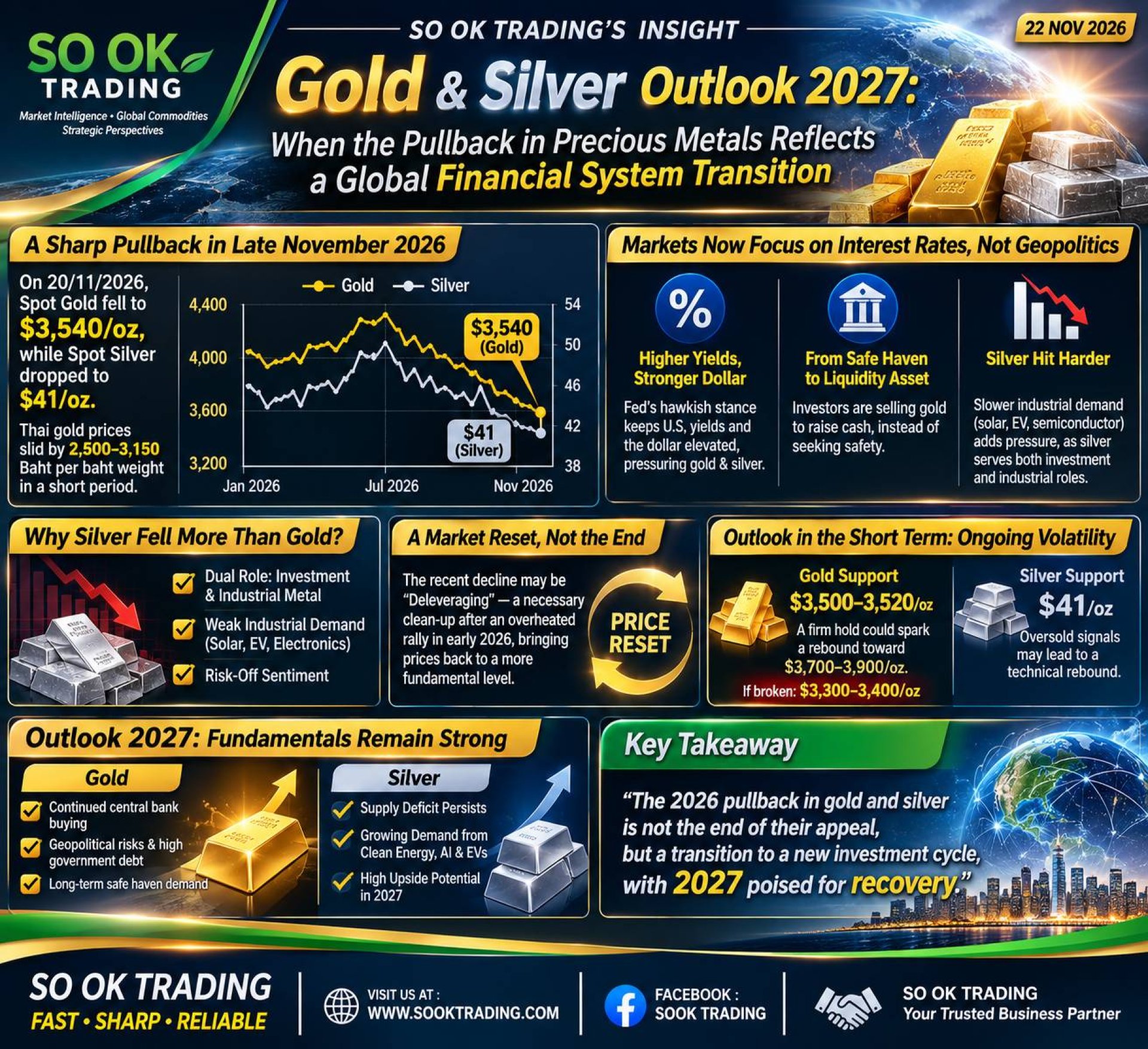
In late November 2026, the global precious metals market experienced a significant wave of selling pressure. As of November 20, 2026, Spot Gold had declined to around US$3,540 per ounce, while Spot Silver fell to approximately US$41 per ounce. The sharp correction also impacted Thailand's domestic gold market, where gold prices dropped by approximately THB 2,500-3,150 per baht-weight within a short period.
While many market participants may view this movement as a normal correction following the strong rally earlier in the year, a broader strategic perspective suggests something more profound. The recent decline is highlighting a structural shift in global financial markets, as investor focus moves away from the era of abundant liquidity and returns to the fundamentals of interest rates, funding costs, and monetary policy.
Markets Are Prioritizing Interest Rates Over Geopolitical Risks
For years, geopolitical uncertainty has been one of the primary drivers supporting gold prices. Gold has traditionally benefited from its role as a Safe Haven asset during periods of global instability.
However, the latest correction suggests that market priorities are changing. Investors are now placing greater emphasis on the direction of U.S. monetary policy than on ongoing geopolitical tensions.
Expectations that the U.S. Federal Reserve (Fed) may maintain a tighter monetary stance have pushed the U.S. dollar and Treasury yields higher. As a result, gold and silver, which do not generate interest income, are facing increasing opportunity costs compared with yield-bearing assets.
This development indicates that interest rates are once again becoming the dominant force driving global capital flows and asset valuations.
Gold Is Evolving from a Safe Haven into a Liquidity Asset
Another notable development is the behavior of institutional investors and large investment funds.
Instead of attracting safe-haven inflows during periods of uncertainty, gold has increasingly been used as a source of liquidity. Many investors have chosen to sell gold holdings in order to raise cash, reduce portfolio risk, or meet margin requirements.
Several factors are contributing to this behavior:
Margin call management
Portfolio risk reduction
Capital rotation into higher-yielding assets
As a result, gold is temporarily functioning more as a Liquidity Asset than as a traditional Safe Haven.
Why Has Silver Declined More Sharply Than Gold?
Although gold has come under significant pressure, silver has suffered an even more severe correction.
The key reason lies in silver's dual identity:
A precious metal investment asset
A critical industrial raw material
As global economic growth slows, demand from industries such as:
Solar Energy
Electric Vehicles (EVs)
Semiconductors
Electronics
has weakened. At the same time, investors have been reducing exposure to higher-volatility assets.
Silver therefore faces pressure from both financial markets and industrial demand, which explains why its decline has been substantially larger than that of gold.
This Correction May Be a Market Reset Rather Than the End of the Cycle
Looking back to early 2026, both gold and silver benefited significantly from abundant global liquidity and aggressive speculative activity.
The rapid price appreciation during that period led to elevated leverage across investment portfolios and derivative markets.
As interest rate expectations shifted, markets entered a Deleveraging Cycle, triggering widespread position reductions among institutional investors, hedge funds, and algorithmic trading systems.
Consequently, the current correction resembles a Price Reset rather than a structural reversal of the long-term precious metals cycle.
Instead of signaling the end of the bull market, the recent decline may represent the market's attempt to realign prices with underlying fundamentals.
Short-Term Outlook: Volatility Is Far From Over
In the near term, market direction will remain heavily influenced by U.S. monetary policy.
For gold, the US$3,500-3,520 per ounce range represents a crucial psychological support level.
If prices can hold above this zone, the market may attract renewed buying interest, with potential upside toward US$3,700-3,900 per ounce.
However, a decisive break below support could open the door to a deeper correction toward US$3,300-3,400 per ounce.
For silver, although the broader trend remains weak, several technical indicators have entered deeply oversold territory.
If silver can maintain support above US$41 per ounce, the probability of a meaningful technical rebound may increase.
Outlook 2027: Long-Term Fundamentals Continue to Support Recovery
Despite short-term challenges, the medium- and long-term outlook for precious metals remains supported by several structural drivers.
For gold, continued purchases by central banks around the world provide a strong foundation for demand. This is particularly evident among emerging economies seeking to diversify reserves away from excessive dependence on the U.S. dollar.
In addition, several key factors continue to support gold's long-term investment case:
Persistent geopolitical uncertainty
Rising global debt levels
Structural economic and financial risks
Together, these factors reinforce gold's role as a strategic store of value and portfolio hedge.
Silver's long-term outlook is equally compelling.
Although prices have corrected sharply, the market continues to face a structural Supply Deficit, while demand from high-growth industries remains strong, including:
Renewable Energy
Data Centers
Artificial Intelligence Infrastructure
Electric Vehicles
Should the global interest rate cycle begin to ease during 2027, silver could emerge as one of the most attractive opportunities within the precious metals sector.
Conclusion
The decline in gold and silver prices throughout 2026 does not necessarily reflect a loss of relevance for precious metals.
Rather, it highlights a broader transformation in the global investment landscape, as markets transition from an era dominated by excess liquidity to one increasingly driven by capital costs and interest rates.
In the short term, investors will continue to face volatility stemming from monetary policy uncertainty and the direction of U.S. interest rates.
From a strategic perspective, however, the current correction may be laying the groundwork for the next recovery cycle in 2027.
Ultimately, the most important question may not be:
"How much further can gold and silver fall?"
but rather:
"Is the market creating an attractive accumulation opportunity ahead of the next growth cycle?"
SO OK TRADING
Market Intelligence • Global Commodities • Strategic Perspectives
SO OK TRADING: Your Business Partner
FAST • SHARP • RELIABLE
VISIT US AT: www.sooktrading.com
FACEBOOK: SOOK TRADING