“Global–China–Thailand Economy 2026: SO OK TRADING Analysis — New Engines Accelerating, ASEAN Emerging as the Stage of Opportunity” : 4 September 2026
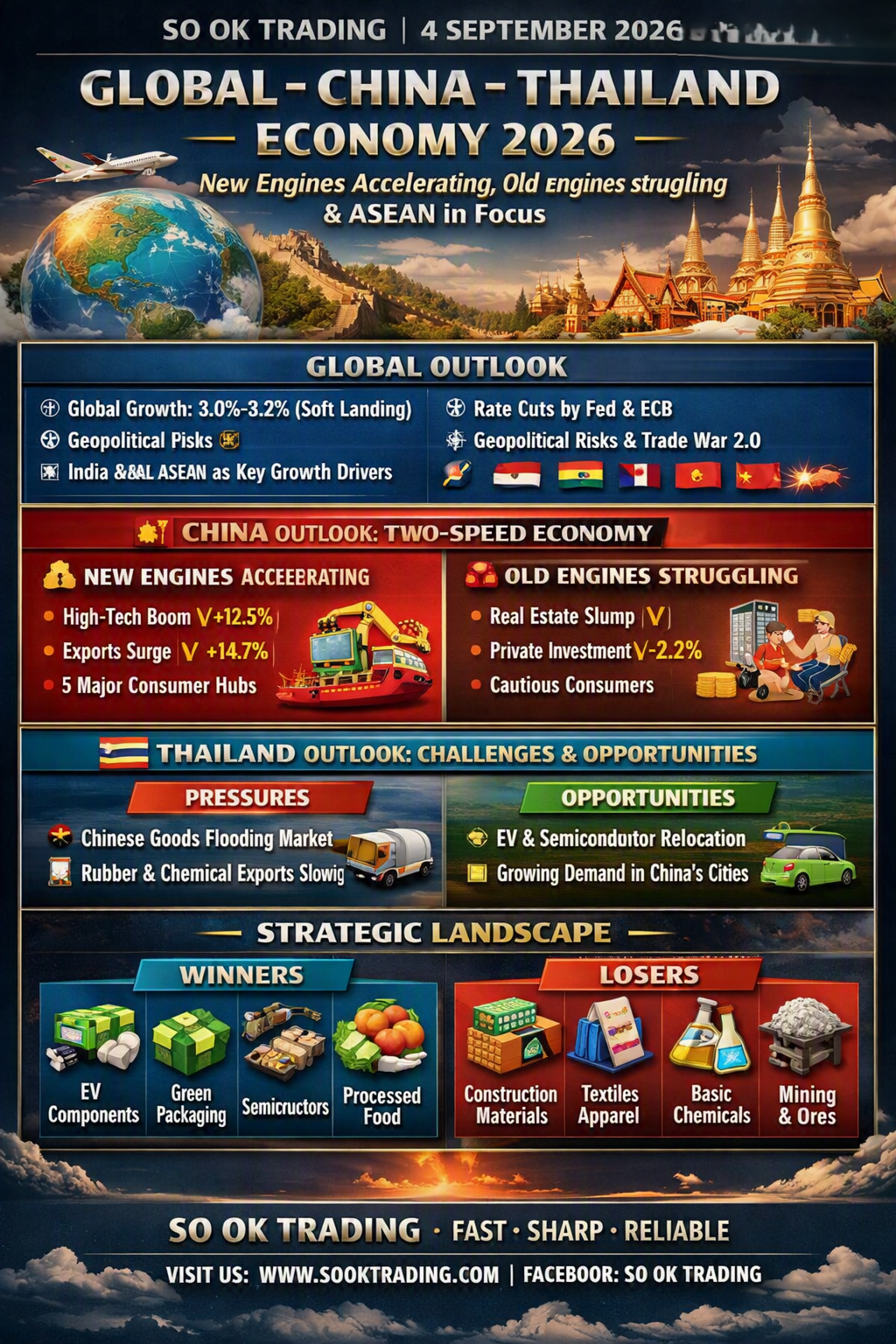
Global–China–Thailand Economy 2026
Article by SO OK TRADING | 4 September 2026 New Engines Accelerating, Old Engines Struggling, and ASEAN Emerging as the Stage of Opportunity
Introduction
The year 2026 marks an era of “multi-speed economies,” as the world undergoes a major transformation. Global growth is expected to remain modest at 3.0%–3.2%, entering a soft landing phase as inflation gradually eases. However, geopolitical risks and the ongoing Trade War 2.0 between the U.S. and China continue to pressure global supply chains, driving diversification under the China+1 Strategy.
Meanwhile, China has successfully maintained its growth target of 4.5%–5.0%, yet internally reveals a clear “two-speed economy”: high-tech industries and exports are accelerating rapidly, while real estate and domestic consumption remain sluggish.
For Thailand and ASEAN, 2026 represents a critical turning point — facing pressures from the influx of Chinese goods while seizing new opportunities from China’s relocation of production bases into the region.
Global Outlook
Growth remains low at 3.0%–3.2%
Major central banks (Fed, ECB) enter rate-cut cycles
Geopolitical risks and Trade War 2.0 weigh on supply chains
India and ASEAN emerge as new growth engines
China Outlook
H1 GDP growth at 4.7%, within target range
New Engines: High-tech +12.5% (3D printing +54%, lithium-ion batteries +40.8%), exports +14.7%
Old Engines: Real estate slump, private investment down 2.2%
Government pushes 5 major cities as global consumption hubs and enforces clean energy policies
Thailand Outlook
Pressures: Chinese goods flooding the market, rubber and chemical exports slowing
Opportunities: EV and semiconductor relocation, electronics–PCB growth, premium demand in China’s urban centers
Structural Dynamics
Global slowdown, but China remains the “game-setter” through technology and clean energy
Thailand and ASEAN face dual challenges — price pressure from Chinese goods and opportunities from supply chain relocation
China–Thailand relations extend beyond trade into strategic supply chain integration
China’s Two-Speed Economy in 2026
Fast Lane: High-tech and exports booming
Slow Lane: Real estate slump, cautious consumers, private investment contraction
Policy Response: Infrastructure stimulus, consumer hub development, clean energy transition
Impact on Thailand
Negative: Market flooding by Chinese goods, slowdown in rubber and chemical exports
Positive: EV and semiconductor relocation, strong demand for Thai electronics and PCB, premium market opportunities in China’s major cities
Deep Dive into 4 Thai Industries
Aluminum: Price dumping risk in construction grade, but opportunities in EV and electronics components
Packaging: Growth aligned with high-tech and food exports, urgent need for green packaging innovation
Minerals: Slowdown tied to China’s real estate, except rare earths with sustained demand
Agriculture: Fruits and processed foods remain in demand, premium market penetration requires high safety standards
✨ Conclusion
The Global–China–Thailand economy in 2026 reflects the reality of “multi-speed growth.” While the world slows, China sustains its targets through new engines. Thailand and ASEAN must adapt wisely — avoiding price wars with Chinese goods while leveraging production relocation to upgrade long-term economic structures.
SO OK TRADING — Your Business Partner
FAST • SHARP • RELIABLE www.sooktrading.com Facebook: SO OK TRADING