SO OK TRADING'S INSIGHT | Antimony Outlook 2027: From Supply Shortage Premium to Strategic Materials Premium in a Reordered Global Economy: 20 NOV 2026
SO OK TRADING'S INSIGHT | Antimony Market Outlook 2026–2027
From the Era of Supply Shortages to the Era of Quality Competition and Global Supply Chain Transformation
In November 2026, the global antimony market entered a critical transition phase. After reaching multi-year highs driven by concerns over global supply shortages, prices have begun to face pressure from slowing demand growth and the return of production capacity outside China.
Antimony prices across China, Europe, and the United States have moved lower simultaneously, while buyers around the world are shifting their focus from stockpiling raw materials for supply security toward evaluating the real value of downstream industrial demand.
As a result, the key question today is no longer, "Will antimony prices fall further?" but rather, "What kind of new economic and industrial landscape is the market establishing a price foundation for?"
The Global Antimony Market Is Entering a Correction Phase
Market data from mid-November 2026 indicates a broad softening trend across global antimony markets.
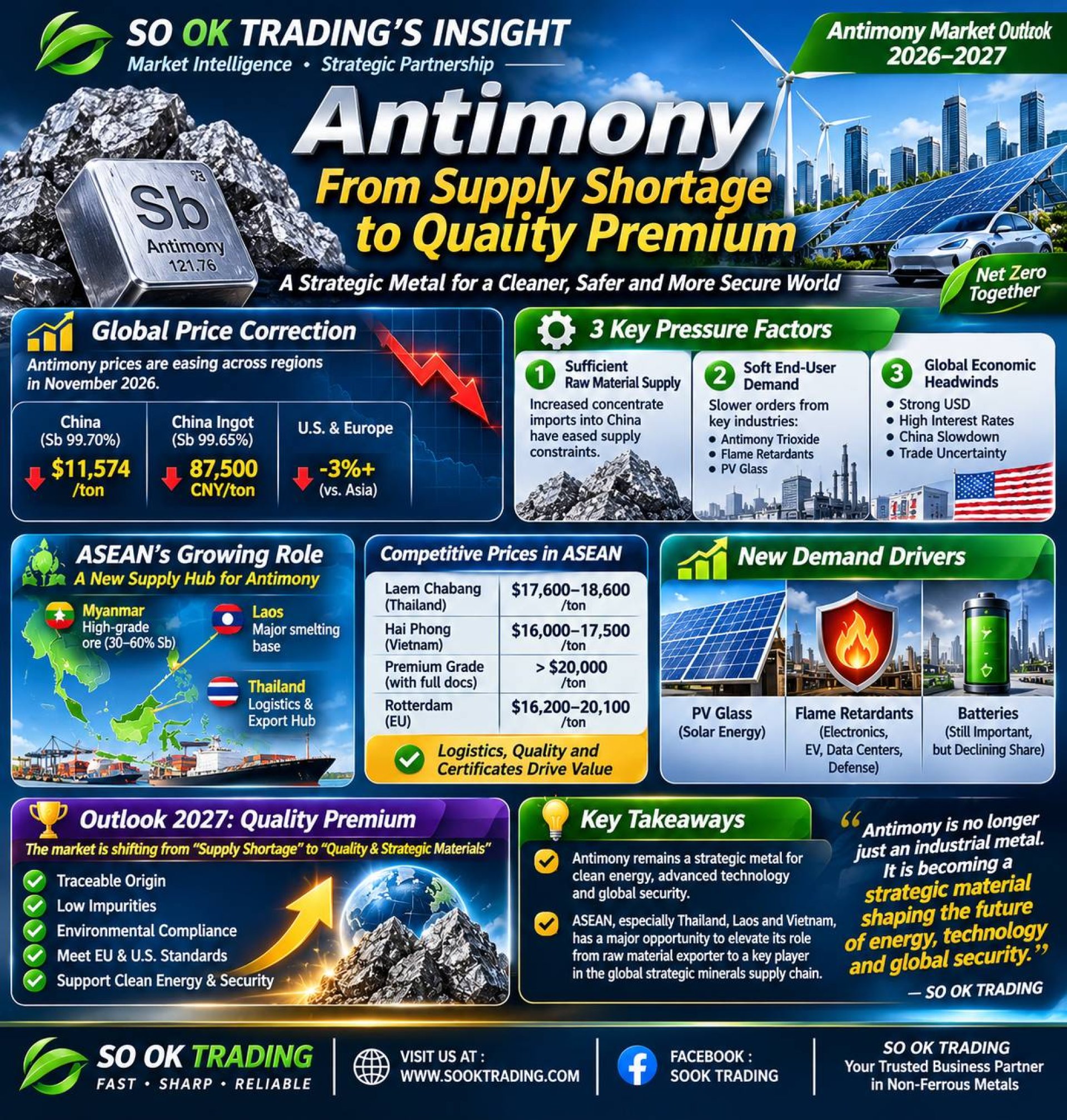
Chinese antimony (Sb 99.70%) declined to approximately USD 11,574 per metric ton.
Chinese antimony ingot (Sb 99.65%) remained relatively stable around RMB 87,500 per metric ton.
U.S. and European markets experienced sharper declines than Asia.
High-purity antimony (5N–7N) fell by more than 3%.
This correction follows the supply-driven rally of 2025, when tight availability pushed prices to historic highs. Since then, new smelting capacity across ASEAN has gradually helped rebalance the market.
Three Key Factors Pressuring Prices in the Short Term
1. Raw Material Supply Has Recovered
Chinese smelters have built substantial inventories following significant imports of antimony ore in recent months.
As supply constraints ease, the market is increasingly focusing on actual consumption rather than concerns over material availability.
2. Downstream Demand Remains Soft
Several major consumer sectors continue to show cautious purchasing behavior, including:
Antimony Trioxide (ATO)
Flame Retardants
Photovoltaic (PV) Glass
Weak order activity has caused antimony compounds to decline ahead of antimony ingots, creating downward pressure throughout the supply chain.
3. Global Economic Headwinds Persist
The market continues to face challenges from:
A stronger U.S. dollar
Higher-for-longer interest rates
Slower Chinese economic growth
Ongoing uncertainty in global trade
Together, these factors have weighed on industrial metals markets worldwide.
ASEAN Is Emerging as a New Global Hub for Antimony
The most significant change in the antimony market over the past two years has not been price movement, but the restructuring of global supply chains.
As China tightened export controls, many producers began relocating smelting and processing operations to neighboring countries.
Myanmar
Myanmar has become the region's primary source of antimony ore.
Many deposits contain grades of 30%–60% Sb, making them a crucial feedstock source for regional smelters.
Laos
Laos has rapidly developed into ASEAN's leading antimony smelting hub.
Many facilities are backed by foreign investment seeking to diversify supply away from China-related export risks.
Thailand
Thailand has emerged as a key logistics, consolidation, and export center.
Laem Chabang Port plays a particularly important role in serving markets such as:
The United States
The European Union
Japan
India
Vietnam and Cambodia
Both countries are strengthening their positions as recognized suppliers of antimony ingots to Western markets due to their ability to issue internationally accepted Certificates of Origin (CO).
ASEAN Antimony Ingot Exports Remain Competitive
Despite softer global prices, ASEAN producers continue to enjoy structural advantages.
Indicative FOB Export Prices
Laem Chabang Port: USD 17,600–18,600 per metric ton
Hai Phong Port: USD 16,000–17,500 per metric ton
Premium-grade products with complete documentation: Above USD 20,000 per metric ton
At the same time, warehouse prices in Rotterdam remain around USD 16,200–20,100 per metric ton.
This highlights how logistics capabilities, product quality, and traceable origin documentation are becoming just as important as the metal itself in determining market value.
Thailand's Growing Role in the Global Antimony Supply Chain
Thailand has attracted increasing attention due to the sharp rise in antimony ore imports from Myanmar.
Import volumes have surged from only a few thousand tons per year to tens of thousands of tons annually during 2024–2025.
This development has intensified discussions around:
Supply chain traceability
Environmental standards
Cross-border pollution management
Transparency throughout the supply chain
These issues may become increasingly important determinants of future competitiveness and operating costs.
Antimony Is Evolving Beyond Batteries Toward Clean Energy and Strategic Security
While the lead-acid battery industry remains a major consumer of antimony, its share of overall demand continues to decline.
Meanwhile, several emerging sectors are driving new growth opportunities.
Photovoltaic (PV) Glass
One of the fastest-growing applications for antimony.
Antimony compounds are used to improve glass clarity and enhance solar energy efficiency.
Flame Retardants
Flame retardants continue to represent a stable and important demand base.
Key end-use industries include:
Electronics
Automotive
Data Centers
Energy Infrastructure
Defense Industries
Defense has become an increasingly important growth driver.
Many countries are expanding military spending and building strategic reserves of critical minerals.
Outlook 2027:
From "Supply Shortage Premium" to "Quality & Strategic Materials Premium"
During 2024–2025, antimony prices were largely driven by fears of supply shortages.
However, the market is entering a new phase in 2026–2027.
Buyers are no longer looking solely for available material.
They are increasingly demanding antimony that is:
✅ Traceable and verifiable in origin
✅ Low in impurities
✅ Environmentally compliant
✅ Eligible for export to the U.S. and European markets
✅ Suitable for clean energy and strategic industries
This means the future winners may not be those with the largest resource base, but rather those capable of delivering high-quality antimony supported by transparent and reliable supply chains.
Conclusion
The global antimony market is transitioning from an era defined by supply shortages to one driven by quality, traceability, and supply chain security.
Although prices may remain under pressure in the short term due to economic uncertainty and softer demand, antimony continues to strengthen its position as a critical mineral for clean energy, advanced technologies, and national security.
For ASEAN countries, particularly Thailand, Laos, and Vietnam, this is more than just another commodity cycle. It represents a rare opportunity to move beyond raw material exports and become indispensable participants in the world's strategic minerals supply chain.
SO OK TRADING'S INSIGHT
"Antimony is no longer just an industrial metal. It is becoming a strategic material shaping the future of energy, technology, and global security."
SO OK TRADING : Your Business Partner
SO OK TRADING : FAST • SHARP • RELIABLE
VISIT US AT: www.sooktrading.com
FACEBOOK: SO OK TRADING
SO OK TRADING
A Leading Non-Ferrous Metals Specialist from Thailand
Connecting global industries with reliable, high-quality non-ferrous metal solutions and strategic supply chain expertise.