SO OK TRADING'S INSIGHT Decoding the Future of the Beverage & Aluminum Can Packaging Industry in Thailand and ASEAN Growth Trends, Market Outlook & Strategic Opportunities (2026–2030) 14 November 2026
SO OK TRADING'S INSIGHT
Overview and Outlook of the Beverage & Aluminum Can Packaging Industry in Thailand and ASEAN
14 November 2026
The beverage and aluminum can packaging industry in Thailand and across the ASEAN region is entering a new phase of growth. Economic recovery, the expansion of the middle class, increasing urbanization, and rising demand for Ready-to-Drink (RTD) beverages are creating strong market momentum. At the same time, growing consumer awareness of health and sustainability is reshaping purchasing behavior and influencing product innovation throughout the industry.
Aluminum can packaging is benefiting directly from the global sustainability movement and the transition toward a Circular Economy. As a packaging material that is 100% recyclable and infinitely recyclable, aluminum has become a preferred choice for beverage manufacturers throughout Thailand and the ASEAN region.
1. Thailand Beverage Market Outlook (2026–2028)
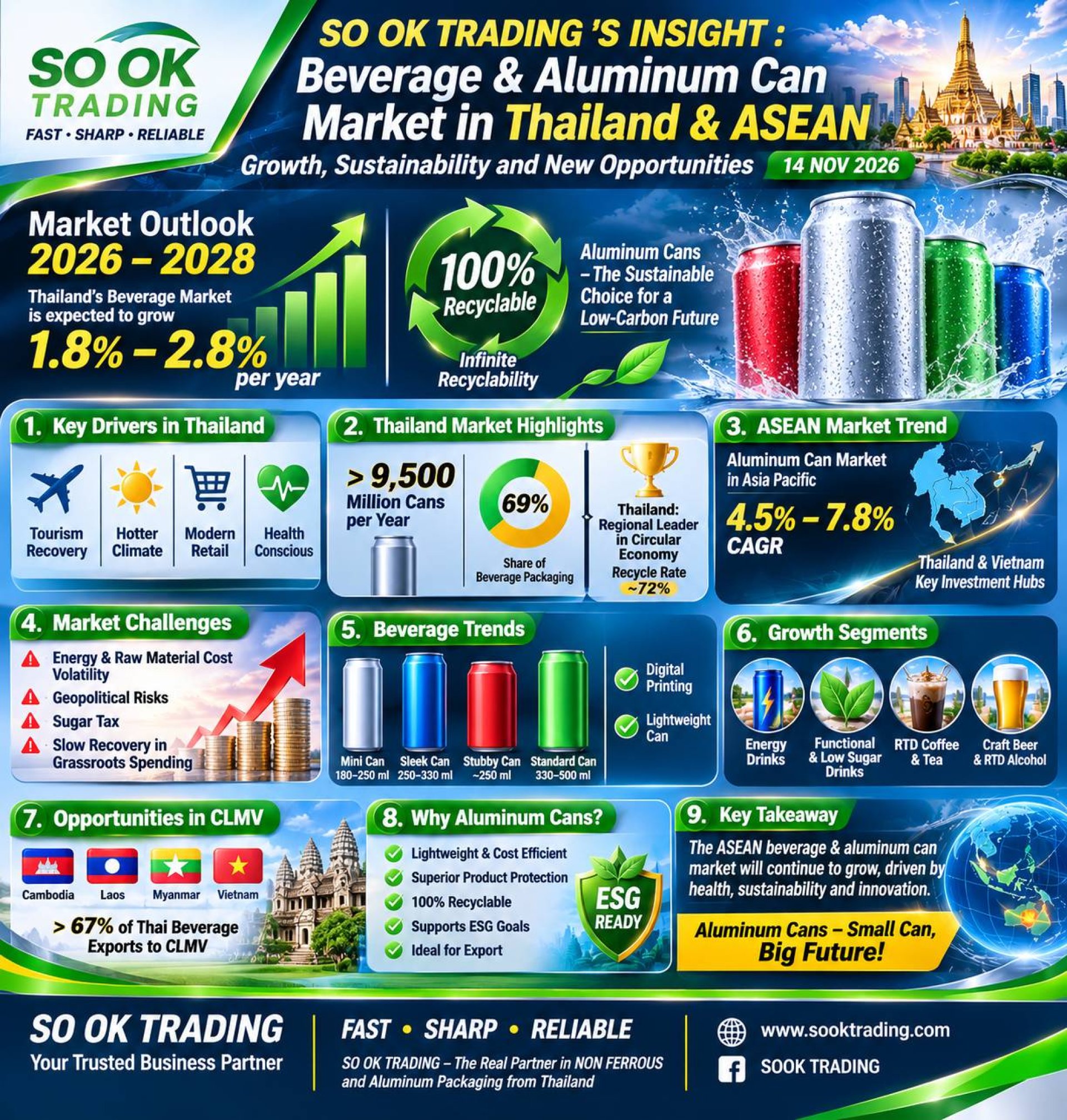
Thailand's beverage industry is expected to continue its steady expansion, with production and domestic sales volumes projected to grow at an average annual rate of approximately 1.8%–2.8%.
Key Growth Drivers
1. Recovery of Tourism and Domestic Consumption
The rebound of both international and domestic tourism is driving higher beverage consumption, particularly across restaurants, hotels, and entertainment venues.
2. Rising Temperatures and Hot Weather
Increasing temperatures across Thailand and many ASEAN countries are supporting growing demand for refreshing beverages and Ready-to-Drink products.
3. Expansion of Modern Retail Channels
Convenience stores, supermarkets, and food delivery platforms continue to increase their reach and accessibility, particularly in urban and secondary cities.
4. Health and Wellness Trends
Consumers are increasingly shifting toward low-sugar, sugar-free, functional, and wellness-oriented beverages, encouraging manufacturers to diversify and reposition their product portfolios.
Emerging Trend: Small-Pack and RTD Consumption
Leading beverage brands are introducing smaller packaging formats, including 180ml, 200ml, and 250ml cans, to meet the growing "Solo Drinking" trend. These smaller serving sizes also offer greater affordability in an environment of rising living costs.
2. Key Challenges Facing the Aluminum Can Industry
Volatility in energy costs
Fluctuations in raw material and packaging prices driven by geopolitical uncertainties
Sugar tax regulations
Gradual recovery of consumer purchasing power in lower-income segments
3. Thailand's Aluminum Can Packaging Market
Thailand is recognized as one of Southeast Asia's leading centers for high-quality packaging production, particularly for beverage aluminum cans.
Today, Thailand's aluminum can market exceeds 9.5 billion cans annually and accounts for approximately 69% of the country's beverage packaging sector.
Thailand's Competitive Advantages
Circular Economy Leadership
Thailand is the only country in ASEAN with a fully integrated Closed-Loop Aluminum Can Recycling System and boasts the highest aluminum can recycling rate in the region at approximately 72%.
Regional Manufacturing Hub
Major industry players continue to expand production capacity to support growing demand across Thailand and neighboring countries, particularly in the CLMV markets.
Strong ESG Credentials
Several Thai can manufacturers have obtained internationally recognized sustainability certifications and are capable of producing cans with high recycled-content aluminum, supporting global beverage companies in achieving their carbon reduction targets.
4. ASEAN Aluminum Can Market Outlook
ASEAN remains one of the fastest-growing regions in the world for beverage and aluminum can packaging industries. Growth is supported by a growing middle class, urbanization, and increasingly mobile lifestyles driven by on-the-go consumption.
The Asia-Pacific aluminum can market is projected to grow at a compound annual growth rate (CAGR) of approximately 4.5%–7.8% over the long term, with Thailand and Vietnam serving as key investment and production hubs.
Major Market Growth Drivers
Rising demand for Ready-to-Drink (RTD) beverages
Expansion of convenience store networks
Growth of On-Trade channels such as restaurants, bars, and entertainment venues
Environmental regulations and restrictions on single-use plastics
Many ASEAN governments are introducing Extended Producer Responsibility (EPR) policies, encouraging manufacturers and global beverage brands to adopt recyclable packaging solutions.
5. Growing Packaging Trends
5.1 Mini Cans and Sleek Cans
Small-sized and slim-format cans are currently the fastest-growing packaging segment in the market.
Popular formats include:
Slim Can (180–250 ml)
Sleek Can (250–330 ml)
Stubby Can (250 ml)
Standard Can (330–500 ml)
These packaging formats help create a premium image, improve consumer convenience, and align with the growing preference for single-serve consumption.
5.2 Digital Printing Technology
Digital printing is enabling can manufacturers to economically produce short-run and customized packaging, allowing beverage brands to launch limited editions, seasonal campaigns, and personalized designs more efficiently.
5.3 Lightweight Can Technology
New-generation aluminum cans have been engineered with wall thicknesses reduced to approximately 0.245 mm, lowering material consumption and carbon emissions while maintaining structural integrity and product safety.
6. Export Opportunities in CLMV Markets
The CLMV countries (Cambodia, Laos, Myanmar, and Vietnam) remain the most important export destination for Thailand's beverage industry, accounting for more than 67% of Thailand's non-alcoholic beverage exports.
Cambodia and Laos
Both countries have strong demand for aluminum cans but limited domestic manufacturing capacity. As a result, they rely heavily on imports of empty cans, can ends, and finished beverage products from Thailand.
Vietnam
Vietnam is one of ASEAN's largest canned beverage markets. Despite intense competition, opportunities remain for specialty can formats, including Sleek Cans and premium printed packaging solutions.
Myanmar
Although Myanmar faces economic and regulatory challenges, demand for Thai energy drinks, canned coffee, and beverage products remains resilient.
7. High-Potential Beverage Categories
Energy and Sports Drinks
This category continues to experience strong growth across Thailand, Vietnam, Cambodia, and Myanmar, driven by urban workers and younger consumers.
Functional and Zero-Sugar Beverages
Growing health awareness and sugar tax policies are accelerating growth in functional and sugar-free beverage segments, which are outperforming the broader beverage market.
Premium RTD Coffee and Tea
Cold brew coffee and premium ready-to-drink tea products are increasingly adopting aluminum can packaging due to its superior ability to preserve flavor, freshness, and product quality.
Craft Beer and RTD Alcoholic Beverages
The growing popularity of craft beer and ready-to-drink alcoholic beverages among younger consumers and tourists is driving demand for aluminum can packaging.
8. Cost Competitiveness and Advantages of Aluminum Cans
Compared with PET bottles and glass bottles, aluminum cans offer several key advantages:
Lightweight and lower transportation costs
Efficient storage and stacking capabilities
High-speed filling performance
Superior protection against light and oxygen
100% recyclability
Excellent suitability for cross-border exports
Although aluminum cans generally have a higher per-unit cost than PET bottles, their advantages in logistics efficiency, production efficiency, product protection, and recyclability make them a highly cost-effective packaging solution over the long term.
Conclusion
Between 2026 and 2030, the beverage and aluminum can packaging industries in Thailand and ASEAN are expected to experience continued growth, supported by economic recovery, urbanization, changing consumer preferences, and stronger environmental policies.
Aluminum cans possess significant structural advantages through their recyclability, alignment with ESG objectives, and superior logistics performance, making them an increasingly preferred packaging format across the region.
As a regional manufacturing and export hub, Thailand remains well-positioned to capitalize on opportunities in CLMV and broader ASEAN markets. High-value beverage segments such as health and wellness drinks, functional beverages, zero-sugar products, and premium beverages are expected to be among the primary growth drivers shaping the industry's future throughout the next decade.
SO OK TRADING
Your Trusted Business Partner
FAST • SHARP • RELIABLE
Visit Us: www.sooktrading.com
Facebook: SOOK TRADING
SO OK TRADINGThailand's Trusted Specialist in Non-Ferrous Metals and Aluminum Packaging Solutions