SO OK TRADING'S INSIGHT: In-Depth Look at the Future of the Aluminum Recycling Industry 2026–2030: Global Trends, Price Direction, and Opportunities for Thailand : 13 NOV 2026
SO OK TRADING – INDUSTRIAL INSIGHT
GLOBAL ALUMINUM RECYCLING INDUSTRY 2026–2030
Global Market Outlook | Scrap Trading | Secondary Alloy | Circular Economy
The Future of the Aluminum Recycling Industry
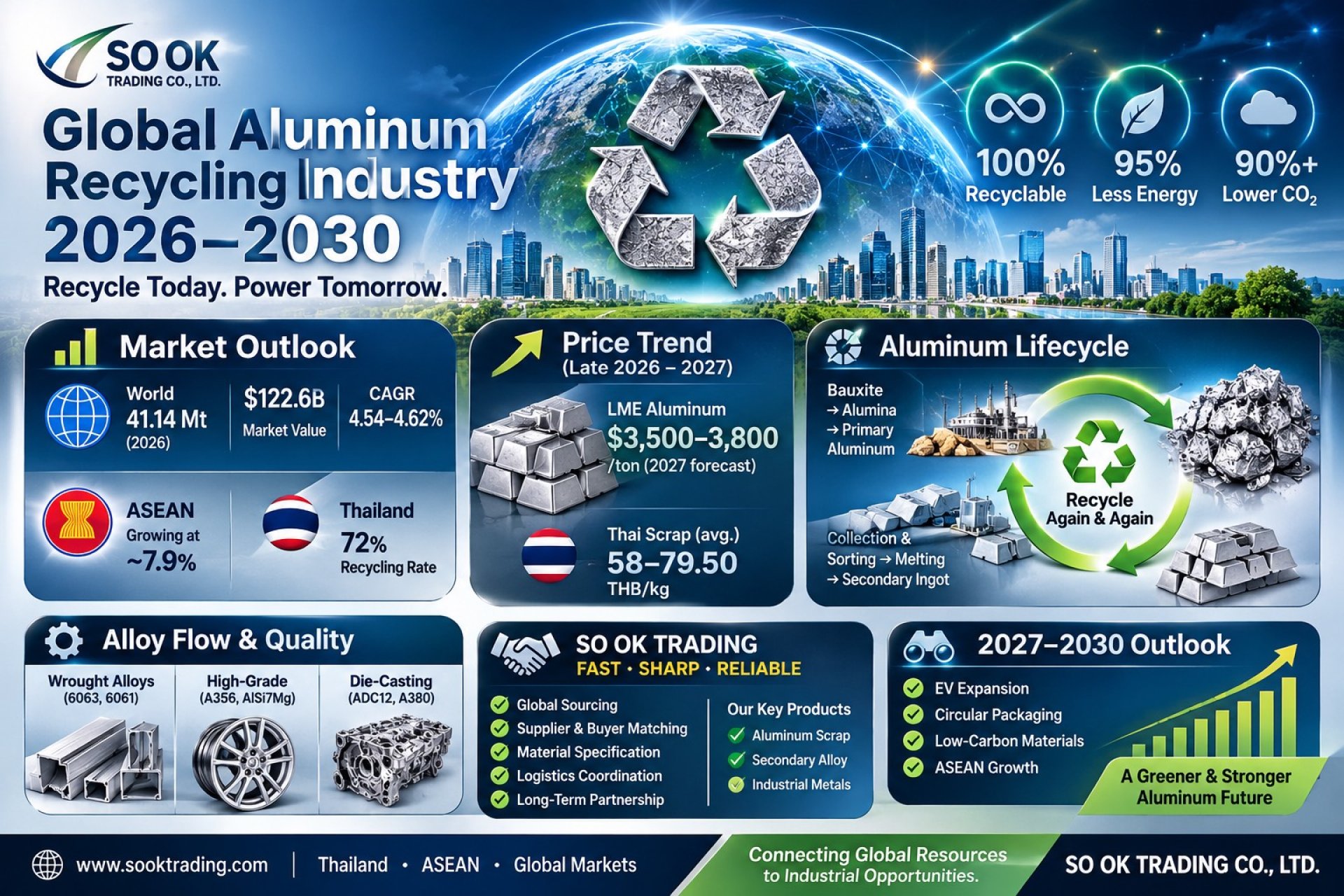
The global aluminum recycling industry is experiencing exponential growth. Because aluminum is 100% recyclable without losing its physical properties, it can be remelted infinitely. Compared to primary smelting from bauxite ore, recycling aluminum saves up to 95% of energy and reduces greenhouse gas emissions by more than 90%.
1. Market Overview & Industry Trends (Global, ASEAN, and Thailand)
Global Landscape
หัวข้อย่อย Market Size & Growth: In 2026, global recycled aluminum production reached 41.14 million metric tons, representing a market value of over USD 122.63 billion. The market is projected to expand at a CAGR of 4.54%–4.62% through 2031–2035. Currently, recycled aluminum accounts for nearly 30% of total global aluminum supply, while the global average Can-to-Can recycling rate stands at approximately 33%.
หัวข้อย่อย Key Drivers & Policies: The Electric Vehicle (EV) industry is a primary growth driver due to surging demand for lightweight components in body structures and battery enclosures, alongside strong packaging and construction demand across Asia-Pacific. Furthermore, the EU’s Carbon Border Adjustment Mechanism (CBAM) and export restrictions imposed by major scrap-exporting regions like the EU to secure domestic supply have intensified global competition for clean scrap and accelerated demand for Low-Carbon Aluminum.
ASEAN Landscape
หัวข้อย่อย Processing & Manufacturing Hub: ASEAN serves as a vital hub for importing and processing aluminum scrap from the United States and Europe into Secondary Ingots to supply automotive and electronics manufacturers relocating production bases to the region. Meanwhile, the ASEAN aluminum packaging market continues to grow steadily at around 7.9%.
หัวข้อย่อย Stricter Standards & Challenges: ASEAN nations have significantly tightened inspections on contaminants and e-waste. For instance, Malaysia enforces a 99.75% purity threshold alongside a strict ban on e-waste imports, while Vietnam caps impurity levels at 1%. Consequently, regional smelters face rising raw material costs and price volatility driven by shifting export policies in origin countries.
Thailand Landscape
หัวข้อย่อย ASEAN’s Can Recycling Leader: Thailand’s aluminum recycling market is valued at approximately USD 1.3 billion. As the only country in ASEAN with a fully integrated closed-loop Can-to-Can recycling system, Thailand achieves an impressive 72% can recycling rate—the highest in ASEAN—driven by circular economy initiatives.
หัวข้อย่อย Production Base & New Policies: Thailand is a major scrap-processing hub producing secondary alloys such as ADC12 for the automotive and electronics sectors, supported by strong manufacturing clusters in Bangkok, Chonburi, and Samut Prakan. With the Thai government preparing to enforce Extended Producer Responsibility (EPR) legislation in 2027 and the Customs Department tightening scrap import controls to block hazardous waste, Thai operators are accelerating investments in X-ray sensor and AI sorting technologies to elevate raw material quality and mitigate CBAM tariff impacts.
2. Price Structure & Market Direction (Late 2026 – Early 2027)
In late 2026, the global benchmark price for aluminum scrap remains elevated at approximately USD 2,664 per metric ton (+23% YoY). In the short term (next 1–3 months), prices are expected to stabilize or soften slightly in line with year-end smelter inventory adjustments. However, for the long term in 2027, analysts project primary LME aluminum prices to climb into the USD 3,500–3,800 per metric ton range—driven by rising energy costs and capacity expansions among major smelters in the US and Asia—which will in turn provide strong upward support for clean scrap prices.
Reference Price Levels by Aluminum Scrap Grade (November 2026)
หัวข้อย่อย Clean Aluminum Extrusions & Profiles (ISRI: Tense / Tata / 6063): Commanding the highest prices due to high purity, trading globally at 85%–92% of LME prices. Domestic yard buying prices in Thailand range from THB 75.00 to 79.50 per kg.
หัวข้อย่อย Clean Automotive Alloy Wheels (ISRI: Taldon): Supported by robust automotive and EV component demand across Asia, trading at 82%–88% of LME prices, with Thai domestic buying prices at approximately THB 72.00 per kg.
หัวข้อย่อย Used Beverage Can Bales (ISRI: Talc Bales / UBC): Global prices have rebounded to USD 2,600–2,670 per metric ton, or 70%–78% of LME prices. Domestic prices in Thailand average THB 68.00 per kg (retail/loose) and THB 79.00 per kg (baled factory-gate delivery).
หัวข้อย่อย Clean Sheet, Thick, & Peeled Aluminum Scrap (ISRI: Talc / Taint): Trading at 55%–80% of LME prices, with Thai domestic prices ranging from THB 58.00 to 70.00 per kg (thick scrap or clean machine-stripped scrap averages around THB 60.00 per kg).
หัวข้อย่อย Mixed & Contaminated Aluminum Scrap (ISRI: Zorba / Taint-Tabor): Facing heavy downward pressure from strict impurity inspections across Asia, resulting in wide discounts and trading at just 45%–65% of LME prices.
(Note: Domestic prices in Thailand are referenced from scrap trading networks and factory-gate delivery rates, subject to adjustment based on volume, moisture, and impurity levels. Current market buyers impose steep deductions if moisture, ferrous metals, or plastics are detected inside UBC bales.)
3. Aluminum Lifecycle & Recycling Process
The aluminum lifecycle consists of two interconnected loops:
1. Primary Loop:
Begins with mining bauxite ore, refining it into alumina via the Bayer process, and undergoing energy-intensive electrolytic smelting to produce Primary Ingots for manufacturing.
2. Secondary / Scrap Loop:
หัวข้อย่อย Scrap Generation: Categorized into New Scrap (Pre-consumer)—high-purity offcuts generated during factory manufacturing—and Old Scrap (Post-consumer)—end-of-life products such as beverage cans, old window frames, and retired automotive parts.
หัวข้อย่อย Collection & Sorting: Collectors, scrap yards, and recycling centers gather metal scrap and classify grades according to international ISRI standards, utilizing magnetic, X-ray, and Eddy Current technologies to remove contaminants.
หัวข้อย่อย Preparation & Baling: Scrap undergoes shredding, decoating (paint removal), and moisture elimination before being compressed into rectangular bales (Baling) to reduce volume and optimize transport and furnace charging efficiency.
หัวข้อย่อย Melting & Refining: Baled scrap is fed into melting furnaces and alloyed with elements such as silicon and magnesium to cast Secondary Ingots, Billets, or Slabs—re-entering manufacturing lines infinitely. For beverage cans (Can-to-Can), the entire cycle from disposal back to retail shelves takes as little as 60 days.
4. Alloy Flow & Quality Control
Accurate grade sorting at the source prevents cross-contamination of alloying elements and preserves maximum material value across three primary streams:
Closed-Loop & High-Purity Wrought Alloys
หัวข้อย่อย Used Beverage Cans (UBC): Can bodies are made from 3004 alloy (manganese-based) and lids from 5182 alloy (magnesium-based). When melted together and chemically adjusted, they are rolled directly back into 3004/3104 sheet coils to stamp new cans with zero downgrading.
หัวข้อย่อย Aluminum Extrusions & Profiles (Extrusion 6063): Remelted with magnesium and silicon into cylindrical billets (6063 and 6061 grades) for manufacturing door/window frames, solar mounting rails, and EV structural components.
หัวข้อย่อย Clean Bare Aluminum Wire (EC Wire): Exceeding 99.5% purity, EC wire is cast into 1000/1350 grade ingots for high-voltage transmission lines, packaging foil, and heat sinks, and is widely used as a "Sweetener" to dilute impurity concentrations in other furnace melts.
High-Grade Casting Alloys
หัวข้อย่อย Clean Automotive Alloy Wheels: Remelted into high-strength casting alloys (A356 / AlSi7Mg) with strictly controlled, ultra-low iron (Fe) content to ensure ductility and impact resistance—used to manufacture new alloy wheels, suspension components, and EV structural Giga-castings.
Downcycling / Sink Alloys
หัวข้อย่อย Mixed, Cast, Radiator, & Thin Scrap (Mixed / Cast / Zorba): Difficult-to-separate scrap or materials with higher iron and silicon levels are melted into standard die-casting alloys such as Japanese grade ADC12 or US grade A380. Acting as the industry’s "Sink Alloy," ADC12 tolerates up to 9.6%–12% silicon and 1.3% iron, making it ideal for die-casting engine blocks, cylinder heads, transmission housings, EV motor casings, and home appliance parts.
SO OK TRADING – Our Vision
SO OK TRADING believes that the future of the metals industry depends not merely on raw material volume, but on the ability to effectively connect resources, manufacturers, technology, and end markets.
We are committed to creating business opportunities through our Global Network, Industrial Knowledge, Strategic Sourcing, and Long-Term Partnerships to drive the growth of the metals industry and circular economy in Thailand and international markets.
CONTACT SO OK TRADING CO., LTD.
หัวข้อย่อย Website: https://www.sooktrading.com
หัวข้อย่อย Business Focus: Aluminum Scrap | Secondary Aluminum Alloy | Industrial Metals
หัวข้อย่อย Market Coverage: Thailand | ASEAN
FAST • SHARP • RELIABLE
Connecting Global Resources to Industrial Opportunities.
Knowledge. Connection. Opportunity.
SO OK TRADING — The True Authority in Thailand’s Non-Ferrous Industry