SO OK TRADING’S INSIGHT: STR 20 Premium Rubber – Thailand’s High-Quality Block Rubber, the Key to Global Tire Industry Success and the Future of Smart EV Tires (November 10, 2026)
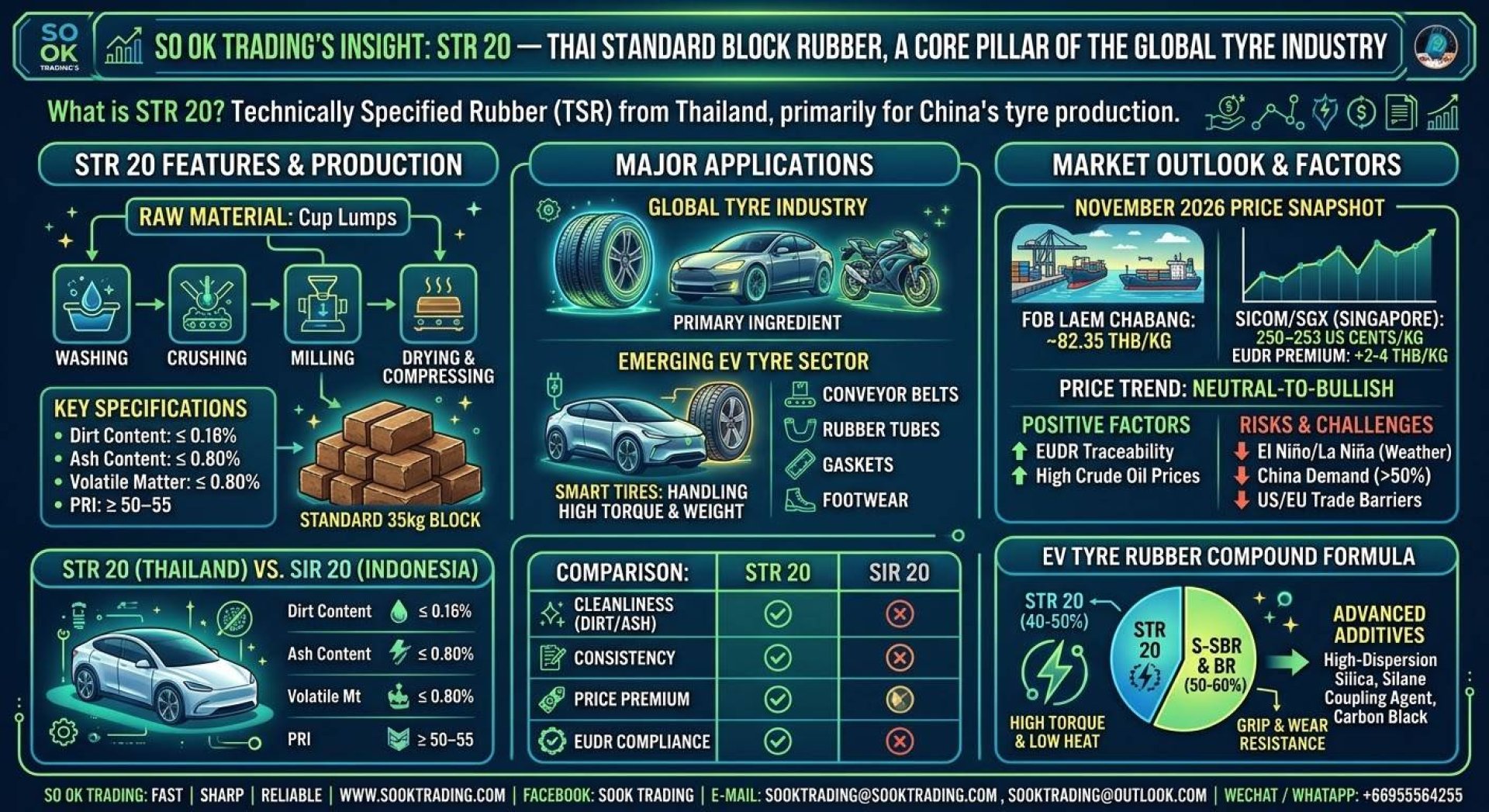
✨ SO OK TRADING’S INSIGHT ✨ STR 20: Thailand’s Standard Block Rubber – The Driving Force of the Global Tire Industry
What is STR 20?
STR 20 (Standard Thai Rubber 20) is a natural block rubber produced from cup lumps. It undergoes washing, shredding, grinding, and compression into square blocks weighing 35 kilograms each. Classified as Technically Specified Rubber (TSR), STR 20 is Thailand’s most exported grade, especially to China, where it serves as a key raw material for car and motorcycle tires.
Why STR 20 Dominates the Market
The strength of STR 20 lies in its cost efficiency and quality. It is cheaper than RSS3 yet maintains stable mechanical properties, making it ideal for mass production. It meets international standards and is widely recognized in global markets, particularly in China.
Its applications range from automobile and motorcycle tires to engineering parts requiring impact resistance, as well as footwear and general rubber products.
Technical Specifications & Quality Standards
STR 20 is a dark-colored square block with consistent texture and high stability.
Dirt Content: ≤ 0.16%
Ash Content: ≤ 0.80%
Volatile Matter: ≤ 0.80%
PRI (Plasticity Retention Index): ≥ 50–55
These figures reflect Thailand’s strict quality control.
Industrial Applications
STR 20 is a core ingredient in the global tire industry. In the era of electric vehicles (EVs), which are heavier and generate higher torque, STR 20 has become essential for producing Smart Tires that withstand immense torque and reduce tread wear.
It is also used in conveyor belts, hoses, gaskets, and footwear, all requiring durability and uniformity.
Market Situation & Outlook (November 2026)
FOB Laem Chabang: 82.35 THB/kg
Singapore Futures (SICOM/SGX): 250–253 US¢/kg
EUDR Premium: +2–4 THB/kg for traceable rubber
The price outlook is Neutral-to-Bullish, driven by tight supply and traceability regulations, despite pressure from Chinese demand and trade barriers in the US and Europe.
Key Drivers & Risks
El Niño / La Niña: Weather volatility affects tapping.
Chinese Demand: Accounts for over 50% of Thai exports.
EUDR Regulation: Creates a two-tier pricing structure.
Crude Oil Prices: Higher oil prices increase demand for natural rubber.
Production Process (Summary)
Washing and sorting cup lumps
Grinding and mixing (creping)
Shredding into fine particles
Controlled drying (110–130°C)
Quality inspection and block compression
STR 20 (Thailand) vs SIR 20 (Indonesia)
Although both are “Grade 20 block rubber,” there are differences:
STR 20 (Thailand): Dirt ≤0.16%, Ash ≤0.80% → cleaner, better chemical dispersion.
SIR 20 (Indonesia): Large supply, but some batches are harder due to raw material curing differences.
Price-wise, STR 20 usually sells at a $10–30/ton premium over SIR 20, with EUDR Premium further strengthening Thailand’s advantage.
EV Tire Compounding Formula
EV tires demand special compounding due to weight, torque, and noise requirements:
STR 20: 40–50% → tear strength, low heat buildup
S-SBR & BR: 50–60% → wet grip, abrasion resistance
Advanced additives: high-dispersion silica, silane coupling agents, functionalized carbon black → balance durability and energy efficiency
Conclusion
STR 20 is not just rubber—it is Thailand’s premium export weapon. With superior cleanliness, stability, and traceability, STR 20 is recognized as Premium Quality Rubber, especially in Western markets and the EV tire industry.
While Indonesia’s SIR 20 remains a choice for volume and cost efficiency, Thailand’s STR 20 is seen as the high-quality option for performance tires and EV tires requiring strict standards.
SO OK TRADING: Your Business Partner FAST • SHARP • RELIABLE www.sooktrading.com sooktrading@sooktrading.com | sooktrading@outlook.com WeChat / WhatsApp: +66 955564255 Facebook: SOOK TRADING