“Thailand Packaging Outlook 2026–2030: Transforming the Thai Packaging Industry into a New Era of Sustainability, Innovation, and Eco-Friendliness — Presented by SO OK TRADING”
Thailand Packaging Outlook 2026–2030 : SO OK TRADING : September 7, 2026
The Thai packaging industry is undergoing a major transformation. Traditionally driven by plastics and paper, it is now entering a new era focused on sustainability, innovation, and recycling to meet both consumer demands and increasingly strict global environmental regulations.
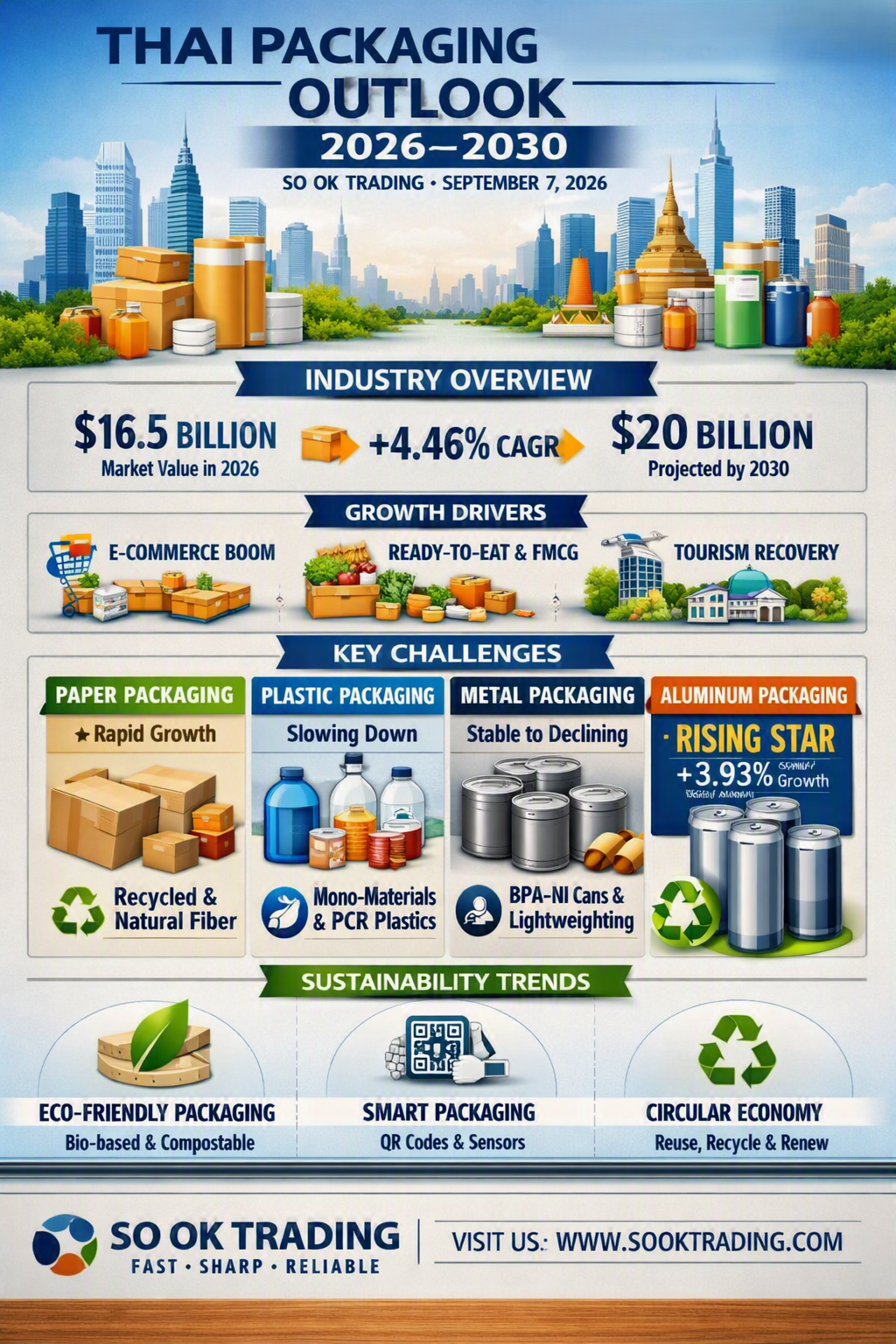
In 2026, the Thai packaging market reached 565.56 billion THB, and is projected to grow at an average annual rate of 4.46%, reaching 703.44 billion THB by 2030. This growth highlights Thailand’s role as a leader in high-quality packaging in Southeast Asia.
Key Growth Drivers
E-commerce and Food Delivery: Market value surpassing 1.1 trillion THB, driving massive demand for paper and plastic packaging.
Food & Beverage (FMCG): Ready-to-eat and FMCG products remain the largest packaging users.
Tourism and Service Recovery: Hotels, restaurants, and catering businesses continue to increase packaging consumption.
⚙️ Major Challenges
Volatile raw material and energy costs influenced by global geopolitics.
Rising competition from China, with key partners such as Japan and Malaysia turning to lower-cost packaging.
Stricter environmental measures requiring rapid adaptation to eco-friendly packaging.
Industry Trends and Adaptation The Thai packaging industry is shifting toward three major trends: 1️⃣ Eco-Friendly Packaging — Circular economy, mono-materials, bioplastics. 2️⃣ Smart Packaging — QR codes, RFID, and indicators for food quality. 3️⃣ Digital Printing & Customization — Flexible production to meet SME and brand differentiation needs.
Packaging Outlook by Material
Paper & Paperboard: Strong growth, especially corrugated and folding cartons for e-commerce and food delivery. Key shift toward recycled paper, natural fibers (e.g., bamboo pulp), and water-based biodegradable coatings.
Plastics (Rigid & Flexible): Largest market share (~40–50%) but slowing growth (2.5–3% annually). Pressured by oil price volatility, bans on certain plastics, and eco taxes. Transition to mono-materials (e.g., BOPE film), PCR plastics, and bioplastics (PLA, PHA).
Tinplate & Steel: Stable to declining, especially three-piece cans in exports. Pressured by U.S. trade tariffs and low-cost competitors. Still important in canned seafood and pet food, with shifts to BPA-NI coatings and lightweighting.
Aluminum — Rising Star: Accounts for 69% of Thailand’s metal packaging revenue, growing at 3.93% annually. Strong demand in premium beverages, craft beer, soft drinks, and the shift from PET to sleek & slim cans. Aluminum is the “material of the circular economy” with 100% infinite recyclability, supported by global brands and government initiatives.
♻️ Recycling in Thailand
Aluminum: Highest recycling rate ~85% due to mono-material and strong economic incentives.
Glass & Paper: ~50–60%, with strong circulation systems but reduced efficiency when contaminated.
PET Plastics: ~25–30%, despite recycling plants, leakage into landfills and oceans remains.
Multi-layer Plastics: <5%, the biggest bottleneck in Thailand’s recycling system.
Market Overview
Market value: 565.56 billion THB (2026) → 703.44 billion THB (2030)
Average annual growth: 4.46%
Thailand remains the regional leader in high-quality packaging.
SO OK TRADING — Your Trusted Business Partner With over 15 years of expertise in the metal and aluminum packaging industry, we are the bridge connecting Thai businesses to global markets — delivering speed, precision, and reliability.
FAST • SHARP • RELIABLE www.sooktrading.com Facebook: SO OK TRADING