SO OK TRADING’S INSIGHT: Transforming Global Energy – The Golden Era of Solar & EV | New Energy, New Economy 2026–2030
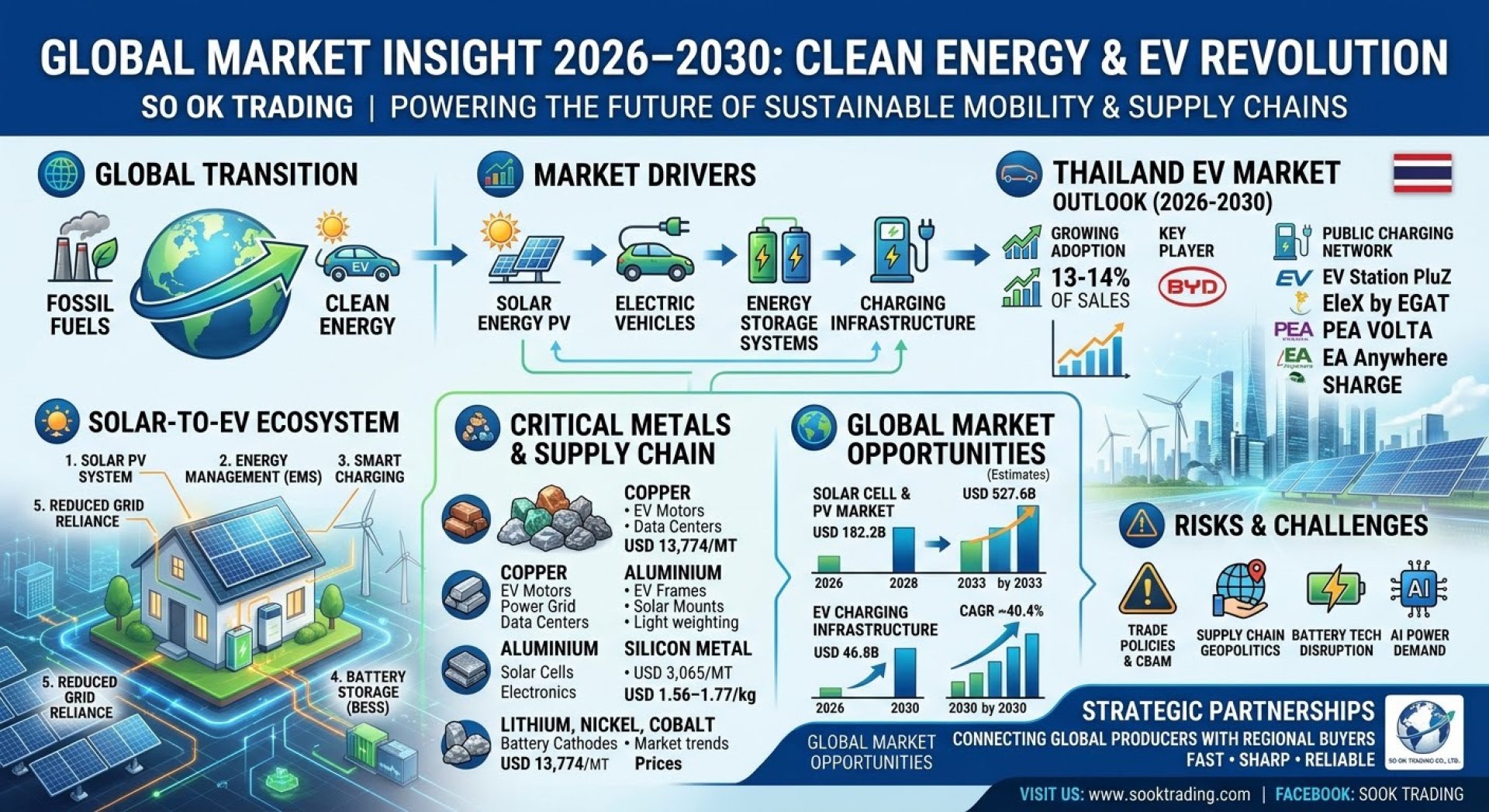
SO OK TRADING | GLOBAL MARKET INSIGHT 2026–2030
Clean Energy & Electric Vehicle Revolution
Global Outlook on Solar Energy, Electric Vehicles & Charging Infrastructure (2026–2030) The Future of Energy | Sustainable Mobility | Global Supply Chain | Non-Ferrous Metals
The world is entering a pivotal era of Global Energy Transition, where Solar Energy, Electric Vehicles (EVs), Energy Storage Systems (ESS), and EV Charging Infrastructure are becoming the central pillars driving the new economy.
This transformation not only creates opportunities within the clean energy industry but also directly impacts industrial metals demand, battery raw materials, power systems, electronic devices, and global supply chains. Between 2026–2030, the global market is expected to shift from competition in EV and solar panel production to competition in technology innovation, energy efficiency, production costs, and resource management across the entire clean energy ecosystem.
1. Thailand EV Market
Thailand is positioning itself as one of the most important EV production bases and consumer markets in ASEAN. This growth is supported by foreign investment, the expansion of Chinese EV brands (notably BYD), and government policies promoting the EV industry.
EV sales account for approximately 13–14% of total car sales.
Competitive factors include pricing, battery technology, driving range, and after-sales service.
Major charging providers include EV Station PluZ (PTT), EleX (EGAT), PEA VOLTA, EA Anywhere, and SHARGE.
Example charging rates:
DC 40–180kW → On-Peak ~7.9 THB/kWh, Off-Peak ~6.6 THB/kWh
DC 180–200kW → On-Peak ~8.2 THB/kWh, Off-Peak ~6.9 THB/kWh
From 2027 onwards, Thailand will increase excise tax on imported EVs from 10% to 35%, aiming to attract automakers to establish local production bases and strengthen domestic supply chains.
2. Solar Energy & Solar-to-EV Ecosystem
Solar energy is rapidly expanding across households, commercial buildings, and industrial facilities. The rise of EVs creates opportunities for direct integration between Solar Rooftops and EV charging systems, reducing reliance on the grid and improving long-term energy efficiency.
Key components: Solar PV, EMS, DLB, BESS, Smart EV Chargers
Government support: 1 million households targeted, 50,000 THB subsidy per household, feed-in tariff of 2.20 THB/kWh
This “Solar-to-EV” model enables households and businesses to charge EVs directly from solar power during the day or store excess energy for nighttime use. In some cases, this can reduce electricity costs to nearly zero.
3. EV Charging Technology & Infrastructure
EV charging infrastructure is expanding globally, with rapid technological advancements.
AC Charging (7.4–22kW): Suitable for homes and offices, lower cost.
DC Fast Charging (40–200kW+): Designed for public stations and long-distance travel.
Global Standards: CCS (Europe/US), GB/T (China), CHAdeMO (Japan), NACS (North America).
Emerging Technologies: Ultra-Fast Charging (>150kW), Smart Charging, Vehicle-to-Grid (V2G), Vehicle-to-Home (V2H), Vehicle-to-Load (V2L).
Ultra-Fast Charging aims to deliver full charging in under 10 minutes, significantly improving convenience. Meanwhile, V2G technology transforms EVs into distributed energy sources, enhancing grid stability and energy resilience.
4. Global Market Outlook 2026–2030
Solar Market: USD 182.2B (2026) → USD 527.6B (2033), CAGR 16.4%
EV Market: Global sales projected to exceed 23.3M units in 2026, led by China, Europe, and North America.
EV Charging Market: USD 46.8B (2026) → USD 503.69B (2030), CAGR 40.4%
Growth is driven by renewable energy policies, declining battery costs, and rising consumer demand for sustainable mobility.
5. Non-Ferrous Metals Market
The clean energy revolution is reshaping global demand for industrial metals.
Copper: USD 13,774/MT – EVs use 3–4x more copper than ICE vehicles.
Aluminium: USD 3,065/MT – Essential for lightweight EV structures and solar mounting.
Silicon: USD 1.56–1.77/kg – Core material for polysilicon and semiconductors.
Lithium Hydroxide: USD 12,261–12,300/MT – Critical for lithium-ion batteries.
Cobalt: USD 33,510/MT – Used in NMC batteries, though demand is declining.
Nickel: USD 16,154–16,322/MT – Key for high-nickel batteries and stainless steel.
Copper is often called the “metal of electrification,” while aluminium plays a vital role in lightweighting and green production. Silicon underpins solar technology, and lithium, cobalt, and nickel remain central to battery innovation.
6. Global Risks & Strategic Challenges
CBAM (EU Carbon Border Adjustment Mechanism): Green Aluminium may gain premium pricing.
China Supply Chain: Overcapacity pressures global prices.
Geopolitical Risks: Energy price volatility and logistics constraints.
AI & Data Centers: Rising demand for copper and aluminium.
Battery Technology Disruption: Solid-state, LFP, and sodium-ion batteries may reshape demand for lithium, nickel, and cobalt.
7. Strategic Business Opportunities
The growth of clean energy extends beyond automakers and solar panel producers, creating opportunities across the supply chain:
Copper cathodes, wires, and products
Primary aluminium and alloys
Aluminium extrusions and solar mounting materials
Silicon metal and solar raw materials
Lithium battery materials
✨ This report demonstrates how the Clean Energy & EV Revolution is reshaping the global economy, highlighting opportunities and challenges that businesses, investors, and policymakers must closely monitor in the coming decade.