SO OK TRADING’s Analysis & Insight: Aluminium & Copper — The Heart of the Global Economy in the Clean Energy Era, Pathway to Net Zero and Digital Transformation, Global Metal Megatrends 2026–2030
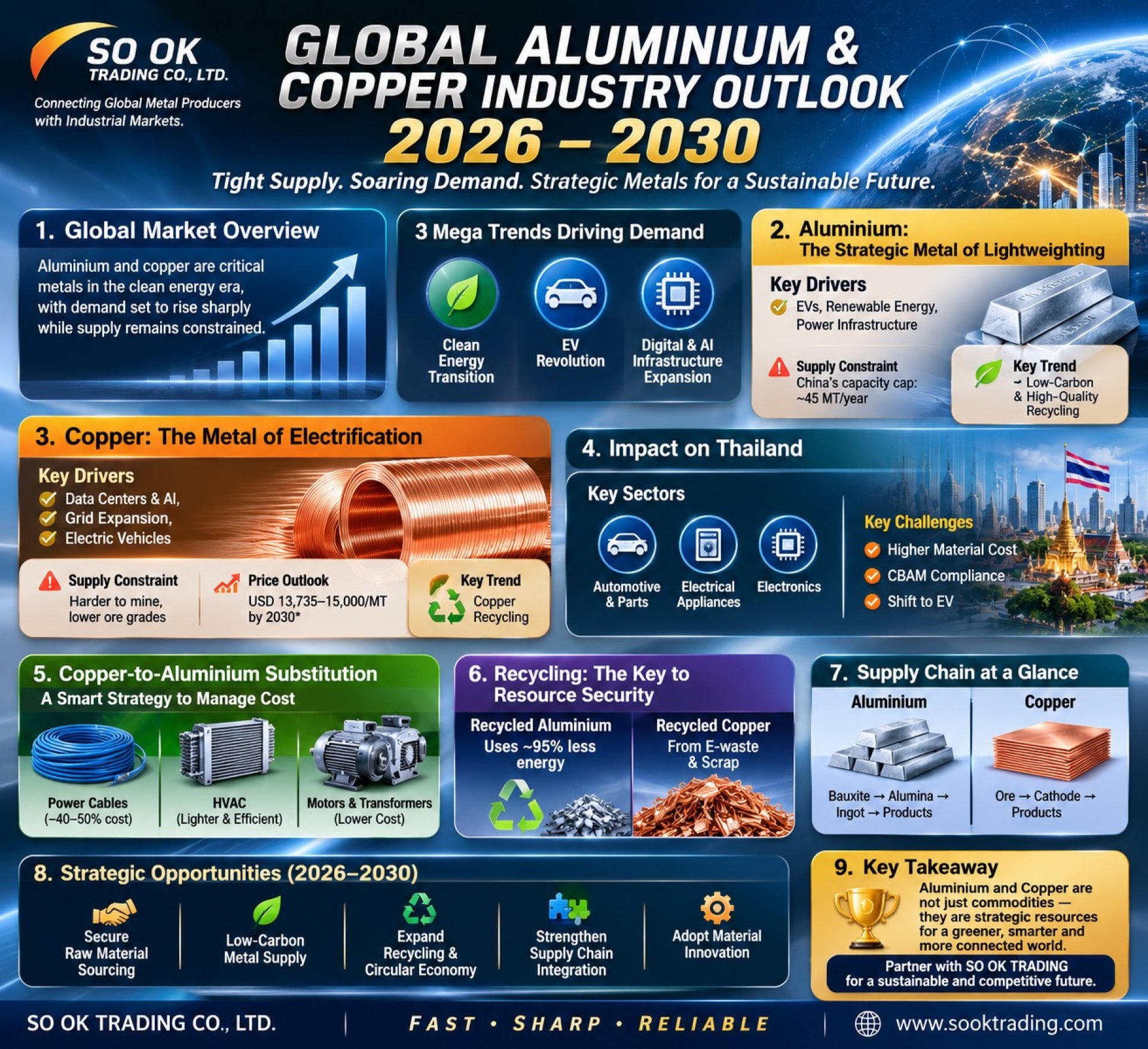
GLOBAL ALUMINIUM & COPPER INDUSTRY OUTLOOK 2026–2030
Global Metal Industry Overview (2026–2030)
Between 2026 and 2030, the global basic metals industry is entering a period of profound structural transformation. Among these, Aluminium and Copper have been elevated as strategic raw materials, playing a pivotal role in driving the transition to clean energy, the revolution in electric vehicles, and the expansion of digital and AI infrastructure.
Demand for both metals is expected to rise sharply due to investments in renewable energy infrastructure, power transmission systems, data centers, and semiconductor technologies. On the supply side, however, constraints such as limited natural resources, rising energy costs, difficulties in mining investment, and stricter environmental regulations are creating risks of structural supply tightness and long-term price volatility.
Aluminium Industry: The Strategic Metal of Lightweighting
Aluminium is the second most important industrial metal after steel, valued for its light weight, corrosion resistance, high strength-to-weight ratio, and infinite recyclability without loss of quality. These properties make aluminium indispensable in industries seeking to reduce product weight, improve energy efficiency, and lower carbon emissions.
Key Demand Drivers
Electric Vehicles (EVs): Used in car bodies, chassis, and battery housings to enhance energy efficiency and extend driving range.
Renewable Energy: Essential for solar panel mounting structures and wind turbine components.
Power Infrastructure: Aluminium cables are increasingly used as cost-effective alternatives to copper in long-distance transmission.
Supply Constraints China, the world’s largest aluminium producer, has capped annual output at around 45 million tonnes. High electricity consumption in smelting and stricter carbon policies further limit expansion.
Technology Trends
Low-Carbon Aluminium
Green Aluminium (produced with renewable energy)
High-Quality Aluminium Recycling
Advanced Aluminium Alloys for EVs, aerospace, and packaging
Copper Industry: The Metal of Electrification
Copper is indispensable in the modern economy due to its superior electrical and thermal conductivity, malleability, and durability. As the world transitions to electrification and digital infrastructure, copper demand is set to surge.
Key Demand Drivers
Data Centers & AI: Copper is critical in busbars, transformers, power distribution, and cooling systems.
Electrical Grid Expansion: Required for integrating renewable energy sources into national grids.
Electric Vehicles: EVs use 2–4 times more copper than internal combustion engine (ICE) vehicles, in motors, batteries, wiring, and charging stations.
Supply Constraints New mine development is costly, time-consuming, and subject to geopolitical and environmental risks. Ore grades are declining, requiring more raw material for the same output.
Price Outlook Analysts project copper prices could reach USD 13,735–15,000 per tonne by 2030.
Technology Trends
Copper Recycling
E-Waste Recovery
High-Purity Copper Production
Advanced Smelting & Refining
Impacts and Opportunities for Thai Industries
Thailand, as a major production hub in ASEAN, will be directly affected by global aluminium and copper trends.
Automotive Industry: Transition from ICE to EV requires lightweight aluminium structures and copper-intensive motors and wiring.
Air Conditioning & Appliances: Rising copper prices squeeze margins; aluminium microchannel heat exchangers are emerging as alternatives.
Environmental Compliance: EU’s CBAM mechanism demands low-carbon aluminium to maintain export competitiveness.
Material Substitution Strategy: Copper-to-Aluminium
As copper prices rise relative to aluminium, substitution strategies are gaining traction.
Power Cables: Aluminium reduces weight and costs but requires larger cross-sections and careful engineering.
Heat Exchangers: Aluminium microchannel technology improves efficiency and reduces material use.
Motors & Transformers: Aluminium windings lower costs but necessitate design modifications.
Recycling Market: The Pillar of Resource Security
Recycling is becoming central to global resource security, reducing reliance on raw mining and supporting sustainability goals.
Aluminium Recycling: Uses 95% less energy than primary production. Sources include automotive scrap, construction waste, and beverage cans.
Copper Recycling: Scrap and e-waste recovery provide high-purity copper, alleviating supply shortages.
Supply Chain Overview
Aluminium: Bauxite → Alumina → Primary Aluminium Ingot → Billet/Slab → Rolled/Extruded Products → Industrial Applications
Copper: Ore → Smelting → Cathode → Wire Rod/Tubes → Applications in power grids, EVs, HVAC, and data centers
Conclusion
Between 2026 and 2030, aluminium and copper will stand at the heart of the global economy’s green and digital transformation. With supply constraints and price volatility looming, businesses must embrace the circular economy, strengthen recycling, and adopt low-carbon materials to remain competitive and achieve sustainable growth.