SO OK TRADING’S INSIGHT: Global Tin Market Shakes! November 2026 — Sharp Correction, Building a New Base Toward the AI & Clean Energy Era
SO OK TRADING’S INSIGHT
Global Tin Market Situation: November 2026 – Sharp Correction Before Recovery
Global Market Overview
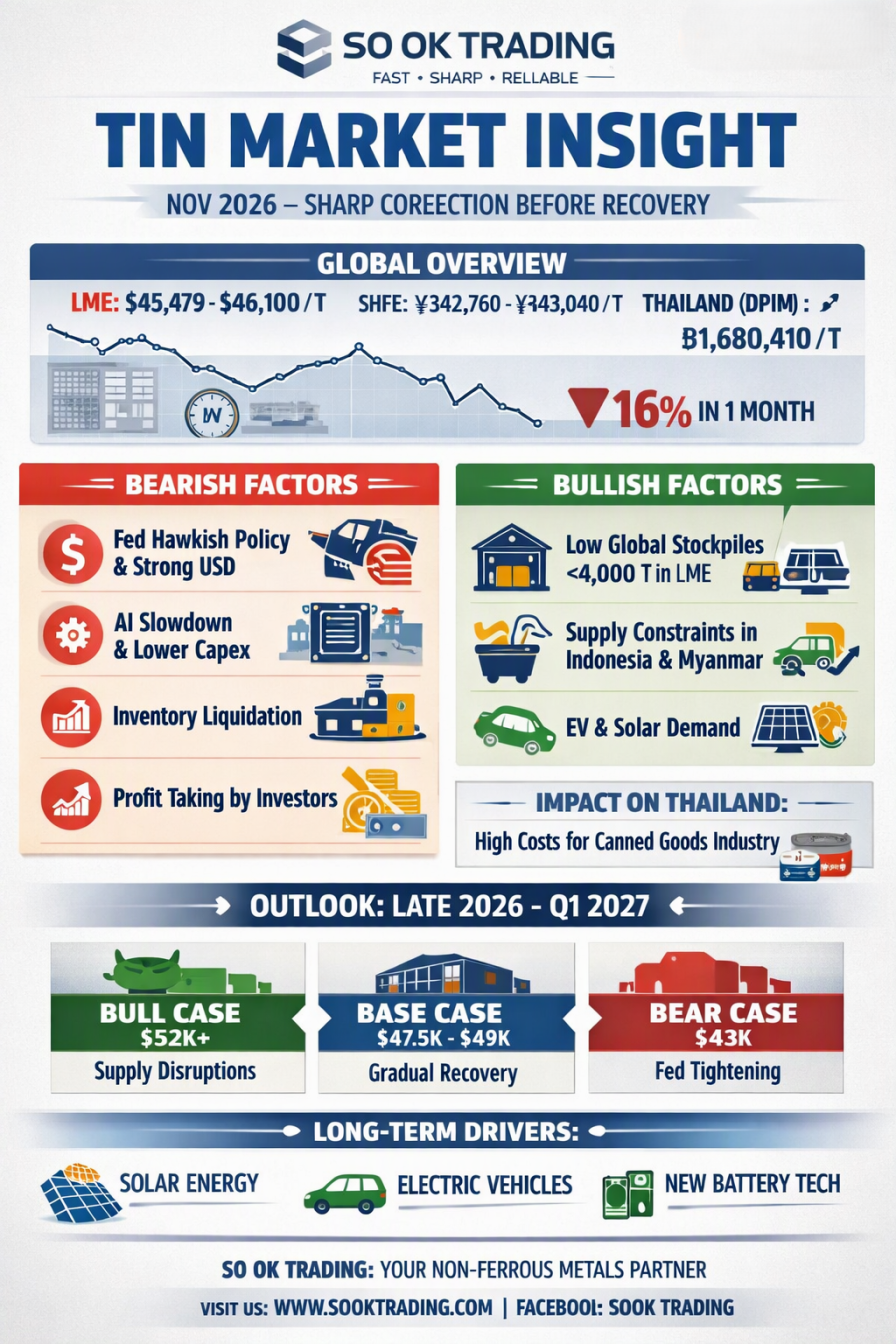
November 2026 marks a turning point for the global tin market. After surging past USD 50,000–55,000 per ton earlier in the year, prices have sharply corrected, dropping more than 16% in a single month to average USD 45,400–46,500 per ton. This is the lowest level in seven months, though still 26.9% higher year-on-year.
London (LME): 3-month contracts closed at USD 45,479–46,100 per ton
Shanghai (SHFE): December delivery contracts traded at RMB 342,760–343,040 per ton (having briefly dipped to RMB 337,400 before rebounding)
Thailand (DPIM): Domestic announced price at THB 1,680,410 per ton
Bearish Drivers
U.S. Monetary Policy (Fed): Hawkish stance post-election, keeping interest rates high and strengthening the USD, directly pressuring dollar-denominated metals.
AI Industry Slowdown: Tin is a key solder material for semiconductors and AI servers, but tech stock corrections and reduced capital expenditure have cooled speculative demand.
Downstream Behavior: Buyers and factories prioritize clearing existing inventories, delaying new orders.
Profit-Taking: Investors reduce exposure to industrial metals as part of broader risk-off sentiment.
Bullish Support
Extremely Low Global Inventories: LME stocks fell to just 3,953 tons in early November.
Supply Constraints: Indonesia’s mining license delays and Myanmar’s instability continue to restrict output.
Structural Demand: Semiconductor, EV, and clean energy industries provide long-term support.
Impact on Thailand
Despite the global correction, accumulated high costs still weigh on domestic industries—particularly tin-coated steel used in packaging such as canned food. Thai authorities are closely monitoring to prevent consumer price shocks.
Price Outlook: Late 2026 – Q1 2027
Analysts believe the tin market has already bottomed out and will gradually recover.
Base Case (65%): USD 47,500–49,000 per ton, supported by recovering AI semiconductor and EV demand.
Bull Case (25%): Prices may exceed USD 52,000 per ton if supply disruptions intensify in Myanmar or Indonesia.
Bear Case (10%): Could fall to USD 43,000 per ton if the Fed tightens further or Western economies slow sharply.
Long-Term Structural Drivers
Chronic Supply Shortages: Declining ore grades in old mines and delays in new projects.
Clean Energy (Solar PV): Tin demand rising as a coating for solar ribbons in photovoltaic panels.
Electric Vehicles (EVs): EVs consume nearly twice as much tin as internal combustion vehicles.
New Battery Technologies: Tin is being developed as an anode material in sodium-ion batteries.
Financial Institutions’ Views
World Bank: Prices peaked in 2026, slight correction expected in 2027.
Sucden Financial: USD 50,000 seen as a new support level; backwardation and falling inventories could trigger a sharp rebound.
Claight Hub / PricePedia: Semiconductor and solar demand outpaces new supply, driving gradual recovery from November lows.
Conclusion
The global tin market in November 2026 is undergoing a sharp correction, but tight supply and expanding structural demand from technology and clean energy sectors are expected to drive recovery in 2027. Prices are likely to return to the USD 47,500–51,000 per ton range in early 2027.
SO OK TRADING Your trusted partner in the non-ferrous metals industry FAST • SHARP • RELIABLE www.sooktrading.com Facebook: SOOK TRADING