“Aluminum P1020: The New Hero of the Future – Transforming the Electrical Industry with Lightweight, Cost-Effective Strength to Replace Copper” SO OK TRADING : October 25, 2026
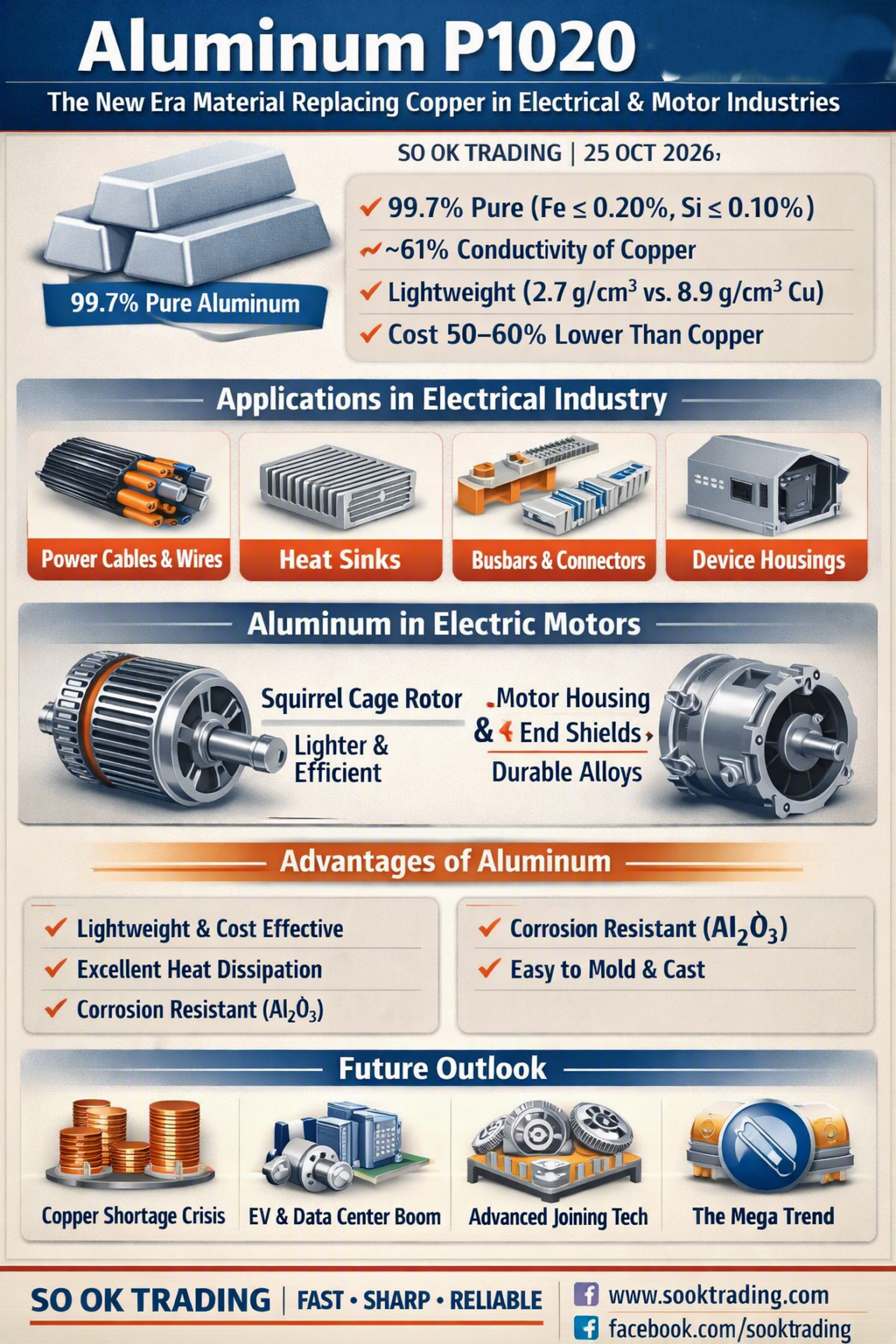
Aluminum P1020 (A7): The New Era Material Replacing Copper in Electrical and Motor Industries
SO OK TRADING | October 25, 2026
Introduction
In today’s industrial world, facing challenges of cost and resource scarcity, materials that can deliver quality, performance, and economic efficiency have become the cornerstone of global competition. Among them, Aluminum P1020 (A7) stands out as one of the most promising raw materials. With a purity of 99.7%, it is not just a metal—it is the “symbol of transition”, steadily replacing copper across multiple sectors, from electrical appliances to motors and electric vehicles (EVs).
Key Properties of P1020
High Purity: Minimal impurities (Fe ≤ 0.20%, Si ≤ 0.10%) ensure smooth electrical conductivity.
Excellent Conductivity & Heat Dissipation: Conductivity at ~61–62% of copper, yet three times lighter, with superior cooling performance.
Lightweight: Density of only 2.7 g/cm³ compared to copper’s 8.9 g/cm³.
Cost Advantage: Even with a 1.6× larger cross-section, it remains 50–60% cheaper than copper.
Applications in Electrical Appliances
Power Cables & Wires: Used for conductors and shielding in cables.
Heat Sinks: Essential in TVs, computers, and LED lighting for cooling.
Busbars & Connectors: Applied in control panels and large-scale power distribution systems.
Device Housings & Structures: Lightweight, corrosion-resistant casings and internal components.
Applications in Electric Motors
Squirrel Cage Rotors: Die-cast aluminum rotors make motors lighter, faster to start, and more energy-efficient.
Motor Housing & End Shields: Combined with silicon alloys to enhance strength and heat dissipation.
Advantages and Limitations
Advantages
Lightweight and cost-effective
Excellent thermal management
Natural corrosion resistance (Al₂O₃ film)
Easy to mold, extrude, and cast
Limitations
Lower mechanical strength, requiring alloying or heat treatment
Larger cross-sectional area needed compared to copper, consuming more space in certain applications
Outlook and Future Situation: Aluminum in Electrical Industries
Current Outlook The use of Aluminum P1020 in electrical and motor industries is expanding rapidly, especially in areas demanding cost efficiency and weight reduction such as high-voltage cables, busbars, and transformers. Many manufacturers have already adapted their processes to integrate aluminum as a copper substitute.
Future Situation Aluminum is set to become a Mega Trend, replacing copper in many sectors due to:
Copper Shortage Crisis: Rising demand from EVs and data centers outpaces global supply.
EV Weight Reduction: Aluminum wiring and motor windings reduce vehicle weight by 40–50%.
Advanced Joining Technologies: Innovations like friction stir welding and copper-clad aluminum (CCA) overcome past corrosion issues.
Economic Value: Larger component designs with aluminum still deliver massive cost savings.
Engineering Outlook Large-scale equipment such as high-voltage cables, busbars, and transformers will be almost entirely aluminum-based. Copper will remain only in applications requiring compactness and maximum conductivity, such as smartphones, micro-motors, and precision electronic circuits.
Conclusion
Aluminum P1020 (A7) is not just a pure metal—it is the material of transition, driving a major shift in the electrical and motor industries. With its superior conductivity-to-weight ratio and unmatched cost efficiency, it is becoming the true hero replacing copper in many applications, and will be central to the advancement of electrical technology and electric vehicles in the future.
SO OK TRADING: Your Trusted Business Partner FAST • SHARP • RELIABLE Visit us: www.sooktrading.com Facebook: SO OK TRADING Contact: SOOKTRADING@SOOKTRADING.COM | SOOKTRADING@OUTLOOK.COM