Share

“Global Aluminium Market Deep Dive 2026: The Power of Portland, Tomago, Malaysia, and Indonesia by SO OK TRADING” : 7 OCT 2026
Last updated: 7 Oct 2026
113 Views

Global Aluminium Market Overview and the Role of Portland, Tomago, Malaysia, and Indonesia From P1020 Raw Material to Thailand and Asia’s Industrial Supply Chain SO OK TRADING : 7 OCT 2026

 
✨ Introduction

Aluminium is one of the world’s most strategic metals, playing a vital role in the global economy and downstream industries — from packaging and automotive to energy and electronics. In particular, P1020 Aluminium Ingot (99.7% purity) is recognized as the “core raw material” that underpins the entire supply chain.

This article explores the latest developments of key producers — Portland Aluminium and Tomago Aluminium (Australia), Press Metal (Malaysia), and INALUM (Indonesia) — and their connections to the Thai market, while analyzing the outlook and future direction of the industry.

 
⚙️ Content

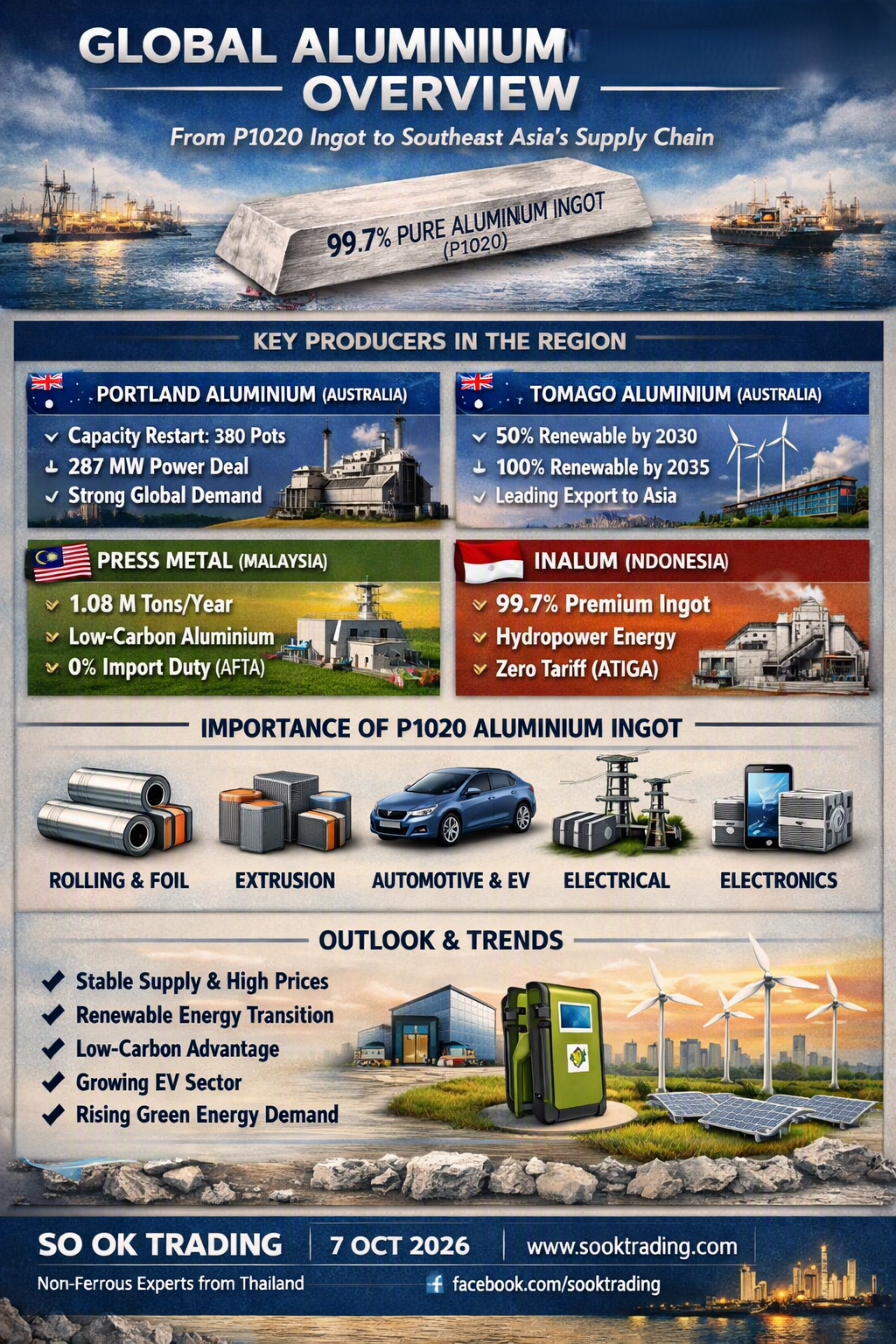
Portland Aluminium – Full Recovery

Capacity Restart: Increased smelting pots from 350 → 380 to meet rising global demand amid Middle East tensions
Stable Energy: New 287 MW power contract with AGL Energy until 2035 → ensures ~358,000 tons/year output
Alcoa Performance: Latest quarterly revenue $4 billion (+24%), exports up 18%, average selling price $4,752/ton
Impact on Thailand: Stable supply, but prices remain high in line with global markets
 
Tomago Aluminium – Transition to Renewables

Electricity Crisis: Previously at risk of shutdown due to power costs (40% of total cost) → government intervention
Renewable Energy Targets: 50% by 2030, 100% by 2035
Production Capacity: ~590,000 tons/year (37% of Australia’s total)
Export Market: 90% exported to Asia, including Thailand → supply chain stability
 
Malaysia – Hub for Low-Carbon Aluminium

Press Metal Aluminium Holdings Berhad (PMB/PMS)

Capacity: 1,080,000 tons/year
Hydropower-based → Low-carbon aluminium
LME-registered → globally recognized
Secondary Alloy Producers: Daiki Aluminium, MAA, AM Alloy, KM Aluminium → producing ADC12, ADC10, LM6 for automotive and electronics
Advantage for Thailand: 0% import duty (AFTA Form D), short shipping time from Port Klang → Laem Chabang
 
Indonesia – Premium Ingot and Thai Partnership

INALUM (PT Indonesia Asahan Aluminium)

Premium Ingot 99.70–99.90%
Hydropower from Asahan Dam → Low-carbon aluminium
Secondary Alloy Partners: PT Sumi Win Metal / Win Asia Thailand → integrated with Thai supply chain
Advantage for Thailand: 0% import duty (ATIGA Form D), diversified supply sources
 
Importance of P1020 Aluminium Ingot

Rolling & Foil: Food/medicine foil, cans, composite panels
Extrusion: Construction profiles, solar structures
Automotive & EV: Engine parts, alloy wheels, battery enclosures
Electrical & Wire Rods: High-voltage cables, conductors
Electronics & Consumer Goods: Heat sinks, smartphones, cookware
 
Outlook and Industry Direction

Portland Aluminium: Stable supply but high prices → Thai buyers must manage costs
Tomago Aluminium: Renewable transition → aligns with EU/US CBAM requirements
Malaysia & Indonesia: Low-carbon aluminium + 0% tariffs → cost and ESG advantages
Global Trend: Rising demand for low-carbon aluminium, especially in EVs and renewable energy
 
Conclusion The global aluminium market is entering a new era focused on supply stability + environmental sustainability. Major producers in Australia, Malaysia, and Indonesia are adapting to meet this demand. For Thai businesses, access to tariff-free and clean-energy aluminium sources offers a strategic advantage to reduce costs and enhance competitiveness in the global market.

 
SO OK TRADING : Your Trusted Business Partner SO OK TRADING : FAST | SHARP | RELIABLE www.sooktrading.com Facebook: SO OK TRADING

Related Content
“Recycled Aluminum: From Scrap to Global Standard – Circular Economy Reshaping Industry with Aluminum Remelt – Remelt Revolution: Transforming the Metal Industry for Net Zero”
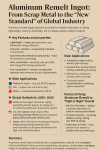
Recycled Aluminum: From Scrap to the New Global Standard As industries worldwide accelerate toward Net Zero and embrace the Circular Economy, Aluminum Remelt Ingots are no longer just an “alternative material.” They are becoming the main driver that every nation relies on for sustainability and economic competitiveness. With outstanding properties—lightweight, strong, corrosion-resistant, and excellent thermal and electrical conductivity—remelt ingots are now essential across diverse industries: automotive, construction, electronics, and packaging, all of which demand high-quality, eco-friendly materials. Most importantly, recycling aluminum consumes up to 95% less energy than producing primary aluminum, dramatically reducing both costs and carbon footprints. At the same time, global demand continues to rise, especially for ADC12, which is highly sought after in China, Japan, and Thailand, along with A356 and AC4B for automotive and high-strength applications. Global Shifts in 2025–2026 - China: Expanding production capacity to support electric vehicle (EV) manufacturing and construction, with stricter import standards for scrap aluminum. - United States: The world’s highest remelt usage (81%), driven by energy efficiency and carbon reduction, reinforced by strict tariffs under Section 232 (raised to 50%). - Japan: Fully dependent on imports and recycling, leveraging advanced sorting technologies and increasing the use of green aluminum in high-end automotive manufacturing. - Thailand: Rising as ASEAN’s scrap hub, exporting heavily to China and the U.S., with an aluminum can recycling rate of 86% and new circular economy initiatives such as the Aluminium Loop. From Scrap → To the Hero of Tomorrow Aluminum Remelt Ingots are rapidly evolving into the new global standard across industries. For those in the metals and manufacturing sectors, now is the time to adapt and seize opportunities in the global market.
21 Feb 2026
Underground Superpower – Australia: Dissecting the Billion-Dollar Global Aluminum Supply Chain, from upstream mining to Thailand’s automotive industry!
Australia: The Underground Superpower Driving the Global Supply Chain Did you know? Behind the world’s heavy industries, electric vehicles (EVs), and the clean energy transition, there is one nation acting as the “backbone,” continuously supplying upstream raw materials. That nation is Australia. From the iron ore riches of Pilbara to becoming the world’s No.1 lithium producer, and now the rising hub of low‑carbon aluminium (Green Aluminium) highly sought after in European markets, Australia is no longer just a miner of raw resources. It is stepping up as a key player shaping global economic and geopolitical directions through its vast mineral wealth. From Pilbara’s iron ore powering global steelmaking to the Green Aluminium projects driving the metals revolution, Australia is transforming natural resources into engines of innovation and sustainability. In this article, SO OK TRADING takes you deep into Australia’s major mining regions, the industry giants leading the charge, and the booming economic indicators, while also highlighting the new role of Australia in the global aluminium supply chain — where Thailand plays a crucial part in automotive and electrical industries. Australia — From Minerals to Global Power. Every piece of metal that leaves Australia is not just raw material, but a “force of the future” driving the world forward with resilience and sustainability.
13 Jul 2026
This website uses cookies for best user experience, to find out more you can go to our Privacy Policy and Cookies Policy
Powered By MakeWebEasy Logo MakeWebEasy