“Thailand Metal Outlook 2036: Aluminum, Copper & Steel – Driving Thailand’s Future with EVs, Clean Energy, and Recycling Toward a Green Economy” SO OK TRADING | 3 OCT 2026
Thailand Metal Outlook: Aluminum, Copper & Steel
SO OK TRADING | 3 OCT 2026
Introduction
Thailand is at a critical turning point in its metal industry, driven by Electric Vehicles (EVs), renewable energy, and increasingly strict global environmental regulations. At the same time, competition from low-cost imports, especially from China, continues to pressure domestic producers. This article explores the current situation, past trends, and long-term outlook (2026–2036) for aluminum, copper, and steel, analyzing industrial applications, growth rates (CAGR), and the path toward sustainability.
Current Situation
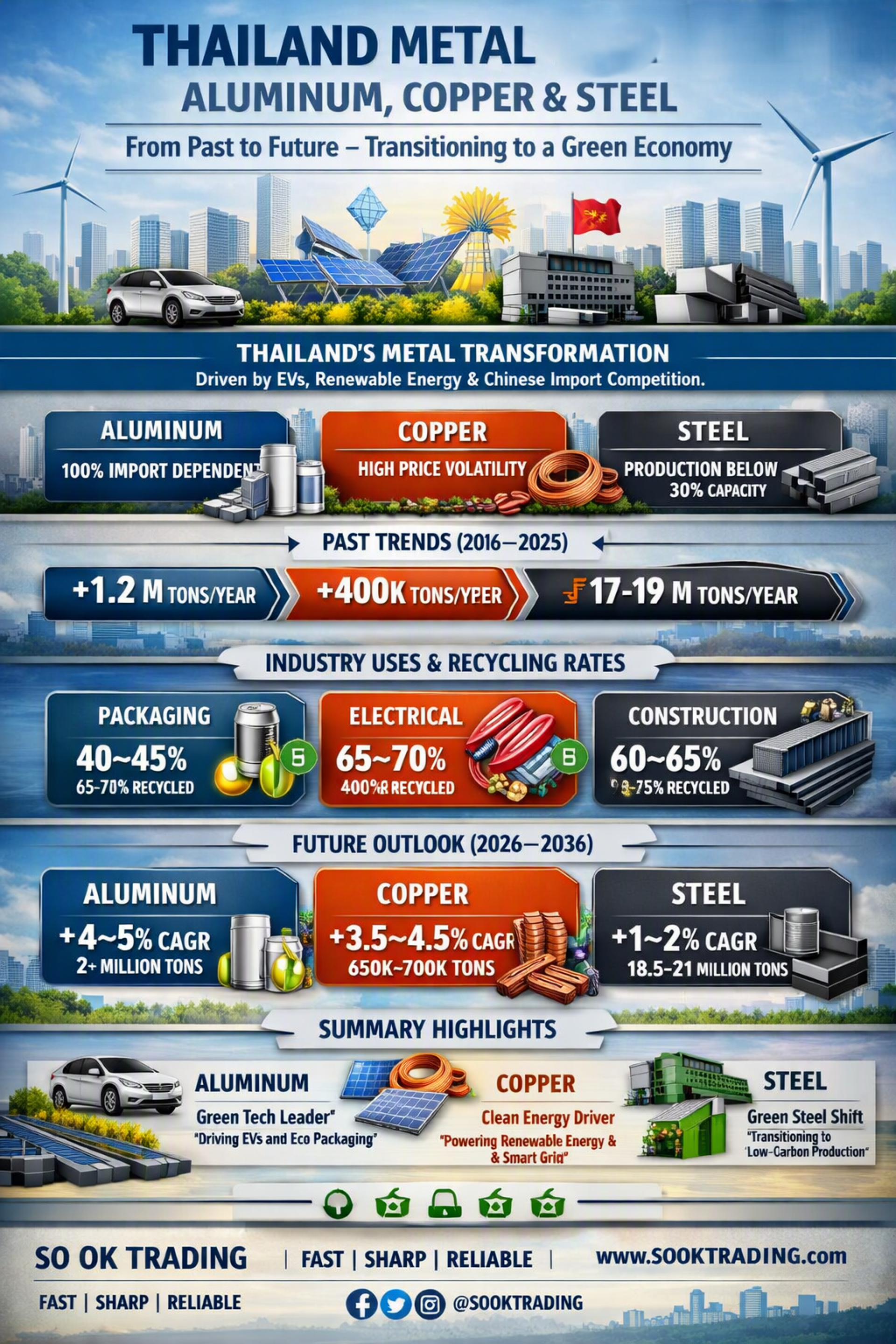
Aluminum: Demand is surging from EVs and packaging, but Thailand relies 100% on imports and faces tariff barriers from key trading partners.
Copper: Widely used in electricity and electronics, but global price volatility significantly impacts domestic production costs.
Steel: The industry is sluggish, with production capacity utilization below 30% due to competition from cheap Chinese steel. The government enforces stricter Thai Industrial Standards (TIS) to block low-quality imports.
Past Trends (2016–2025)
Steel: Demand once reached 17–19 million tons annually but dropped sharply during COVID-19. Current demand is around 18 million tons, while actual production has shrunk to 5.8–8.1 million tons.
Aluminum: Grew against economic headwinds, rising from 800,000 tons in 2016 to 1.2–1.4 million tons, driven by packaging and lightweight automotive components.
Copper: Increased step by step from 300,000 tons to 400,000–450,000 tons, supported by household appliances and grid expansion.
Industrial Applications
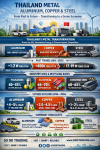
Aluminum: Packaging (40–45%), Automotive (30%), Construction (20%)
Copper: Electricity & Electronics (65–70%), Air Conditioning (20%)
Steel: Construction & Infrastructure (60–65%), Automotive (20%), Machinery & Packaging (15%)
Recycling Rates
Steel: Highest at 90–95%, with a well-established domestic scrap cycle.
Aluminum: Average 60–70% (beverage cans exceed 90%).
Copper: Only 40–50%, with most scrap exported abroad for refining.
Outlook 2026–2036
Aluminum: Fastest growth (CAGR 4–5%), expected to exceed 2 million tons by 2036, driven by EVs and eco-friendly packaging.
Copper: Stable growth (CAGR 3.5–4.5%), projected at 650,000–700,000 tons, fueled by smart grids, renewable energy, and EV charging infrastructure.
Steel: Low growth (CAGR 1–2%), expected to remain within 18.5–21 million tons. Transition to Green Steel and anti-dumping measures are critical.
Detailed Analysis
Aluminum: EVs use 30–40% more aluminum than conventional cars. Thailand aims to become the “Detroit of Asia” for EV production. The challenge lies in building a domestic recycling system for high-grade aluminum scrap.
Copper: Renewable energy expansion drives demand in grids and transformers. Price volatility remains a risk, making e-waste recovery technology essential.
Steel: The government is pushing Green Steel production and strengthening anti-dumping measures. Transition to low-carbon electric arc furnace (EAF) production is inevitable.
Conclusion
Thailand’s metal market reflects a clear divergence:
Aluminum & Copper are the rising stars of the EV and clean energy era.
Steel remains the backbone of infrastructure but must transition to Green Steel to survive competition.
Recycling is the key to sustainability: steel is mature, aluminum is strong, while copper still has significant room for improvement.
Thailand is entering a new era where competition is not only about price but also about quality, sustainability, and alignment with the Green Economy.
SO OK TRADING — FAST | SHARP | RELIABLE Your trusted partner in the new era of metals www.sooktrading.com Facebook: SO OK TRADING