“Aluminum Recycling (Remelt): Thailand Aluminum 4.0 – Powering a Low‑Carbon Economy and Building a Sustainable Green Future” SO OK TRADING Insight | 30 SEP 2026
Thailand’s Aluminum Industry: Structure, Production, and Future Outlook
SO OK TRADING | 30 SEP 2026
Introduction
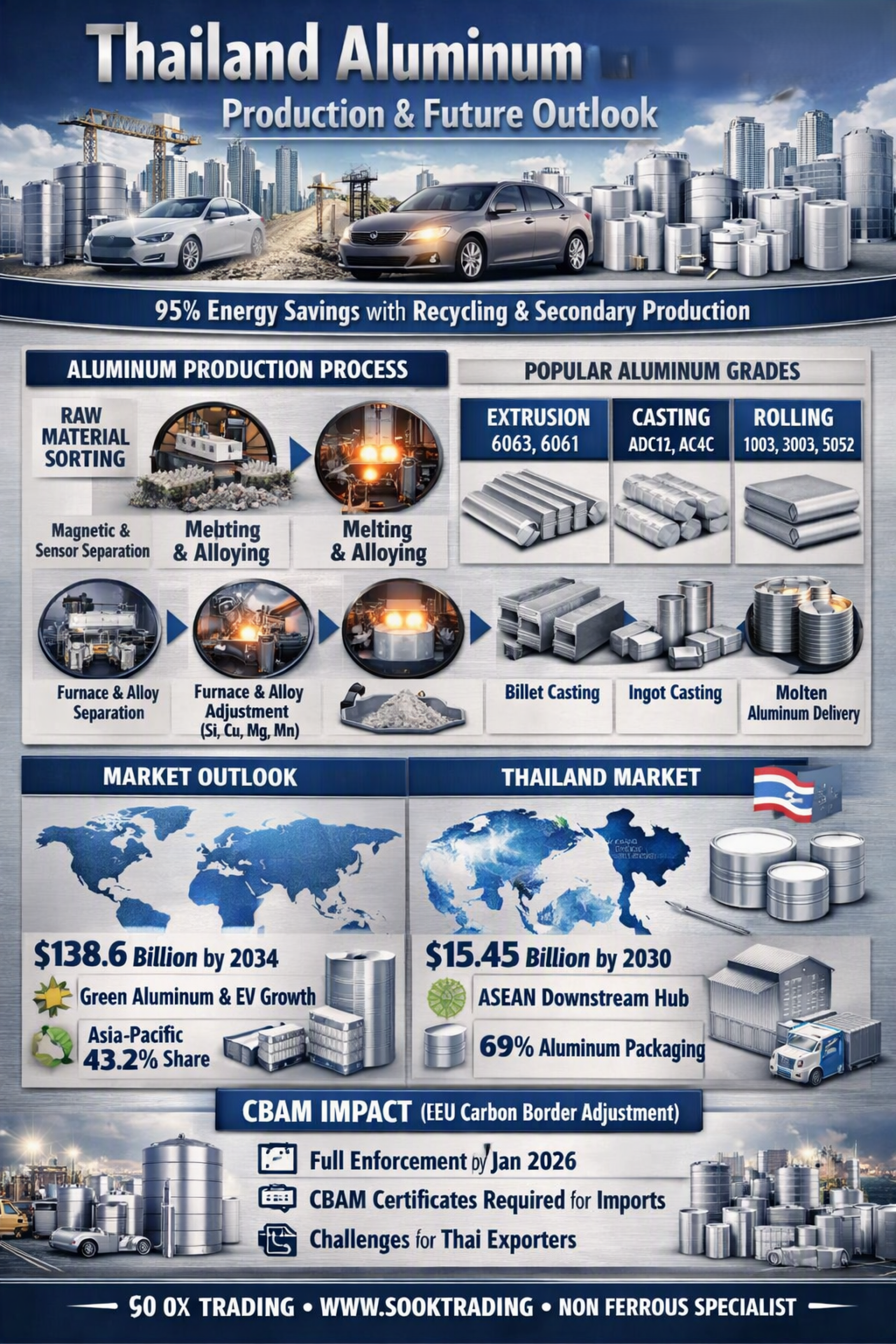
Thailand’s aluminum industry is becoming a vital pillar in the global supply chain, particularly in the automotive, construction, and packaging sectors. Although the country does not have bauxite mines or primary smelters, it has built strong competitiveness through secondary production, recycling aluminum scrap and producing billets for extrusion. This approach reduces energy consumption by up to 95% compared to primary production, aligning perfectly with global decarbonization and sustainability goals.
Production Process
Raw Material Preparation and Sorting: Magnetic and sensor separation, cutting and cleaning aluminum scrap such as cans, old automotive parts, and machining waste.
Melting and Refining: Using reverberatory or induction furnaces, adding flux to remove impurities and hydrogen gas, and adjusting alloy composition with Si, Cu, Mg, and Mn.
Casting:
Billet Casting: Producing cylindrical billets for extrusion.
Ingot Casting: Producing alloy ingots for die‑casting.
Molten Aluminum Supply: Delivering molten aluminum directly to customers.
By‑Product and Environmental Management: Recycling dross (containing 15–80% aluminum) and installing air treatment systems such as bag filters and scrubbers.
Popular Aluminum Grades in Thailand
Extrusion: 6063, 6061
Casting: ADC12, AC4C
Rolling: 1100, 3003, 5052/5083
Challenges and Environmental Standards
Managing dross with residual aluminum content.
Semi‑automated pollution monitoring systems (SEM).
Investment in air treatment technologies and renewable energy.
Pressure from Thailand’s Carbon Neutrality 2050 target requiring structural changes in production.
Outlook and Future Directions
Global Market Outlook
Recycled aluminum market projected to reach USD 138.6 billion by 2034 (CAGR 6.6%).
Growth driven by Green Aluminum, EV platforms, and advanced sorting technologies.
Asia‑Pacific expected to account for 43.2% of global revenue, led by China and India.
Thailand Market Outlook
Thailand’s aluminum market projected to reach USD 15.45 billion by 2030 (CAGR 10.46%).
Emerging as a Regional Downstream Hub in ASEAN.
Aluminum packaging dominates with 69% market share, especially sleek and slim cans.
Remelt plants concentrated in the EEC (Chonburi, Rayong, Chachoengsao).
Thailand committed to Carbon Neutrality by 2050.
Impact of CBAM (EU Carbon Border Adjustment Mechanism)
Full enforcement starting January 1, 2026.
EU importers required to purchase CBAM certificates based on product carbon content.
Direct impact on Thai exporters, particularly ingot and extrusion producers.
Conclusion
Thailand’s aluminum industry is undergoing a major transformation, shifting from import dependence to becoming a regional hub for value‑added aluminum products. Recycling and secondary production not only reduce costs and energy consumption but also align with global decarbonization and sustainability trends. Adapting to CBAM and investing in clean technologies will be crucial for Thailand to maintain competitiveness in the global market and rise as a leader in the sustainable aluminum industry of the future.
SO OK TRADING: Your Trusted Business Partner FAST • SHARP • RELIABLE Visit: www.SOOKTRADING.com Facebook: SOOK TRADING SO OK TRADING: The True Non‑Ferrous Specialist from Thailand