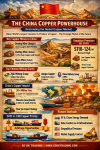
“China: The Global Copper Powerhouse – Copper Empire Driving the Future of Clean Energy, EVs, and Global Markets with Yangshan Premium” SO OK TRADING’s Insight | September 28, 2026
China and the Global Copper Market: Key Mines, Yangshan Premium, and Future Outlook
SO OK TRADING Insight | September 28, 2026
Introduction
Copper has been recognized as the “strategic metal” of the modern era, serving as the backbone of clean energy industries, electric vehicles (EVs), and digital infrastructure. As the world’s largest consumer and smelter of copper, China plays a decisive role in shaping both prices and the global market direction.
Major Copper Mines in China
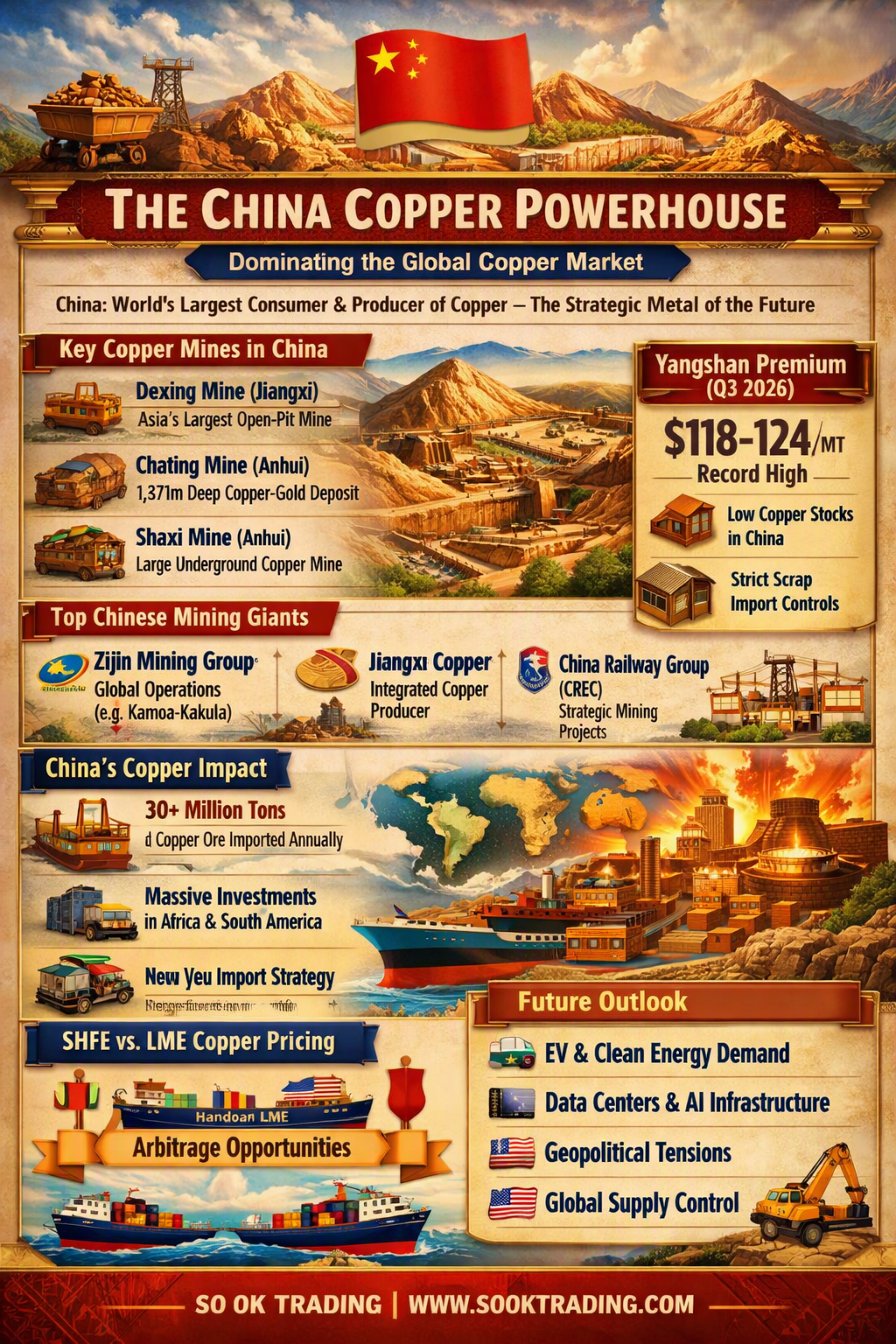
Dexing Mine – Jiangxi Province The largest open-pit copper mine in Asia, operated by Jiangxi Copper, with a mining history spanning over 1,000 years.
Chating Mine – Anhui Province A super-large copper-gold deposit, with ore layers reaching up to 1,371 meters thick. Expected to become a major production base in eastern China.
Shaxi Mine – Anhui Province A large underground copper mine operated by Tongling Nonferrous Metals.
China’s Mining Giants
Zijin Mining Group – Rapid growth, strong cost control, with global investments including the Kamoa-Kakula mine in the Congo.
Jiangxi Copper – One of the largest integrated copper producers, with investments in Africa and South America.
China Railway Group (CREC) – A state-owned enterprise expanding into strategic mining projects.
China’s Copper Situation
China is the world’s largest consumer and smelter of copper.
Imports over 30 million tons of copper concentrate annually to support EV, solar, and clean energy industries.
State-owned enterprises invest heavily in global mining projects, particularly in Africa and South America, to secure supply chain stability.
Factors Impacting Global Copper Prices
China’s economic slowdown (short term) → LME copper prices decline.
Clean energy megatrend (long term) → Sustained growth in copper demand.
Shift from refined copper imports to concentrate imports → Domestic smelting capacity expands by 9%.
Government policies – Tight control of scrap copper supply; “resources-for-loans” strategy via the Belt and Road Initiative (BRI).
Yangshan Premium
A key indicator reflecting China’s real physical copper demand.
Q3 2026: $118–124 per ton, the highest level in years.
Main drivers:
Domestic copper stocks down by over 80%.
Strict government controls on scrap copper imports, leading to increased imports of refined copper cathodes.
SHFE vs LME Copper Pricing (Shanghai vs London)
Positive Correlation: When real demand is strong → Premium and LME prices rise together.
Negative Correlation: When LME surges due to speculation → China’s premium declines.
Arbitrage Window (SHFE/LME): When Shanghai prices exceed global levels → Premium spikes to attract imports.
Copper Outlook
Short Term (2026–2027): Prices remain volatile due to China’s economy, but high Yangshan Premium reflects tight supply.
Medium Term (2028–2030): Copper demand in China will continue to grow, driven by EVs, data centers, and clean energy infrastructure.
Long Term (2030 onwards): China will remain the key driver of global copper markets through overseas mining investments and domestic smelting expansion.
Industries Linked to Copper Demand
Electric Vehicles (EVs) – Use significantly more copper than internal combustion engine vehicles.
Renewable Energy (Solar, Wind) – Power grids require massive amounts of copper.
Data Centers & AI Infrastructure – Rising demand for cables and cooling systems.
Construction & Infrastructure – Copper remains a core material for wiring and piping.
Future Direction
China will continue to control the global copper supply-demand balance.
Yangshan Premium will remain a critical benchmark for the Asian copper market.
Geopolitical competition with the US and Europe will intensify, as both seek to reduce reliance on China.
EVs, clean energy, and data centers will sustain copper prices at elevated levels.
Conclusion
China is not only the largest consumer of copper but also the rule-setter of the global copper market. Through imports, overseas mining investments, and domestic smelting expansion, the future of copper worldwide is inseparably tied to China.
SO OK TRADING: Your Trusted Business Partner FAST • SHARP • RELIABLE Visit: www.sooktrading.com Facebook: SOOK TRADING