Share

“Lead Bullion: Powering Batteries, Forging the Green Energy Future — An Article by SO OK TRADING, April 7, 2026”
Last updated: 7 Apr 2026
1928 Views

Lead Bullion & Battery Market: The Metal Power Driving the New Energy World
 
What is Lead Bullion?
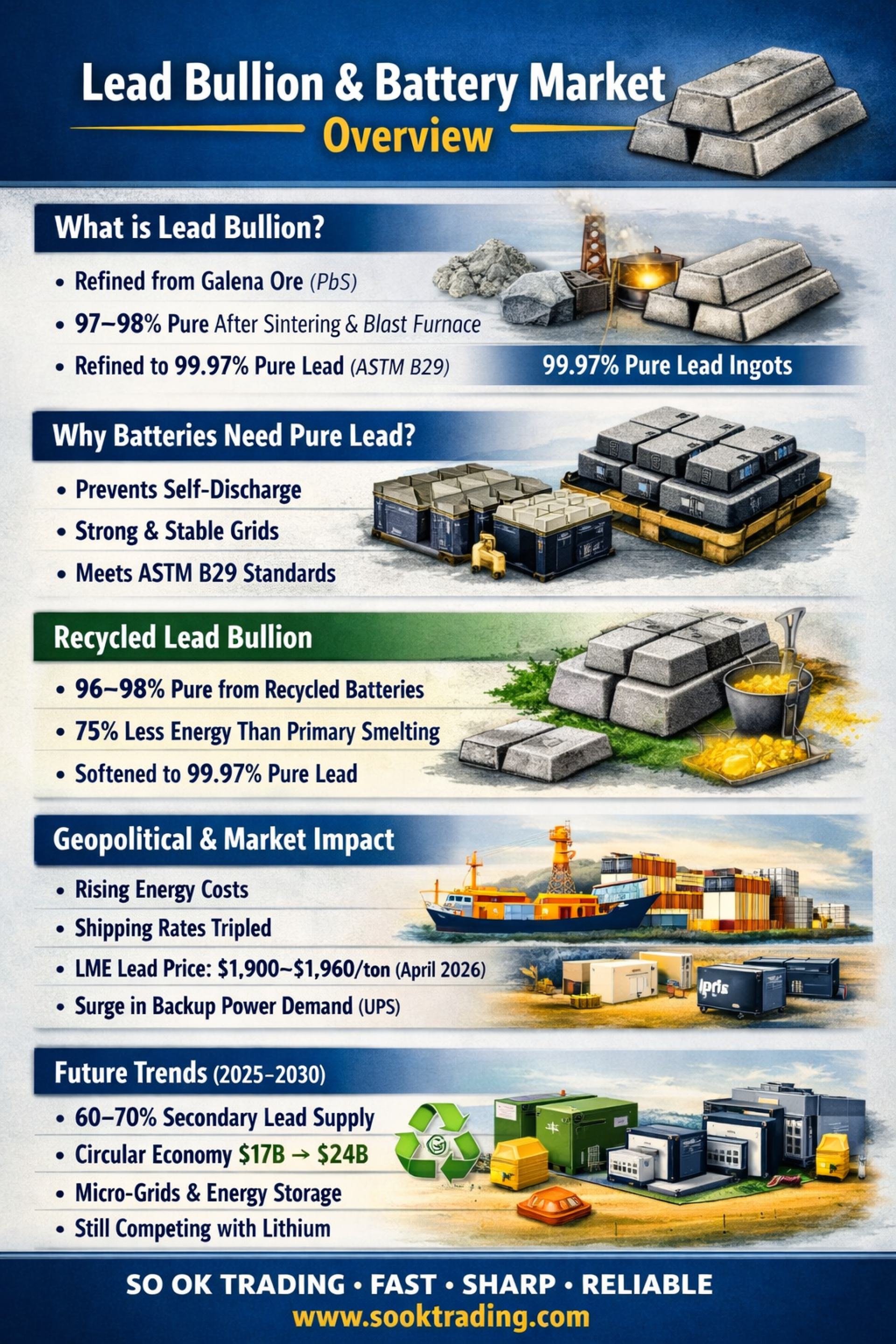
Lead Bullion (crude lead) is produced from Galena ore (PbS) through sintering and blast furnace smelting, with purity around 97–98%. However, it still contains impurities such as silver, copper, antimony, tin, and arsenic. Therefore, it must undergo refining to reach 99.97% pure lead under ASTM B29 standards, before being used in the battery industry.

“Lead Bullion is often cast into large ingots (Ingots or Pigs) for easy transport to refineries.”
 
⚡ Why Do Batteries Require Pure Lead?
Impurities accelerate degradation: Copper or iron cause rapid self-discharge.
Grid strength: Refined lead is often alloyed with antimony or calcium to ensure strong and stable battery grids.
Strict standards: ASTM B29 strictly limits impurities such as antimony, arsenic, and nickel.
 
♻️ Lead Bullion from Battery Recycling
Purity 96–98%, but with high antimony content (1.5–4%).
Softening process: Removes antimony, arsenic, and tin to achieve 99.97% soft lead.
Advantages: Uses 75% less energy compared to primary smelting.
Caution: Poor separation may leave high levels of bismuth, which is difficult to remove and affects battery quality.
 
Geopolitical Factors & Middle East Conflict Impact
Energy prices surge: Refining costs rise immediately.
Freight rates soar: Shipping costs increased 2–3 times after the Strait of Hormuz crisis.
Global market (April 2026): LME lead price at USD 1,900–1,950/ton, with inventories up to 281,000 tons.
Impact on Thailand: Lead prices fell, but electricity and shipping costs rose by 47%.
Opportunity in crisis: UPS battery demand surged in hospitals, data centers, and communication systems.
 
Future Outlook (2025–2030)
Secondary lead dominates: Expected to account for 60–70% of global demand.
Circular economy growth: Lead-acid battery recycling market projected to grow from USD 17B to USD 24B.
Competition with lithium: EVs rely on lithium, but starter batteries and UPS remain lead-based.
Micro-Grid & ESS: Developing countries favor lead batteries for affordability and easy maintenance.
ESG & clean technology: Smelters must adopt emission-reduction technologies, such as hydrogen instead of coke.
 
Lead Bullion Summary
Lead prices down, but energy and shipping costs up → Thai manufacturers must manage costs carefully.
Golden opportunity in UPS market → Geopolitical instability drives demand for lead-acid batteries.
Future is recycling → Closed-loop systems will be the key strategy for sustainable battery production.
Recycled Lead = 75% Cost Savings + ESG Compliance + Circular Economy Solutions

 
SO OK TRADING — FAST • SHARP • RELIABLE We are your trusted business partner, delivering high-quality Lead Bullion and Lead Ingots that meet international standards, supporting the battery industry and renewable energy sectors.

Visit us at: www.sooktrading.com Contact us directly: sooktrading@outlook.com


Related Content
“Africa: The Future Resource Treasure — Africa Rising & Copperbelt Awakening, The Turning Point of Global Industry and the New Supply Shift in Mineral Markets”   SO OK TRADING | 5 July 2026
Africa: The Future Resource Treasure LME • NON‑FERROUS • RARE EARTH • PRECIOUS METAL SO OK TRADING | 5 July 2026 Africa — a continent rich in mineral resources and industrial metals, now standing at the center of global demand in the era of clean energy and advanced technology. From copper in the Copperbelt (DRC–Zambia), with the world’s highest ore grades, to cobalt, lithium, and rare earths powering EV batteries and next‑generation energy systems, Africa is becoming the world’s supply frontier. “The Kamoa‑Kakula mine in Congo produced 388,838 tonnes of copper in 2025 — a new high‑quality deposit under global spotlight.” The race among global powers is intensifying — China, the United States, Europe, the Middle East, Russia, and Japan are all investing heavily to secure strategic mineral supply chains across Africa. Yet despite its vast resources, Africa faces critical logistics bottlenecks: copper cathode exports delayed at borders for days, truck shortages, and high security risks. New infrastructure projects — railways and ports in Tanzania, Mozambique, and South Africa — are now being accelerated to unlock smoother trade routes.
5 Jul 2026
LEAD INGOT กับ อุตสาหกรรม BATTERY
Lead ingot คือ โลหะตะกั่วแท่งที่ใช้เป็นวัตถุดิบหลักในการผลิตแบตเตอรี่ตะกั่ว-กรด เนื่องจากมีความหนาแน่นสูงและคุณสมบัติทางเคมีที่เหมาะสม ทำให้เป็นส่วนประกอบสำคัญในแผ่นขั้วบวกและขั้วลบของแบตเตอรี่ Lead ingot ที่มีความบริสุทธิ์สูงจะช่วยให้แบตเตอรี่มีประสิทธิภาพและอายุการใช้งานยาวนานขึ้น การใช้งาน Lead ingot ในแบตเตอรี่ วัตถุดิบหลัก: ใช้เป็นวัตถุดิบตั้งต้นในการผลิตแบตเตอรี่ตะกั่ว-กรด ซึ่งใช้ในรถยนต์ ระบบสำรองไฟ (UPS) และระบบกักเก็บพลังงานแสงอาทิตย์ การผลิตแผ่นขั้ว: เป็นส่วนประกอบสำคัญในการผลิตแผ่นขั้วไฟฟ้าของแบตเตอรี่ ซึ่งเป็นส่วนที่เกิดปฏิกิริยาเคมี คุณภาพและประสิทธิภาพ: ความบริสุทธิ์ของตะกั่วใน lead ingot มีผลโดยตรงต่อประสิทธิภาพและอายุการใช้งานของแบตเตอรี่ การรีไซเคิล: นอกจากใช้ผลิตใหม่แล้ว ตะกั่วจากแบตเตอรี่ที่ใช้แล้วยังสามารถนำมารีไซเคิลและแปรรูปเป็น lead ingot เพื่อนำกลับมาใช้ใหม่ได้อีกครั้ง
27 Nov 2025
“Battlefield of Metals! Non‑Ferrous Metals June 2026: Watching Recovery Signals After the May Price Storm – Copper & Aluminium Building a New Base for 2026”
Non‑Ferrous Metals Market – June 2026: Battlefield of Volatility! By SO OK TRADING | 7 June 2026 This month, the Non‑Ferrous Metals market on the London Metal Exchange (LME) has become a true battlefield of volatility. Copper and aluminium, which had surged to multi‑year highs earlier in 2026, corrected sharply in late May before beginning to establish new bases in early June. Meanwhile, lead, tin, nickel, and zinc each show unique trajectories worth close attention.
7 Jun 2026
This website uses cookies for best user experience, to find out more you can go to our Privacy Policy and Cookies Policy
Powered By MakeWebEasy Logo MakeWebEasy