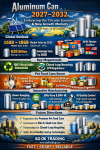
“Aluminum Can Industry 2027–2032: Driving the Circular Economy and a Sustainable Future — SO OK TRADING: FAST • SHARP • RELIABLE” : 24 SEP 2026

Aluminum Can Packaging Industry 2027–2032: Advancing the Circular Economy and Emerging Growth Markets
By SO OK TRADING | September 24, 2026
Introduction
Between 2027 and 2032, the aluminum can packaging industry is undergoing a major transformation. Once valued mainly for convenience and low cost, aluminum cans are now positioned as the cornerstone of the Circular Economy and a driver toward Net Zero, in response to increasingly stringent global environmental regulations. Aluminum cans are no longer just packaging — they are becoming a symbol of sustainability and environmental responsibility.
Global Market Outlook
Market value is projected to grow from USD 58 billion (2026) to USD 75.7–86.4 billion by 2032, with a CAGR of 4.0–4.9%.
Global beverage can demand is expected to reach 630 billion units annually by 2030.
APAC (Asia-Pacific) will lead the market, driven by China, India, and ASEAN, while Europe and North America will focus on value growth through innovation and premium products.
Key Megatrends
Shift from Plastic to Aluminum: 100% recyclable, no loss of quality, and 95% less energy compared to primary aluminum production.
Closed-Loop Recycling Models: Global EPR regulations are being enforced. For example, India requires new aluminum products to contain at least 5% recycled content by 2027–2028.
New Packaging Designs: Slim and Sleek cans are gaining popularity, with expansion into categories such as cold brew coffee, functional drinks, wine-in-can, RTD cocktails, and canned water.
Manufacturing Innovations
Down-Gauging: Thinner can walls reduce raw material costs by 5–10%.
Smart Linings: Transition to BPA-Free / BPA-NI coatings for safety and compliance with international standards.
AI-Driven Quality Control: High-speed camera inspections reduce scrap rates in fast production lines.
Pet Food Cans: A Rising Market
One of the fastest-growing segments is premium pet food.
The canned pet food market is projected to reach several billion dollars by 2035.
Growth drivers include:
Rising urban pet ownership.
Increasing demand for high-quality, nutrition-focused pet food.
Aluminum cans deliver safety, long shelf life, and 100% recyclability, prompting global manufacturers to shift from plastic to aluminum in line with ESG goals and consumer preferences.
Outlook: Opportunities and Challenges in Thailand
Thailand is the manufacturing hub for aluminum cans in ASEAN, with 55–60% of production capacity located in the EEC (Chonburi, Rayong, Chachoengsao, Samut Prakan, Saraburi).
The Thai market is expected to grow from USD 1.47 billion (2024) to USD 2.2 billion by 2029, with a CAGR of 4.9–8.4%.
Key players: Thai Beverage Can (TBC), Bangkok Glass (BGC), SWAN + NEXT CAN INNOVATION.
Thailand’s closed-loop recycling system is highly efficient, enabling used cans to be recycled into new cans within 60 days.
Future Directions
Expansion into premium pet food cans.
Investment in Slim/Sleek can production lines to meet modern lifestyle demands.
Partnerships across the full recycling supply chain to strengthen competitiveness.
Adoption of safer, eco-friendly coating technologies to align with global standards.
Conclusion
The period from 2027 to 2032 represents a golden opportunity for Thai manufacturers to expand exports and strengthen their position in ASEAN. Aluminum can packaging is not merely a container — it is the core of the Circular Economy and the pathway to Net Zero, shaping the future of the global packaging industry.
SO OK TRADING: Your Trusted Business Partner FAST • SHARP • RELIABLE VISIT US AT: WWW.SOOKTRADING.COM FOLLOW US: FACEBOOK @SO OK TRADING