Share

“Global Metal Market Volatility 2026: In-Depth Analysis of ZINC – LEAD – ANTIMONY and Their Impact on Thai Industry | SO OK TRADING Global Market Insights: FAST • SHARP • RELIABLE | Capturing Metal Price Signals to Reshape Thai Business Strategies for the
Last updated: 22 Sept 2026
45 Views

**Global Metal Price Analysis (ZINC – LEAD – ANTIMONY) and the Impact on Thai Industry
SO OK TRADING | September 22, 2026**

Introduction
In 2026, the global base metals market is facing volatility driven by multiple factors: slowing demand in the construction sector, supply constraints from smelters, and rising energy costs due to geopolitical tensions. Zinc, Lead, and Antimony — essential raw materials for Thai industries — reflect the ongoing transition toward a clean energy economy and the restructuring of global supply chains. Thai businesses must adapt strategies to manage cost pressures and the risks of a weakening baht.

 
Market Overview and Price Trends
Zinc (Zn)

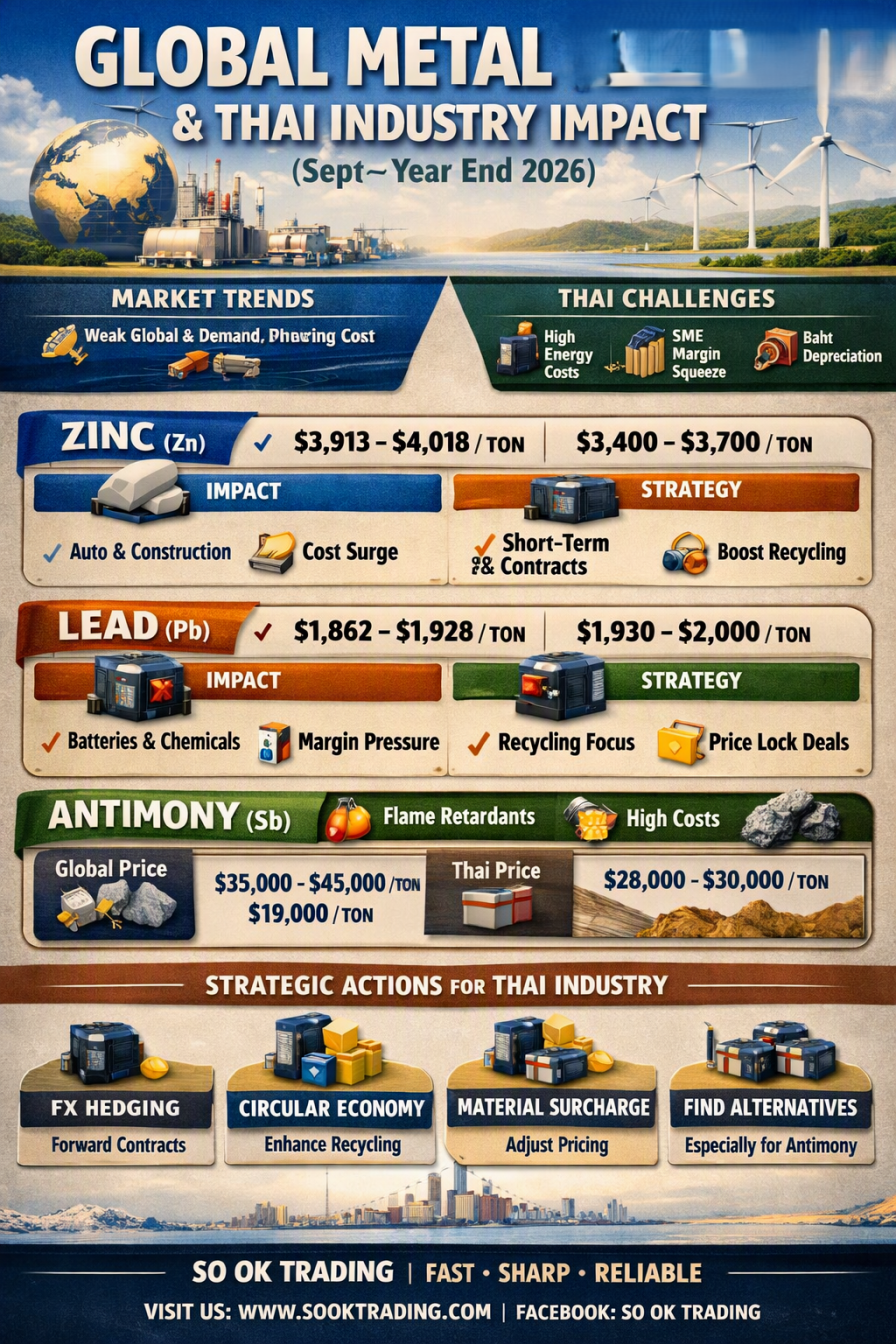
Current Price: $3,913 – $4,018 / ton
Q4 Forecast: $3,400 – $3,700 / ton (due to weaker global construction demand and China’s production recovery)
Impact on Thailand: Automotive, galvanized steel, and construction sectors face short-term cost surges
Strategy: Utilize short-term contracts and strengthen scrap recycling
Lead (Pb)

Current Price: $1,862 – $1,928 / ton
Q4 Forecast: $1,930 – $2,000 / ton (stabilized by recycling supply in China)
Impact on Thailand: Automotive batteries, chemicals, and radiation shielding materials see slight cost increases (~$60/ton), squeezing margins
Strategy: Expand recycling and secure price-lock contracts
Antimony (Sb)

Current Price: $35,000 – $45,000 / ton (global) | $19,000 / ton (Thai LCB price)
Q4 Forecast: $28,000 – $30,000+ / ton (China continues to restrict export quotas)
Impact on Thailand: Flame retardants, solar glass, and electronics face costs nearly double historical averages
Strategy: Accelerate search for substitutes and adjust production formulas
 
Common Challenges for Thai Industry
Energy & Geopolitical Risks: Electricity and fuel costs up ~20%
SME Pressure: Shrinking profit margins, limited ability to pass costs to consumers
Currency Risk: Baht expected to weaken slightly (33.00 – 33.60 / USD), raising import costs
 
Future Applications and Industry Outlook
Zinc (Zn)

Transitioning from construction metal to renewable energy support material
Key in solar panels, wind turbines, and data center structures
Development of Zinc-Air and Zinc-Ion batteries for energy storage
Lead (Pb)

Maintains relevance in 12V batteries despite EV transition
Most complete circular economy among metals
Essential for backup power systems and chemical industries
Antimony (Sb)

Strategic material in flame retardants and solar glass
High costs drive substitute material development
Critical resource in global supply chains
 
Strategic Recommendations for Thai Businesses
Currency Risk Management: Apply FX hedging and forward contracts to 50–70% of Q4 imports
Circular Economy: Strengthen scrap metal recycling to reduce reliance on global markets
Contract Adjustments: Include material surcharge clauses in long-term project agreements
Seek Alternatives: Prioritize substitute materials, especially for Antimony
 
✨ SO OK TRADING — FAST • SHARP • RELIABLE Your trusted partner in Thailand’s Non-Ferrous Metals market www.sooktrading.com | Facebook: SO OK TRADING

Related Content
HNY 2026 with a First Analysis on Thai Baht Value
he Thai baht in Q1 2026 is expected to strengthen against the US dollar, driven primarily by a weaker dollar globally, a seasonal tourism boost, and expectations of US Federal Reserve rate cuts. This strength is occurring despite a weak domestic economic outlook and the Bank of Thailand's (BoT) likely continued easing of its policy rate. Exchange Rate Drivers and Forecast External Factors: The primary driver for the strengthening baht is external, mainly the broad weakness of the US dollar as global markets price in expected Fed rate cuts. The baht is also correlated with global gold prices, which have been climbing. Tourism High Season: The period extending into Q1 2026 is the high season for tourism, which typically brings in foreign currency and supports the baht's value. Policy Divergence: The BoT is expected to continue its easing cycle, potentially cutting the policy rate further to 1.00% by Q1 2026 to stimulate the sluggish domestic economy. This divergence from a potentially less aggressive US Fed in Q1 could support the baht in the short term, though some analysts warn the currency could weaken later in 2026. Forecasts: Projections for 2026 generally place the baht in a range of 30.80–33.00 per US dollar. Some models estimate it could trade around 31.06 by the end of Q1. A persistently strong baht below 31 per US$ is seen as a significant risk to the Thai export and tourism sectors. Key Economic Context Weak Growth: Thailand's economy is expected to slow down to a 5-year low growth rate of around 1.6-1.8% in 2026, pressured by US tariffs, global trade tensions, and high household debt. The central bank chief expects an improvement in Q1 2026 after a weak second half of 2025. Political Uncertainty: A general election expected in February 2026 could also introduce volatility, though some historical trends suggest the baht may strengthen following the formation of a new government. Low Inflation: Headline inflation is projected to remain subdued or even negative, providing the central bank with justification for further rate cuts to stimulate demand. In summary, Q1 2026 is characterized by a strong and volatile baht driven by external factors, contrasting sharply with a weak domestic economy and accommodative monetary policy.
1 Jan 2026
Analysis of Industrial and Metal Markets Ferrous and Non-Ferrous Metals   In a world shaken by Middle East volatility By SO OK TRADING   April 9, 2026
Global Metal Market 2026: A Year of Volatility and New Opportunities This year, precious metals are surging, while industrial metals are driven by clean energy and AI technologies. SO OK TRADING presents a comprehensive overview of the global metals market, highlighting price trends in gold, copper, tin, and aluminum, along with updates on the situation in Thailand — helping you spot opportunities ahead of the curve. FAST • SHARP • RELIABLE Your trusted business partner
9 Apr 2026
Battery to Bullion: Thailand’s Circular Power Play: Lead the Future: Car Batteries & Circular Economy: From Cars to Commodities: The Rise of Lead Recycling
“Car Batteries: From Energy to Business Opportunity” In an era where the world is transitioning to clean energy, car batteries are no longer just about starting engines. They represent the starting point of a circular economy that transforms waste into pure lead, creating golden opportunities for Thai entrepreneurs in 2026–2027. ♻️ Battery Recycling = Lead Bullion Production = Driving a Sustainable Metal Industry
17 Feb 2026
This website uses cookies for best user experience, to find out more you can go to our Privacy Policy and Cookies Policy
Powered By MakeWebEasy Logo MakeWebEasy