Copper Scrap: Strategic Resource for a Green Future, Driving Net Zero and Powering the Booming AI–EV Era” SO OK TRADING: 13 SEP 2026
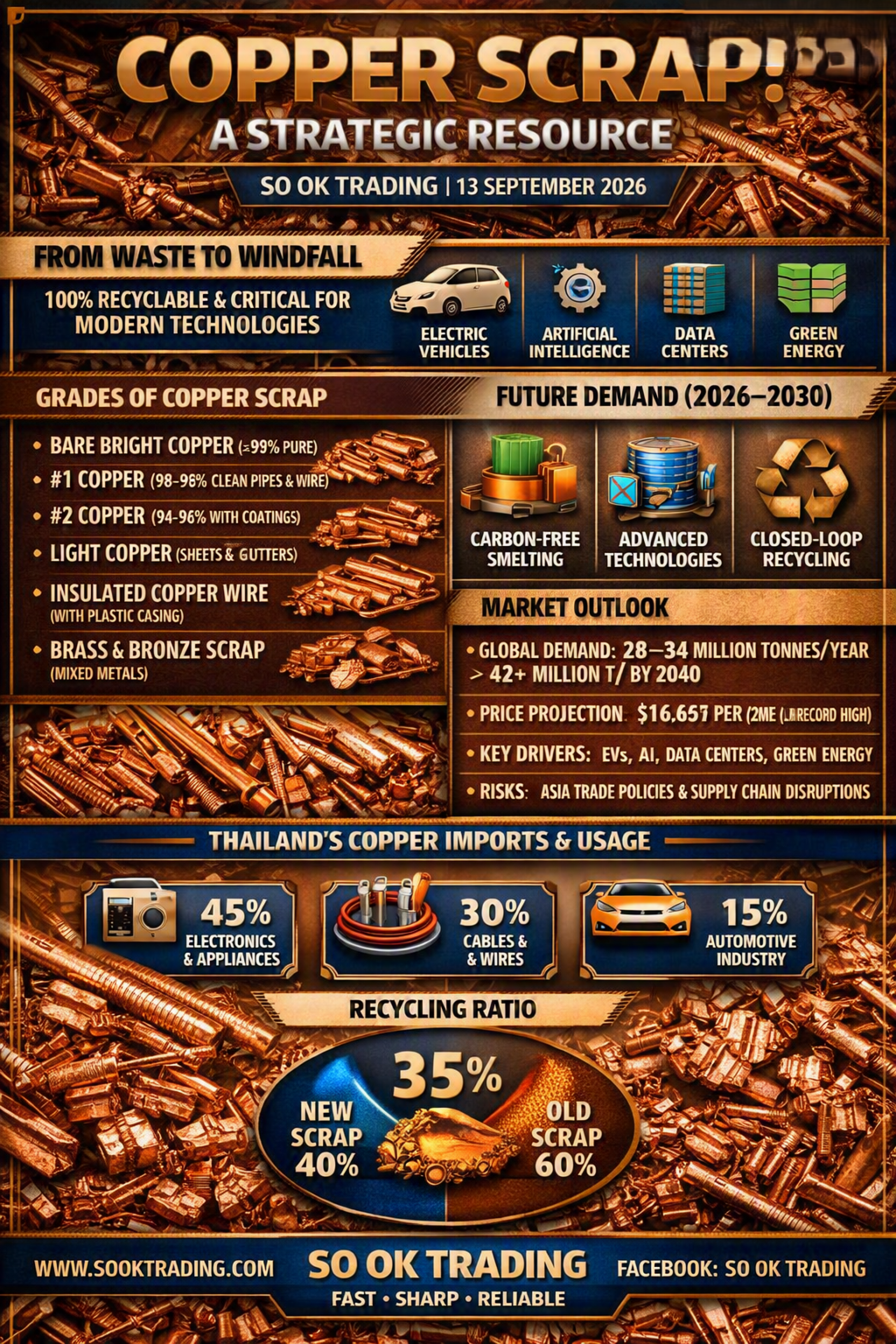
Copper Scrap: Strategic Resource in the Circular Economy Era : SO OK TRADING : 13 SEP 2026
Introduction
Copper scrap has shifted from being regarded as “recyclable waste” to a strategic resource that plays a crucial role in the modern global economy. It is indispensable in industries such as clean energy, electric vehicles (EVs), artificial intelligence (AI), and data centers. Because copper can be recycled 100% without losing its physical or chemical properties, it has become the backbone of the Circular Economy and the Green Supply Chain.
Types and Grades of Copper Scrap
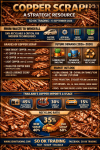
Bare Bright Copper: Highest purity ≥99%, free from rust or coating, commands the highest price
Copper Scrap #1: Purity 98–99%, typically clean copper pipes or stripped wires
Copper Scrap #2: Purity 94–96%, contains contaminants such as paint, solder, or motor residues
Light Copper: Thin sheets, gutters, household items, lower value due to weight loss during smelting
Insulated Copper Wire: Copper wires with insulation, requires labor and machinery for separation
Brass & Bronze Scrap: Copper alloys mixed with zinc or tin
Future Applications (2026–2030)
Carbon-Free Smelting: Global smelters increasingly use scrap instead of new ore, reducing carbon footprint by up to 85%
Advanced Industries: High-purity recycled copper applied in high-voltage cables, busbars, and EV components
Green Regulations: Laws mandating recycled copper ratios and closed-loop recycling by technology brands
Market Outlook
Global Demand: Currently ~28–34 million tons/year, projected to reach ~42 million tons/year by 2040 (+50%)
Global Price (LME): September 2026 hit a record high of $14,875/ton; forecast to remain strong at $11,000–12,000/ton (2026–2027)
Key Drivers: EVs, data centers, AI, clean energy, military budgets
Risks: Policy volatility in China and Southeast Asia
Thailand’s Copper Imports & Usage
Imports: Thailand has no mines or primary smelters, relying 100% on imported copper cathodes and scrap
Domestic Usage: ~250,000–300,000 tons/year
Appliances & Air Conditioning: ~45–50%
Wires & Cables: ~30%
Automotive & Electronics: ~15–20%
CAGR: Thailand’s downstream industries grow at an average of 15.1% annually (LH Bank data)
♻️ Recycling Ratio
Global: 30–35% of copper demand comes from recycling
Types: New Scrap ~40%, Old Scrap ~60%
Europe (EU): Recycled copper usage as high as 45–50%
Copper Price (LME)
September 2026: Record high $14,875/ton
Drivers: Investments in data centers, AI, clean energy, military budgets
Constraints: Mine closures in Chile, U.S. tax measures
Conclusion
Copper scrap has become the core of the circular economy and future industries, strategically supporting the transition to clean energy, AI, data centers, and EV production. Although Thailand lacks mines or primary smelters, demand remains strong and continues to grow as the country serves as a manufacturing hub for appliances and electric vehicles in ASEAN.
SO OK TRADING: Your Trusted Business Partner SO OK TRADING: FAST • SHARP • RELIABLE Visit: www.sooktrading.com Facebook: SO OK TRADING